Fears that the Bhabha bungalow would be demolished have been
belied with its purchase by the Godrej family for residential purposes
Sherene Vakil
On June 18, 2014, when the historic Bhabha bungalow, Meherangir was auctioned in the face of opposition from some quarters, it fetched a record price of Rs 372 crores, setting a new benchmark for real estate in Bombay. The proceeds of the sale will go to the National Centre for the Performing Arts (NCPA) to which the entire estate of its founder, Dr Jamshed Bhabha was willed. The bungalow was purchased by Smita Godrej Crishna. Daughter of the late industrialist Naoroji Godrej, she is a director in Godrej Holdings Limited, the Naoroji Godrej Centre for Plant Research and Raptor Research and Conservation Foundation. Mumbai Mirror (MM) reported on June 19 that Godrej Crishna has told friends that the iconic property will be used by the family only for residential purposes and there are no plans to demolish it to create a modern structure, as some had feared.
Sitout on first floor terrace
Scientists from the Bhabha Atomic Research Centre (BARC) and the Tata Institute of Fundamental Research (TIFR) had protested vehemently against the sale of the historic bungalow, insisting that it should be made into a museum in honor of India’s leading nuclear scientist Dr Homi Bhabha whose residence it was until his death in 1966. Two employees of BARC and TIFR filed a PIL (public interest litigation) against the sale on June 13, but the Bombay High Court refused to stay the auction, stating that the sale could be revoked if need be, mentioned The Times of India (TOI) on June 19.
"We must go out of our way to save and preserve (Homi) Bhabha’s house,” Raghunath Mashelkar, former director general of the Council of Scientific and Industrial Research, New Delhi told The Indian Express (IE) on June 17. Indian scientists have an "emotional link” with the scientist and BARC is named after him. Former Atomic Energy Commission chairman Anil Kakodkar admitted to IE: "I feel deeply hurt, anguished and helpless that we are unable to save Bhabha’s home from near and certain demolition.”
An email appeal was also sent to Ratan Tata by the Atomic Energy Workers’ and Staff Union of BARC soliciting his good offices in the matter, but Tata excused himself, responding that though he would be "personally pleased to see this beautiful house preserved as a museum,” he was in no way involved in the auction process, noted IE on June 17.
Maharashtra chief minister Prithviraj Chavan and senior nuclear scientist Prof C. N. R. Rao have petitioned Prime Minister Narendra Modi to save the bungalow. The Bombay High Court (BHC) was informed at a hearing on June 23 that the Prime Minister’s Office is considering taking over the house of Homi Bhabha in the public interest, and converting it into a museum, reported the Free Press Journal (FPJ) on June 24. "The Office of the Prime Minister of India has written a letter to the Department of Legal Affairs to present the viewpoint of the Central Government before the court and the office of the Prime Minister is exploring the possibilities of adopting appropriate proceedings to acquire the said property of Dr Homi Bhabha to retain his memory in order to maintain it as a monument,” stated an affidavit from the Department of Atomic Energy (DAE) presented in the BHC. In it the DAE sought that the Maharashtra government declare the property a protected monument under the Maharashtra Ancient Monuments and Archaeological Sites and Remains Act, 1960. A division bench headed by the chief justice posted the matter for June 30 for further hearing, FPJ noted.
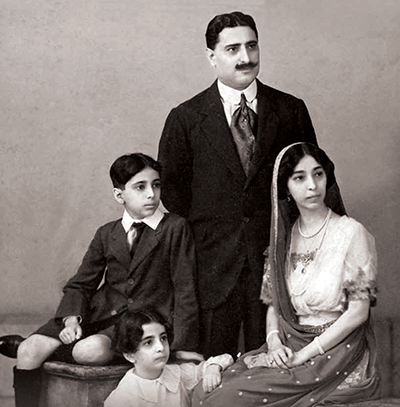
Jehangir and Meherbai Bhabha with sons Homi and Jamshed
In a memorandum, prominent personalities from the fields of arts, cinema and theater have urged the Prime Minister not to intervene in the matter, reported FPJ on June 20. "Homi Bhabha spent only a few years of his life here (at Meherangir) whereas Jamshed Bhabha lived there till his death in 2006. In his will he bequeathed the bungalow and its contents to the NCPA.” The demand to convert Meherangir into a Homi Bhabha Museum is disregarding not only Jamshed Bhabha’s legacy but also ignoring the vital cultural activities of the NCPA to which he dedicated his life, wrote Keki Daruwalla, Adil Jussawala, Gieve Patel, Farrokh Chothia and Zareer Masani, among others including Alyque Padamsee, Anil Dharkar and Atul Dodiya.
Conservationists, however, are relieved that Godrej Crishna’s was the winning bid at the auction. "I am glad that it has been bought by an eminent family, who has their roots in the city,” Abha Narain Lamba, conservation architect admitted to TOI on June 20. She considered this a "perfect solution” as the NCPA’s coffers will be filled and the city will retain a historic bungalow. Architect Brinda Somaya was also happy that the place "wasn’t bought by a developer” since maintaining it as a private residence was in keeping with its history. Another spot could easily be found for a museum, she told TOI.
Chairman of NCPA Khushroo Suntook, described the protests against the sale to the TOI as an "assault on private property.” Speaking to Hindustan Times (HT) on June 19 he confirmed that the proceeds of the sale will be used to modernize the theaters, upgrade equipment and expand its activities, fulfilling "the dreams and legacy of Dr Jamshed Bhabha… This was never Homi Bhabha’s bungalow. He was only a one-third owner. It is also not a heritage property. It was the private property of Jamshed Bhabha whose will states the bungalow shall be sold to fund NCPA.” Suntook explained that "it is a properly probated will. Homi was a great lover of culture himself. Both brothers would have been disappointed with the opposition to (the) auction… It is sad to see it go but that was his will.” Suntook also told HT that every important paper belonging to Homi Bhabha, including his personal letters and letters by important dignitaries have been given to the TIFR. "The scientific community should have gathered the facts properly… Why doesn’t BARC make a museum?”
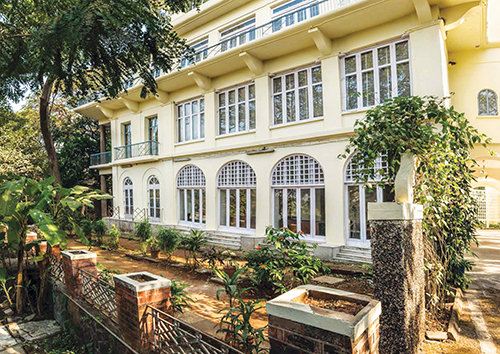
A section of the ground floor and garden
According to Indira Chowdhury’s book, A Masterful Spirit: Homi J. Bhabha, the Malabar Hill bungalow’s name Meherangir is a combination of the names of Meherbai and Jehangir Bhabha, Homi and Jamshed’s parents, who bought the property from the Bombay Municipal Corporation in 1937. Meherangir was a connoisseur’s delight, with a foundation of art deco and regency style furniture layered with exquisite silverware and rare Persian rugs. It also had a massive library. "When I first stepped inside the house three years ago, I could sense that it was a gracious and welcoming home,” recalled Dadiba Pundole whose auction house Pundole’s conducted a public auction of Jamshed Bhabha’s belongings in October 2011. The proceeds from the auctions aggregated Rs 27 crores. Pundole described to MM: "Two superbly engineered 13-and-a-half feet dining tables occupied the living areas on the ground and first floors. The Bhabhas certainly entertained many a guest.”
In the 13-room ground plus three-storey bungalow Homi occupied the third floor, the parents lived on the second level while Jamshed and his wife Betty were on the first floor, MM mentions. The bungalow has a terrace, three balconies, eight servants’ quarters, three covered parking spaces, an open parking area and two gardens.