As a 17-year-old teenager Aspy Engineer
flew in the Aga Khan Cup race
Rusi Sorabji
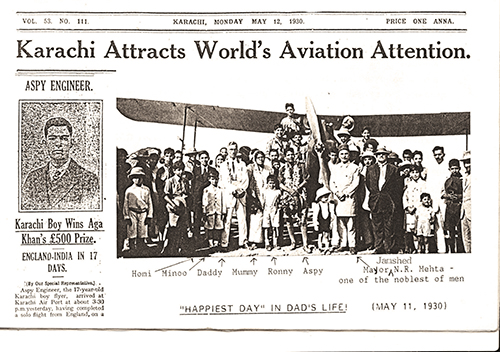
Ninety-one years ago on Navroz day, Aspy Engineer, a Parsi boy aged 17 years, three months and six days, flew a single engine aircraft into England, all the way from India, carving a place for himself in the annals of world aviation. Lest we forget this audacious young man’s achievements, here is an account, condensed from 18 foolscap pages written by Engineer, as well as Sorabji’s father’s recollections, the author’s conversations with Engineer and printed reports. Over several installments Parsiana will be carrying his adventurethat refers to his remarkable flight and the prevalent difficult flying conditions between Karachi to England through three continents and returning solo to win the Aga Khan Cup race.
In 1929 a competition was announced by the Royal Aero Club of England, open only to Indian nationals, with a 500 pound sterling prize donated by the Aga Khan. The competition was for the fastest timed solo flight between any point in India to a touchdown in England or vice versa, in a single engine aircraft. Though it was known as the Aga Khan Cup race, there was no cup, nor was it a race as such. The main stipulation was that the flight had to be completed within four weeks from the start.
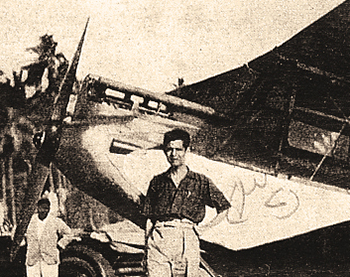
Travelling with his father Meherwan late one evening in August 1929, young Aspy Engineer (pictured) noticed some activity at the Drigh Road (pictured) airport in Karachi where a huge hangar was under construction in anticipation of the arrival of the Airship R101. Meherwan informed him that all the aircraft on the ground were for the new Karachi Aero Club (KAC) and asked his son whether he would like to join the Club and learn to fly. Aspy’s response was, "I would love to, but how can I fly when I am not eligible for even a car driving license?”
Meherwan replied that Aspy could join right away and within three or four months obtain a Flying ‘A’ license on his forthcoming 17th birthday in December.
Aspy joined the KAC where his instructor was "Red Hot” Jones and the ground engineer one Mr Langford. He was soon up in the air "full of confidence flying with added zest with the wind and clouds rushing past and, as it were, brushing one’s cheeks.”
His account reads: "My main problem at this time was transportation to the airfield and back. Although my father was good enough to buy me a small two-seater Peugeot car, I did not have a driving license. Fortunately, I met R. N. Chawla at the Club. He was looking for transportation and agreed to drive my car to the airfield and back. I got behind the wheel as seldom as I possibly could.”
In conversation, Chawla frequently indicated he would like to compete for the Aga Khan Cup race. When Meherwan presented his son a De Havilland Gypsy Moth for his 17th birthday, Chawla suggested that the two fly out to England together and Aspy could fly back to India solo for the Aga Khan Cup. Chawla’s suggestion found favor with Aspy’s parents. Meherwan agreed to pay all the expenses for both, while his mother Maneckbai blessed the plan and predicted that her son would win the race.
Aspy got his flying license a few days after his 17th birthday in mid-December. He and Chawla decided to fly to Delhi to get to know each other better and chalk out some cross-country flying experience. They obtained Chawla’s parents’ blessings in Kanpur and met officials of the Directorate General of Civil Aviation (DGCA) in India at Delhi to request some financial assistance from the government for their rare venture.
"With help from Brig Lal Nehru we were able to extract a promise from the DGCA that he would do his best but that this was a matter requiring approval of the Legislative Council,” reported Aspy who continued, "Our plans for the flight to London were progressing fairly well. We had arranged for petrol and oil to be had en route as also obtained air maps up to Cairo. Maps for the remainder of the flight to London would be available at Cairo. We kept all plans as secret as possible and succeeded in doing so, the main reason being there were several competitors and we did not want to alert them. Man Mohan Singh had made two attempts and crashed en route but was attempting a third. Then there was Bapu Murad and J. R. D. Tata from Bombay, who was a serious competitor. Therefore, we thought it prudent to keep our flight plans quiet. If someone else won the Aga Khan prize, I would not only lose that distinction but Col Shelmerdine of the DGCA would not be able to assist us with a grant to cover even a small portion of our large expenses.
"Now with the painting of a Farohar on my aircraft and what little spares and chamois leather for refueling we could squeeze into our small plane, we were set.
"What amazes me, when I now look back on March 1930, was my supreme confidence that Chawla and I would reach London and that I would fly back in time to win the Aga Khan prize. Was ignorance bliss? That supposition may be partly true. However, I am convinced that the main reason why I experienced no fear or concern or a moment’s hesitation was entirely due to complete faith in my mother’s prediction that come what may only her son Aspy and no one else would win the Aga Khan prize. Indeed, that is what actually happened.
"The auspicious day for our departure, especially selected by my mother, dawned and the VT-AAZ Gypsy Moth was rolled out of its hangar. Only my family and a few friends were there to bid us bon voyage.
"We left Drigh Road airport at 7.45 a.m. on Monday, March 3, 1930. The then leisurely world press in Karachi broke the news with headlines on Thursday, March 6. Our arrivals and departures were of no consequence to any officials at most places. Many airfields or landing grounds en route had no communication or meteorological briefing. So some arrivals and departures went unnoticed as happened to me between Bushire (Iran) and Basra (Iraq) some months later. Above all, our small aircraft had a short range and when facing a strong westerly head wind could easily force us down much before our destination.
"In bad weather we had to frequently hug the ground and as navigational aids were nonexistent, we had to sort of smell the way about. The two of us were pilots, navigators, mechanics, refueling staff and what have you, all rolled into one and inexperienced ones at that! Water, food or even a cup of tea presented quite a problem in many places. Our longest delays, due to frequent refueling halts, were because of non-availability of fuel at the landing sites or transportation to town for fuel.” To be continued