"Today our community has lost its commitment to our religion. However, till the end Eruch stood committed both to our community and his religion. Eruch had the courage of conviction. He never hesitated to express his views in the public domain and yet he had the magnanimity to respect the views with which he did not agree. Apart from his commitment to our religion, he remained dedicated to his profession till the last.”
This tribute from Chief Justice of India Sarosh Kapadia to the late Eruch Desai, solicitor and senior-most partner of Mulla and Mulla Craigie Blunt and Caroe (M&M), 20 years a trustee of the Bombay Parsi Punchayet (BPP) who retired after a brief spell as its chairman, was couched in a personal message to Burjor Antia, another senior partner of M&M. It was read out by BPP CEO (chief executive officer) Mehli Colah at the condolence meet jointly organized by the BPP and Mullas on February 4, 2011 at the Walchand Hirachand Hall of the Indian Merchants’ Chamber in Bombay. Desai, 79, had succumbed to prostate cancer on December 24, 2010.
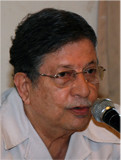
The legal community was prolific in its acknowledgement of Desai’s grasp of Company Law as well as his fine human qualities. Chief Justice of the Bombay High Court Mohit Shah wrote to condole Desai’s young son and budding advocate Hormazdyar. Senior advocate at the Supreme Court Anil Divan, senior counsel Fali Nariman, Antia, Crawford Bayley and Sons senior partner Dadi Engineer, Additional Solicitor General Darius Khambatta, M&M partner Homiar Vakil and others recalled their association with Desai by letter and speech. They were joined by captains of industry.
Desai (top) and (above) second from left with Jamshed Guzder, Naoroji Godrej and Minoo Shroff
While business icon Kumar Mangalam Birla attended Desai’s funeral, his mother Rajashree Birla spoke of the "void in our midst” at the condolence meet. She described Desai as "the only professional who worked for four generations in our family. (He was) involved in all legal matters. We saw him as a member of our extended family,” she noted, describing him as a noble soul who believed in inclusive growth. Her husband, S. K. Birla, echoed similar sentiments in a letter from Calcutta.
"He punctually attended all the board meetings (Century Textiles and Industries Limited)… His advice was instrumental in a number of excellent decisions that the board had taken. Whenever we had queries regarding the affairs of (our) other companies also, we always sought his advice. In his loss, the company has lost a very valuable, legal and corporate advisor... He was a person of the highest sincerity, honesty and integrity. We have lost a good friend,” wrote Basant Kumar and Sarala Birla to Desai’s wife Coomie.
Desai was on The Baroda Rayon Corporation Limited’s board for over a decade and "during restructuring of our Company he played a very vital role,” wrote Sangram Gaekwad, Maharaja of Baroda. Maharaja Jyotiraditya Scindia registered a personal loss when he wrote to Coomie, "In him I have lost an honest and committed elder who was always generous with his advice.”
Hiroyuki Aota, director of the Energy Company of the Panasonic Corporation wrote Desai’s "lifelong dedication and most admired leadership had been the basis for many successful accomplishments and his name will be identified with us for good.” The sentiment has been echoed by others.
"I have no words to write about my dear friend and very dear well-wisher of the Leela Group — Eruch Desai. …He called me Krish, which only he did in all my life!” noted its chairman Krishna Nair.
Desai was the legal consultant for four generations of the Birlas. Seen here with (clockwise from top left) Ghanshyam Das Birla, Basant Kumar Birla, Kumar Mangalam Birla and Aditya Vikram Birla
Each lawyer had his own tale to tell about his erstwhile colleague. "Eruch had signed his Articles with late Mr Noshirwan Petigara. He was fortunate to have the opportunity to work under the two stalwarts of the legal profession at that time, namely Mr Nariman Santook and Mr Noshirwan Petigara, who were then, the authority on Corporate Law. Eruch became a solicitor on April 20, 1956 and completed 50 years in the profession on April 20, 2006. For this landmark, he was felicitated by the Incorporated Law Society,” long standing colleague Antia shared the insider’s view with the audience at the condolence meet. Describing him as "methodical, punctual and a staunch disciplinarian,” Antia said, "He was always well-dressed and well groomed…gentle in his tone and generous with good manners.” According to Antia, Desai did not tolerate injustice. Misuse or misconduct of any kind from any quarter attracted stern action. But he was very jovial, good natured and had a knack for repartee.
"Being the senior most partner of the firm, he led and guided the firm towards its progress and prosperity. Like the captain of the ship, he took full responsibility to lead the firm from the front and never shirked his duties to protect and defend the firm. He made his assistants and his staff work hard but he himself worked even harder,” noted Antia, referring to Desai working on Sundays and holidays when the occasion demanded it.
With son Hormazdyar and wife Coomie
The leading solicitor was a lecturer for LLM students in the Department of Law of the Bombay University. A member of the legal committee of the Bombay Chambers of Commerce and Industry, he always found time to speak at seminars or write articles in newspapers on subjects dealing with Company Law, MRTP (Monopolies and Restrictive Trade Practices) Act (now repealed), Foreign Exchange Regulation Act (now known as Foreign Exchange Management Act).
"Though Company Law was his forte, he attended to several other types of matters — civil as well as criminal. He gave legal services to about 100 Indian and foreign corporations of high stature. The list of his clientele includes chief ministers and governors of Indian states, consulates, maharajas, foreign banks, foreign airlines, Indian film producers and stars, just to name a few.”
Vakil, also an M&M man for the past 25 years, writes of two instances Desai had related of his interactions with his seniors Shiavax Vakil and Phiroze Vakil. Shiavax who had first entrusted Desai with work pertaining to G. D. Birla had once forgotten Desai’s surname and instructed the peon to summon "Eruch Birla.” Desai, who considered himself a staunch orthodox Parsi, was reportedly furious.
Outstanding criminal lawyer Phiroze Vakil had once given Desai an important citation under which a director or a trustee can be absolved in criminal proceedings. But Desai inadvertently lost it. To teach him a lesson Phiroze Vakil called Eruch to his chambers, gave him the citation, discussed various other important cases and offered him tea. Thereafter, he sent his memo of exorbitant fees: Rs 5,000 for rendering legal services. Although shocked Desai sent a cheque immediately (but) after six months found that Vakil had not encashed it! "After this incident, he kept his case papers as well as his precedents systematically and meticulously and the documents carefully paginated,” recalled Homiar Vakil.
Farokh Subhedar, Tata Sons’ chief operating officer and company secretary described Desai as "humble.” He recalled his association with Eruch on a joint venture (JV) project. When difficulties arose with the JV partner Desai "asked what is your problem? He convinced them that the differences they perceived” were not so. "Made them see they would face the same problems if they went alone.”
Divan and Engineer harked back to their student days at the Government Law College (GLC). "Eruch was the table tennis champion in the College and I was runner up,” recalled Divan. "He was also a good carrom player but he never played chess like me. We had many pleasant hours in the College common room,” wrote Divan in his letter to Coomie, adding, "He was always popular with the lady students.”
Desai’s parents Byramsha and Bhikhamai
"We spent a lot of time in the canteen and the common room. We were among those misguided souls who believed we could learn more law in the canteen and the common room” than in the classroom, said Engineer. Later, as co-trustees on the BPP board, Engineer observed, "The agenda moved fast,” when Desai was chairman.
"There is no better senior to work for,” declared Khambatta referring to Desai’s painstaking research and polishing his work. "He pushed the envelope as far as it could go. He never misled his clients.” Khambatta said his decision to leave the solicitors’ firm and go to the bar was a difficult one. Desai had "a passion for his religion.”
BPP chairman Dinshaw Mehta regretted Desai’s short stint as BPP chairman in 1995: "He could have done a great job as chairman if he had served a full term. He never lost his cool (or his) gentlemanly behavior, never (harbored) rancor. (He was a) traditionalist (but he was also) a great humanist (who) got the right for (intermarried Parsi) ladies to have their bodies interred in the Towers of Silence after the Roxan Shah case.” (Mehta was alluding to Desai’s detailed legal analysis of the religious rights of out married Zoroastrian women based on the community’s history and the recorded opinions of various respected high priests over the years. His brief had led to a change of position by the BPP board and the beginning of a new policy allowing the consigning of such a body to the dakhma on the affidavit of the next of kin that the lady had continued her Zoroastrian practices despite being married outside the community.)
On the chairmanship controversy it was former BPP chairman Minoo Shroff who noted at the condolence meeting, "I was president at the meeting where the chairmanship issue was decided. It was painful. But Eruch had no vindictiveness. He had a consensual approach, (he was) never a confrontationalist.” [After Dr Aspi Golwalla’s retirement in 1993, the majority of trustees being from the Committee for Electoral Rights (CER) launched a new system of ‘election’ of the chairman whereas traditionally the senior-most trustee on the board automatically became chairman. They selected Shroff to be president for that particular meeting and elected Jamshed Guzder to fill the office even though Desai had served a slightly longer uninterrupted term as trustee. Lawyer Homi Ranina and Bombay University vice chancellor Dr Mehroo Bengalee, the two dissenting trustees, approached the Bombay High Court on the issue of seniority versus election and the Court upheld seniority. In the process two years of Desai’s trusteeship were lost. He chose to retire at the end of his term, having completed 20 years as trustee and three months as chairman.]
In his obituary tribute titled "Steadfast and Rock Solid” ("Parsi Tari Arsi,” The Bombay Samachar, December 26, 2010) liberal Zoroastrian solicitor Berjis Desai notes, "Throughout the last 30 years of this columnist’s involvement in Parsi affairs, this column almost always disagreed with Eruch Desai… However, we have never known him to be unpleasant or vituperative with persons holding an opposing view… He never used sarcasm as a tool in his many writings on community affairs, several of which were printed in this column…”
Referring to Eruch’s unrelenting opposition on the issue of universal adult franchise for the election of BPP trustees of which Berjis was proponent and votary, the latter writes, "As it so often happens, we suddenly find, after a long period, that the opposing view was indeed correct… Initially we though he was fearful of change; however, he was right and we were wrong.”
On Saturday afternoons and evenings he would spend time with members of the community who came to him for assistance. Rotarian Sam Daruwalla spoke of Desai as a man with "great talent and great heart.” He said Desai established a free legal cell for the needy in the Rotary Club of which he was a member” but tendered his resignation later because of pressures of time.
Coomie notes that before the illness which only came to light last June, Eruch would leave for work punctually at 8.45 every morning. He did not like and would not brook delay. But there were times for fun. Many a client invited them to be a part of their family celebrations. At the wedding of the grandson of the Maharaja of Sandur in Baroda the invitation insisted on them joining the barat. As everyone was expected in their traditional finery, Eruch in dagli and pugree and Coomie in a gara joined the dancing party!
Besides being a table tennis champion he had also won prizes in billiards and snooker for his club. His hobbies included collecting curios, antiques and paintings. He loved listening to western classical music, reading, watching cricket matches (live as well as on TV), watching TV channels on wild life and history, time permitting.
Educated at the Imperial High School, St Xavier’s College and GLC, the son of Bhikhamai and Byramsha Desai was elected trustee at the age of 43 in 1975. He was the youngest trustee on the BPP board when he cast the only dissenting vote against chairman B. K. Boman Behram’s decision to withdraw the BPP from the Federation of Parsi Zoroastrian Anjumans of India in 1978 because Federation vice president and Delhi Parsi Anjuman president Shiavax Nargolwalla had criticized the Punchayet’s electoral system at the just concluded Third World Zoroastrian Congress.
When the navjote of American engineer Joseph Peterson had been performed in New York in 1983 the BPP board was of a mind to condemn it in the strongest possible terms, Desai had mentioned to Parsiana during an interview prior to his reelection in 1985. Though personally against conversion, Desai said he had told the board that though "we have followed the tradition of not converting anybody in this country, the legal position is quite clear.” In the celebrated Parsi Punchayet Case the judges had held that the Zoroastrian religion enjoins conversion though the Parsis had adopted the policy of not converting anyone. "As trustees we can deny such converts the benefits under the Punchayet… the head must rule the heart,” he had affirmed (see "Desai’s decade,” Parsiana, September 1985). He had also noted then, "My only party is the community and my only interest is the interest of the community… I have sometimes given my views against particular groups and sometimes in favor, depending on the merits of the proposal. No matter which group supports me, it does not mean that there’s a quid pro quo…”
Desai is survived by his wife Coomie and son Hormazdyar.