Patrons and players have contributed to the evolution of cricket in the Emirates
Sharjah, Abu Dhabi and Dubai were the cynosure of all cricket eyes while the Indian Premier League (IPL2020) battles were played out between September and November 2020. These same venues will draw cricket fans from all over the world for the IPL2021 in a few months. This is something no ardent follower of cricket nor the father of cricket in the Emirates, Abdul Rehman Bukhatir, could have dreamt of four decades ago.
Not many are aware of the Zarathushti connection in the early days of cricket in the United Arab Emirates (UAE). For, when International Cricket arrived in the Emirates in 1980 the first match played between an Indian XI (consisting of Test players) and the UAE XI, there was a local "Bawa” as lead umpire. Local newspapers, Gulf News and Khaleej Times carried his picture tossing the coin, under bold headings, "Cricket Comes to the Emirates.” This "Bawa” was the 50-year-old spirited cricketer Rusi Sorabji, a nephew of one of the first Parsi Test and Pentangular cricketers, Phiroze Edulji Palia. Some from the Indian team addressed him as "Bawa.” Being a friend of Lala Amarnath (the 1950 Indian Test team captain), his son, Test cricketer and popular commentator Mohinder Amarnath called him "Uncleji”.
Sorabji’s sister Mani Thakur’s son Ashish, a Delhi University and a North Zone player, soon appeared on the scene. A stylish batsman and medium pacer, Ashish played for Air India. He was also one of the batting mainstays for the Emirates XI team. In 1986 he captained the Emirate India XI that won the UAE Cricket Championship. He toured England, the Far East, Africa and Australia with the Air India and the UAE teams. None of the Parsi media in India at the time or later recorded these contributions to cricket.
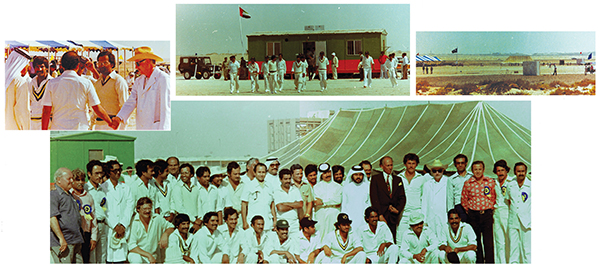
Clockwise from top l: at the first international cricket match in the UAE, Rusi Sorabji (r) greets India Ambassador Mann Singh;
Dubai team take the field with portacabin (in background) serving as the players’ room; sandy plot on the outskirts of Dubai
levelled for a cricket pitch; Indian and Dubai teams with Sorabji (standing 5th from r) and Joe Seniors (standing ext l)
Clockwise from top: Sharjah stadium in the late 1970s with Sorabji and Abdul Bukhatir (standing 2nd and 8th from r)
Photo: Daraius Sorabji; Sir Clive Lloyd as umpire at Pakistan vs India match, 1986;
Dubai cricket team and officials with Ashish Thakur (standing 9th from l)
Much of the UAE then was in a developmental transition from small settlements along the coast that not so long ago resembled a terrestrial no man’s land in which the sea, sand and sabkha (Arabic term for saline flats), often fused indistinguishably. Sharjah, the third largest Emirate, on the southern shores of the Persian Gulf near the Straits of Hormuz, was for decades an unknown desert airstrip operated by the Royal Air Force and later by the British Overseas Airways Corporation on the way to the subcontinent and Australia. Also, the Imperial Airways flying boats that used the Dubai Creek for their overnight halts would house their passengers at the Sharjah airport fort, safe from the nomadic local bandits on camelback.
From end September to May, every weekend (Thursdays and Fridays in the Emirates) expatriates from the subcontinent, UK and other cricketing countries would gather to indulge in their favorite game, on grounds that they themselves had sculpted out of sandy wastelands, using their company’s heavy earth moving equipment like shovels, graders, road rollers, water tankers, compactors and left-over materials from projects executed by their firms. The soil for the wicket was trucked from Ras Al Khaimah, mixed with waters of the Persian Gulf, edible oil and bags of Pakistani gobur imported as manure for the Rose Garden of Al Ain. The resulting wicket, baked by the sun, was hard wearing and produced an even bounce that assisted the fast bowlers earlier in the day and the spinners as the game progressed.
At the Al Khan Cricket Grounds behind the Sharjah Industrial Area, where the Air India-Dubai team played frequently, surplus bricks and concrete blocks from building construction sites were used to raise the seating area around the boundary. Automobile seats from scrapped, accidented cars, collected from the nearby "car and truck graveyard” and old discarded office chairs provided the make-do seating for the spectators and supporters. Incidentally, for some years Rusi Baria, manager of Worldwide Travels, Sharjah (and now a resident of California), was the manager for the Air India team. World Wide Travels, one of the Bukhatir group companies, were travel agents to the 900 employees of General Enterprises Company where Sorabji was the supply and materials manager. In 1977-78, there were about half-a-dozen cricket grounds like the one at Al Khan that was located just outside Sharjah going towards Dubai.
It was Sorabji’s friend Chandru Bhan of the Lancashire Cricket League who was instrumental in introducing him as a cricketer to prominent lovers of the sport: the visionary Bukhatir because of whom Sharjah is today the undisputed ODI (one-day international) cricket capital of the world; and the brothers, Abdul Rahim and Abdul Latif Galadhari. The Galadharis who had their origins in Iran were probably one family that then contributed more than any other local family to the growth and development of Dubai and its trade. Both Bukhatir as also the Galadharis were businessmen, merchants, bankers, industrialists, hotel magnates. The Galadharis also owned a newspaper and were the distributors for Mazda and some American and European automobiles amongst other services.
Along with Bukhatir and the Galadharis, the invaluable contributions to UAE cricket by Joe Seniors should not be forgotten. A founder office bearer of both the Dubai and Sharjah Cricket Association and a patron of the Air India Dubai cricket team, he arranged for several teams from the UK to visit Dubai and Sharjah and arranged for an escorted foreign tour for the Air India team.
Most weekends, the Bukhatir team played the Galadhari team. The Galadhari employees consisted mostly of expat Indians and so did their cricket team. Bukhatir’s able lieutenants were the former Pakistan Test captain and Kent county player, Asif Iqbal and Qassim Noorani. On the staff of the various Bukhatir group companies were many Pakistani Test cricketers whose job was to play cricket on weekends.
Sorabji was invited to play for the Galadhari team, but for some unknown reason ended up umpiring the game. This happened every time the industrialists were present. However, the compensations and gifts for umpiring were not bad. Once Sorabji asked Abdul Rahman if he had any hand in wanting him as the umpire. The answer was, "Rustom why do you think we assign you the umpiring job? We know you are a Zaar-thorsty.”
It was one afternoon in May 1980 that Sorabji first played with Bukhatir. At that time the partly covered stadium had a seating capacity of 8,000-9,000. Seats were molded fiberglass reinforced plastic and benches had no backrests. All that has now been replaced with the best available and the capacity increased to 28,000. Today the stadium hosts regular five-day and one-day matches. Spectators can watch the game from the cool comfort of the high-tech pavilion where they are provided with a class of comfort not found anywhere else, along with conveniences of the latest electronic gizmos to enjoy the day’s proceedings.
Within 20 years of Sorabji’s arrival in 1977, Sharjah and the neighboring Dubai and Abu Dhabi were transformed into one of the world’s great playgrounds, lush in greenery, offering the best in cricket, golf, football, Formula One racing, ice skating, polo, speed-boat racing, horse racing, tennis, yachting and even synthetic ski slopes on the sand dunes.
"Sir, was that a six?”
It was a memorable floodlight night at the Al-Nasr Football Stadium in 1981 where Dubai XI was playing a mixed team from England. Occupying the crease was Pakistan and Sussex county’s Imran Khan (current Prime Minister of Pakistan). The Dubai XI, captained by Vikrum Kaul, Sorabji’s friend from Delhi and cousin of then Indian Prime Minister Indira Gandhi, included Ashish. Khan found the shorter boundaries of the football grounds to his liking and slammed eight massive sixes in rapid succession. Watching the ball soar into the night sky and out of the ground is something of a joy for cricketers, irrespective of who hits it. In the excitement of the moment, Sorabji forgot or was tired lifting both hands to signal the six. The scorer seated high up in the football stadium in the dark sent him a note which read, "Sir, was that a six?”
A season later, two teams of English county cricketers played at the same stadium. The opposing teams included Indian test players Farokh Engineer and Bishen Singh Bedi. Engineer was known to be a dashing, hard hitting batsman and an agile, friendly chatterbox of a wicket-keeper. But on this floodlit night in Dubai, he stumped Bedi after pushing him out of the crease, all in the flash of a wink and then shouted, "How’s that?” When Sorabji, the leg umpire, started walking towards him and the stumps, Engineer called out: "Not out! Not out!”
Bowled over
Another incident imprinted on Sorabji’s memory occurred in November 1985 at the Sharjah Cricket Stadium during an India vs Pakistan match when he accompanied two Zarathushti ladies who were very interested in watching it.
Sorabji firmly believes that nowhere in the world can you enjoy an India vs Pakistan match more than when it is being played in Sharjah. The large, staunchly partisan spectators, evenly matched in numbers, alternate in pelting the other side with slogans in Urdu and Hindi. Reaching the stadium an hour-and-a-half before the game was scheduled to start, the trio found their seats five rows from the front.
Pakistan batted first and the maiden boundary of the match let loose the bedlam. Pathans dancing, flags and banners waving, out of tune bugles drowning out what one supporter with a truck-battery operated amplifier was yelling. Soon one of the openers was run out with no more than a couple of runs. This time it was the bells ringing, blowing of the conch sounding like a foghorn and small groups doing the bhangra in the Indian camp.
As the second wicket partnership progressed, a small group in the Indian camp started a chant: "Hamaré paas kya hai (What have we got)?” Then another person would shout, "World Cup, Asia Cup, Rothman Cup.” This would be followed by "Bhaiyon, beech-wallon ké paas kya hai (Brothers what have the other side got)?” Then someone would shout, "Kuch bhi nahi (Nothing).”
When India batted, Sunil Gavaskar was welcomed to the crease with loud clanging of the bells and chants of "Ganpati Bapa Morya.” The cry was repeated with more gusto as the runs piled up and victory seemed assured with Gavaskar still there with 60 not out. Then as wickets started to tumble, Gavaskar’s scoring slowed down as did the Ganpati Bapa chants and cheering from the Indian crowd. The silence was broken when someone on the mega-horn asked, "é bhai, téré Ganpati ko kya ho gaya? So gaya (Brother what happened to your Ganpati? Has he fallen asleep)?”
The most awkward moment occurred when Khan moved to the deep long-on position, less than 20 yards from where Sorabji and his friends were seated. Before anyone from the two groups could make a sound, one of the ladies from Calcutta jumped out of her seat and let out a shout in Gujarati that echoed all over the stadium, "Imran, maar chhakko (Imran, hit a six).” Embarrassed, Sorabji instinctively yanked at her skirt and asked her to quieten down, simultaneously pulling his cap over his nose, knowing that some media or TV cameras would be focusing on them. There was a flabbergasted look on Khan’s face as if he was bowled by a ball that bounced thrice before he completely missed it. This probably was the only time Khan was bowled over by a Parsi lady!
Rusi Sorabji shared his Sharjah cricket memories with Parsiana.