For Burjor’s chahrum lunch, a small goat was purchased to serve mutton dhansak to the entire Seervai Vad except for Sorabji, Burjor’s classmate in primary school. Being a believer in the Theosophy movement started in India in 1879 by Madame Blavatsky and Col Olcott at Adyar in Madras, Sorabji had turned vegetarian. At 32, he was already the assistant to the Divan of Baroda, had penned a history of Navsari from ancient times and was considered a wise young man.
After Burjor’s pre-dawn uthamna prayers were concluded, Sorabji walked up to Aimai and consoled her that Burjor continued to exist, albeit in a disembodied form, on the astral plane; and therefore to grieve for his body was ignorance. Burjor’s son Rustom listened to this conversation intently and felt somewhat reassured.
"Sorabji is a learned fool and unZoroastrian,” remarked Jehangirji, Burjor’s uncle and the patriarch of the Seervai clan who always wore a red lengha (pyjama) as the Navsari revenue collector of the Gaekwads of Baroda. Tales abounded about Jehangirji’s ruthlessness in collecting revenue from agricultural tenants in and around Navsari. Tongues wagged that he had amassed a mini fortune from the poor who were unable to pay their revenue dues, particularly if there was a crop failure.
"The choker and your marriage gold necklace, along with the gold chains and buttons which Burjor brought from Singapore, we must deposit with Jehangirji for safe custody,” Aimai’s mother-in-law instructed her.
"I am not comfortable with Jehangirji,” confided Aimai.
"Neither am I, daughter-in-law. This choker was obtained from Jehangirji by my husband after much controversy. However, we have no choice. Widows cannot keep their jewelry. Until Rustom marries and brings home his bride, it has to be entrusted to a family elder.”
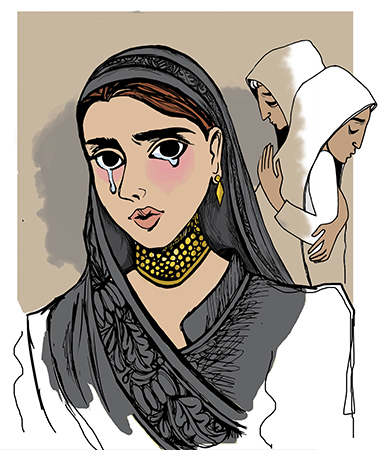
Illustration by Farzana Cooper
Aimai thought for a while and asked, "How about Sorabji?”
The older lady remained silent.
"Bapaiji, he is a good man,” said Rustom.
"Jehangirji will be furious. And nothing remains a secret in Navsari, but who cares,” said Burjor’s mother bitterly.
The women walked over to Sorabji’s house.
"I am touched by the confidence you have reposed in me. I shall safeguard it,” said a visibly elated Sorabji.
The seven tolas (a tola is roughly 10 gms) choker had a plain vanilla design and fitted tightly around the neck. Many Seervais believed that this choker had been made by melting the gold bangles confiscated by Jehangirji from those agricultural tenants who had failed to pay their dues.
Burjor’s orphaned family of five was sustained under the umbrella of the joint family. Rustom was a diligent student and secured a double promotion twice, to reach Std XI at age 15. Jehangirji, however, had other plans. One of his acquaintances from Bombay had a thriving shop in Bareilly Cantonment, selling provisions including ham, liquor and cheese to the British soldiers. He required a young and honest shop assistant.
"Kakaji, let me complete my matriculation exam,” Rustom meekly suggested.
Jehangirji did not even bother to reply. Like his father, Rustom dropped out of school and departed for Bareilly.
After three years, when Rustom was granted leave to return home by the owner who was delighted with his work, he was told that he would be married in the next two weeks to a pretty girl with blue eyes from the larger Seervai clan. The clan was divided into three sarkars (branches). Jehangirji belonged to the motti sarkar (main branch), while the girl’s father hailed from the vacchli sarkar (middle branch), and therefore was considered to be slightly inferior in the pecking order. The dowry fixed by Jehangirji was a single gold set, as the girl’s father was a poor school teacher.
Four days before the marriage Aimai went to Sorabji’s house, no longer in Seervai Vad, as he had prospered in his administrative career with the Gaekwads, to take back the jewelry.
Sorabji smiled, blessed Rustom and promptly handed over the box containing the jewelry. Aimai and her mother-in-law opened the box to find everything intact, except the choker.
Daughter-in-law! Where is our choker?”
Aimai rushed back to Sorabji.
"Aimai,” said Sorabji sternly, "I handed over the box to you as I had received it. I don’t remember any choker.”
"Surely, Burjor must have spoken to you about this choker?”
"I will ask him when I meet him,” said Sorabji coldly.
"Serves you right, trusting strangers instead of elders,” remarked an unperturbed Jehangirji, "I will deal with Sorabji after the marriage. Let the new bride wear Aimai’s gold necklace.” At the wedding, why Rustom’s bride was not wearing the famous choker was the question uppermost on the lips of the Seervai ladies.
After the marriage, Jehangirji, donning the traditional red lengha and pointed jodas (rough shoes), marched imperiously to Sorabji’s cottage on the outskirts of Parsi Navsari. Sorabji was visibly shaken at the appearance of the patriarch.
"Where is my choker, Sorab?”
"I don’t have any choker. Please don’t accuse a man of my standing and integrity.”
"You claim to be a Theosophist and have written articles that truth is the only religion, isn’t it?”
Sorabji remained silent.
"You are playing with fire, Sorab. Be warned!”
Jehangirji had a reputation for his enemies to be found dead in some faraway fields. Sorabji took this as a death threat.
"I work in the Divan’s office, Jehangirji. If anything happens to me, you will be hanged.”
"Who wants to kill a worm like you Sorab, usurping the only property of your friend’s widow and children. However, be warned, you dog!” said Jehangirji and left.
Several years passed and the choker was forgotten. Many in Navsari came to believe that a robber baron like Jehangirji was perhaps preferable to a hypocrite like Sorabji.
A decade later Sorabji’s son, Gustad, was married to a prosperous farmer’s daughter in Bharuch. Sorabji had by then severed his ties with the Seervai clan and none were invited. However, an old retainer informed Jehangirji, then in his late 80s, that Gustad’s bride had worn the famous choker.
"Excellent! Excellent!” exclaimed Jehangirji to the puzzled retainer.
On the fourth day after Gustad’s marriage, in his father-in-law’s farmhouse at Bharuch, a saw-scaled viper bit Gustad’s toe while he was asleep. He never woke up.
Jehangirji summoned Aimai and her mother-in-law.
"Your young daughter-in-law escaped widowhood due to Sorab’s greed. This choker was indeed made out of the melted gold bangles of a widow who had cursed me. ‘Jehangir Bawa,’ she had said, ‘three brides who wear any jewelry made out of my bangles, which you have forcibly taken away, will be young widows.’ I could have easily taken the choker from that puny Sorab, but then I calculated that his greed will save our family from yet another young death.”
After Gustad’s first month’s prayers, a sobbing Sorabji returned the choker to Jehangirji who told him, "Grieve not, Sorab. Gustad continues to exist, albeit in a disembodied form, on some astral plane.”
Berjis Desai, author of Oh! Those Parsis and The Bawaji, occasionally practices law.