Rudy Cotton was the most prominent
Parsi jazz musician ever in India
Stanley Pinto
I first met Rudy Cotton several months before I met Rudy Cotton. That’s the sort of enigmatic opening line that is supposed to grab readers and lead them on to the rest of what might well be a banal perambulation through a forgettable biographical journey. You’re going to have to decide for yourself, gentle (or otherwise) reader.
It was 1959 and I was not quite 16. St Xavier’s College, Bombay, decided to put me in their boxing team for no reason other than that I was under 72 lbs (32.6 kg) and would probably get a winner’s medal and two valuable points by default in the inter-collegiate tournament, to help the college extend its hold on the University champions’ trophy. I had never boxed before, but pugnacity was my overwhelming defence mechanism. And joining the ranks of the pug-nosed and cauliflower-eared was an immeasurable leg up at a time when I was making little headway with the girls in college.
Living not too far from my home were the two Khatow brothers, Sammy and Percy. Legends in their own lifetimes: national champion boxers with the signature pug noses and cauliflower ears to show for it. They’d pulverized every opposition in sight, all over the Asian continent, not to mention a few of the Western Railway yard foremen who’d had the audacity to suggest they should turn up to work for a living, on the flimsy excuse that
they were employed by the Railway. Quite magical fellows, at least to a not quite 16-year-old prospective boxing star.
I started to haunt the Khatow home, chatting up my new heroes, taking tips for the knockouts that would festoon my career as a boxer, and generally doing what champions do when they’re not savaging someone for an evening’s entertainment. Then one day Percy (or perhaps it was Sammy) said to me, "Our older brother Cawas is coming to visit us for a few days. You should meet him. He is a musician, he plays the ‘sexyphone.’”
Brother Cawas was Rudy Cotton, of course. In an era when musicians had names like Ken Mac, Hal Green and Chic Chocolate, he’d been re-baptized (or whatever it is that Zoroastrians do when they wish to change identities even at the cost of disenfranchisement).
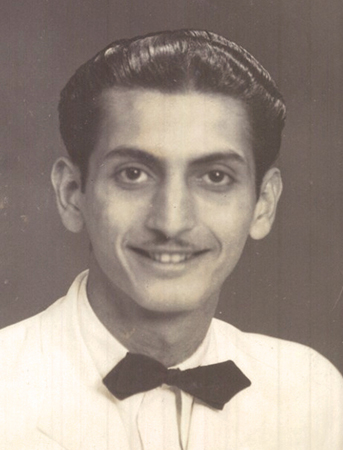
Rudy duly arrived. A tall, slender reed of a man. And quite devastatingly handsome to boot. With the wry, cynical humor that was, I believe, his hallmark, he joined my personal pantheon of Khatow family heroes instantly. One day before he left, he even took out his tenor saxophone and played it for me. And by gum, so magical was the man’s personality, the instrument metamorphosed into a sexyphone right before my goggling eyes.
My career in boxing came to an abrupt halt at the business end of some inconsiderate bloke’s fist in the first round of the first bout in the inter-collegiate tourney. The ignominy of it was a large consideration when I fled college to a career in music. And one day shortly thereafter, at the pre-pubescent age of almost 17, I found myself in Delhi with what was most definitely the worst assemblage of tone-deaf musicians ever in the history of the business. For reasons that no one could fathom, they were contracted to perform at the Tavern in the (then) Oberoi Imperial Hotel.
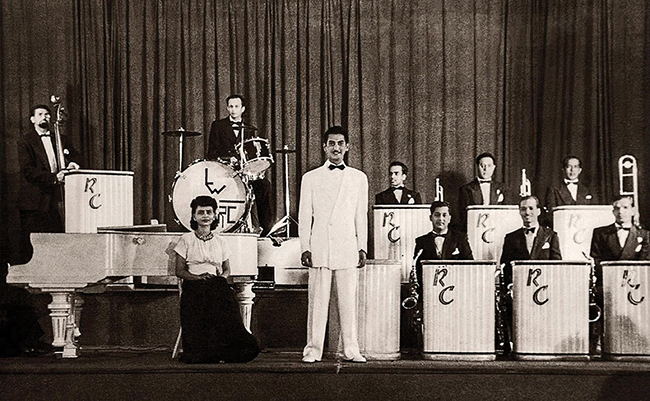
Rudy Cotton (top and above, standing center) with his band at the Savoy,
Mussoorie Photo: firstpost.com, Frank Fernand Family, Serendipity Arts Festival
Above: Cotton, on the saxophone with band members (from l) Johnny Gomes,
Danny Salvador, Charles Judah and George Bennett Photo: Taj Mahal Foxtrot
All the musicians on the Delhi scene arrived on opening night, standing in the shadows, watching the debacle that followed, as the high and mighty of the city’s society danced, or attempted to, to the cacophony of our music. Rex Al, India’s answer to Count Basie who led the band at the Alps restaurant, snorted loudly in disgust and left. George Pacheco, leader of a marvelous quartet at the Volga, smiled quietly to himself, malice writ large on his cherubic face. Frank Dubier, leader of a cutting-edge jazz group at the Standard restaurant, thought we were even ‘further out’ than he was. The only fellow to actually sit down at a table and order a drink, immaculate in a white suit, on his arm the most lovely piece of tinsel that ever was gift-wrapped in a gold-lamé gown, was Cotton. When our eyes met, I was ready to hang myself from the Tavern’s Bosendorfer concert piano’s fattest string from the ignominy of it all. But Cotton smiled at me, benignly.
Later, during our first break of the evening, I walked out to the Imperial’s porch with him and some of the remaining musicians. Cotton had an avuncular arm on my shoulder, propping up my failing persona. His companion of the evening, the singer Geri Dee, walked with her arm through mine. And behind us, among a clump of other musicians, was an obnoxious fellow, a drummer I seem to recall, making snide remarks. The remarks stopped when, in the driveway of the Imperial, my hero Cotton turned round and laid him out with a well-timed vintage-Khatow haymaker. This is my friend, it said to the spread-eagled form at his feet, and when you mess with him, you mess with me.
Cotton was leading the band at the Laguna, a new restaurant not far from the Imperial. He was returning from a long and troubled hiatus, I was told, after exorcising a slew of demons not uncommon to musicians, famous and infamous alike. Every night he stood at the head of his band, in a magnificent white mohair suit, his sax gleaming in his arms, pouring out the fattest sound I’d ever heard from a tenor saxophone. Many years later, watching the great Dexter Gordon walk out on stage at the famed Yoshi’s restaurant in San Francisco, I remembered my friend Cotton. The same imperious stance, the same gentle smile, the same twinkle in the eye, and the same fat ferocity in the sounds he produced.
Cotton and I became friends for reasons that few, often myself included, could understand. He was a musician in the best sense of the word; I invented new, atonal, almost Chinese chords to well-worn songs each time I played them. The foxiest women left their men standing at the slightest hint of his ‘come hither’ look; I didn’t know which end was up. This was a man of the world. I was not quite a man. But we were friends, Cotton and I, and that’s all that mattered.
Sadly but not unexpectedly, our band at the Imperial didn’t last very long and I was soon back on the train to Bombay. I saw Cotton one more time, the evening before I left. He gave me some music sheets, some sage advice and a long hug. The music has long been lost in the detritus of a dissolute half-century, the advice is in there somewhere in the mix of a lifetime of experiences, but I can still feel that hug.
I never saw Cotton again, not even when he opened the first Jazz Yatra in Bombay. I arrived late and by the time I did, 7,000 others had carried him away on their shoulders. As has the history of a genre of men the like of which we shall perhaps never see again.
Adapted from an article the author had originally contributed for a souvenir publishesd in 2005 for the Rudy Cotton Memorial Concert organized by the Delhi chapter of Jazz India.