The first ever World Zoroastrian Youth
Leaders Forum met with an enthusiastic response
Jim Engineer and Shazneen Limjerwala
In an effort to involve and attract Zoroastrian youth to the affairs of the community, a 10-day workshop was organized from March 16 to 25, 2018 at the Asha Centre in Gloucestershire, England, founded by activist Zerbanoo Gifford. The object of the first ever World Zoroastrian Youth Leaders Forum (WZYLF) is "to enable future leaders of the Zoroastrian community worldwide to build friendships and working partnerships to tackle issues they believe impact on their local communities and the wider world.”
Terming the Forum "a bold initiative that some of the young Zoroastrians are putting together,” Gifford believed, "the time has come for well-educated and balanced youth from our community to take the reins of leadership.”
Sanaya Master of Auckland, New Zealand who assisted with the organization of the meet explained, "that unlike a Zoroastrian Congress the Forum will be a gathering of inspired change makers who after discussion and exchanged conversation will decide on action. The Asha Centre will provide an opportunity for young Zoroastrians "to collaborate and to set the foundation for global projects that will grow over time,” (see "Connecting youth leaders,” Parsiana, November 21, 2017).
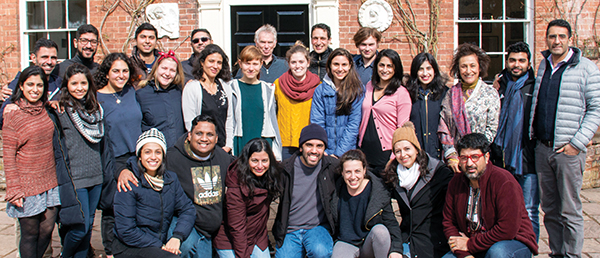
Organizers and participants at the Asha Centre
From left: Zerbanoo Gifford, Mark Gifford, Adrian Locher, Sanaya Master, Shazneen Limjerwala, Jim Engineer
From left: Baroness Jan Royall, Prof Yuhan Vevaina, Dr Zenobia Nadirshaw, Shahin Bekhradnia,
Sammy Bhiwandiwala, Edul Daver
Group exercises and deliberations: a "transformative experience"
"The Asha Centre is a British educational charity working for the empowerment of young people worldwide. The Centre is built on the Zoroastrian principles of sustainability, social responsibility and selfless service. This sacred space is the perfect environment to self-reflect, find inspiration, foster strong bonds and discover a deeper sense of purpose,” wrote participant Shazneen Limjerwala from Bombay.
"It was a transformative experience... This Forum’s aims were tied to… understand the dynamics of sustainable change to reflect on the global Zarathushti community connect with the heart of Zoroastrianism and with one another; and to unite and focus our energies for the betterment of the Zarathushti community.”
The participants she noted "ranged from 24 to 47 years. A number of participants had lived and worked in more than one country and came with varied professional expertise in the fields of education, law, psychotherapy, architecture, management, advertising, catering, armed forces and entrepreneurship. The extent of involvement with the community varied too: some were on committees of community organizations, others had supported individuals and groups in the community, some taught religious classes. Still others were on the cusp: wanting to contribute and looking for concrete ways to do so.”
Participant Jim Engineer of Chicago wrote: "Our goal was to celebrate our interconnectedness as a group, to trust each other, to respect each other’s views, and to form a vision for future Zoroastrian generations living in harmony and thriving as a united community… The lens through which we viewed the Forum was worldwide in scope, yet our experiences were tied to our home continents and regional involvements. Each one of us brought a unique perspective, view and level of leadership that qualified our involvement and enabled us to speak ardently on behalf of our experiences, and eventually on behalf of one another as a group.
At Parsiana’s request Limjerwala and Engineer penned their thoughts and impressions on the 10-day gathering. Parsiana has edited, shortened and combined their pieces to present a feel of the Forum.
Stimulated by our scenic and serene surroundings at the Asha Centre, we never watched TV, were rarely in front of our computers or on the phone, were not stressed or distracted and always open to new ideas, techniques, and methods for achieving consensus and unity as we began to form our vision for the future. There was no shortage of laughs and hugs to make each moment an instant memory.
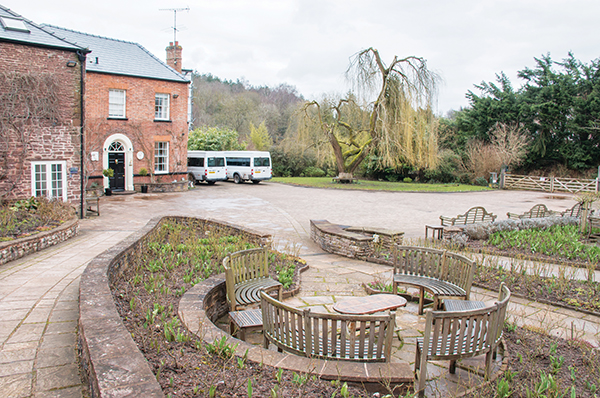
Cool environs: "scenic and serene"
As we began to envision our ideal Zoroastrian future, perhaps 50 to 100 years from now, we used meditation to produce visuals that ultimately helped us frame our WZYLF Vision: A harmonious Zarathushti community flourishing through righteousness.
With our vision in place we set our sights on identifying and mapping the most critical issues to us individually, and then collectively. Issues of highest concern to us were: preserving the religion’s philosophical teachings as also cultural traditions and practices; sustaining and building fire temples and religious centers; environmental preservation; gender equality in community leadership and within the priesthood; and most critical to our time, the inclusion of non-Zoroastrian spouses and their children.
Perhaps no other issue or theme was more critical to our discussions on dwindling numbers than the topic of inclusion that brought about a sense of empathy for Zoroastrians and their non-Zoroastrian spouses and children who are questioned on their identity while attempting to simply worship peacefully. To us youth, no single country or geography has a monopoly on views, or the ability to dictate who can be a Zoroastrian and who cannot, and change if it is meant to take place, must take place organically and from within rather than through external forces and bodies.
Our WZYLF Mission is: "To connect today’s Zoroastrian youth leaders, fostering dialog, and empowering diverse voices into action. We aimed to resolve the host of issues with future-focused common-sense ideas, and in some instances, structural policy recommendations to help organizations locally and globally to usher in a new generation of Zarathushti leadership and work toward a more inclusive future driven by responsible governance.”
Invigorated and interlinked
At the beginning of each session, we practised energizers: group exercises that left us feeling invigorated, i.e. physically agile, mentally active, and connected with the rest of the group. For example, we were divided into two groups, making rhythmic music by clapping hands at particular intervals. Thereafter, each of the groups was made to begin the rhythm at different times. It was challenging to stick to one’s group rhythm, unperturbed by the other.
The Swapping Cultures exercise through thoughtfully worded questions, stimulated reflective and creative thinking, followed by discussions, to facilitate the release of latent creative wisdom. Some of these explored our relationship with ourselves, and with our faith and the community. Additionally, the varied excursions widened our horizons to include multiple insider and outsider perspectives of our faith.
Discussions during the day were hosted and facilitated by the Centre’s co-directors Mark Gifford and Adrian Locher. Mark is one of two sons of Zerbanoo and her husband Richard. Locher, a leading visual artist and executive producer at the Gloucester Theatre Company, would be invaluable alongside Mark for boundless leadership, generosity, thoughtfulness, creativity, sensitivity, and a depth of understanding that enabled us as a group to not just work together, but to cultivate, map and prioritize the maze of issues challenging our future.
Zerbanoo was the mover, the heart behind the WZYLF. To her, it "was a dream, envisioned many years ago. It embodied a vision of young Zoroastrians taking their rightful place leading our community today towards an open-minded, courageous and righteous future.” Zerbanoo has been a progressive, forward-thinking champion of social justice, women’s rights, racial equality, interfaith tolerance and environmental sustainability for decades. Her example of courage and depth of historical context provided rare color to our efforts, as we sat in awe of her trailblazing example.
At the outset, she spotlighted the contributions of legendary Iranian and Parsi Zoroastrians who went beyond the Zoroastrian community to lead the world. Zerbanoo’s example is tied to going beyond one’s traditional comfort zone, to affect change in the world, and to pursue our dreams and endeavors without fear or favor. She also elaborated on her beliefs. Life is Karmic; defiance is important. So are good manners. Trust in other people. Never be disappointed. Her manifesto was to develop real friendships, be brave. A great deal of talent is lost to the world, because of lack of courage.
We had a discussion and lunch with Baroness Jan Royall, the principal of Somerville College, Oxford University. In her engaging interaction, she focused on the history of Somerville College, its mission, famous students it has educated over the decades, and most importantly, the College’s central role in affecting change on gender equality issues. She proudly shared that alumna Cornelia Sorabji (November 15, 1866-July 6, 1954), an Indian woman born to a Zarathushti father and English mother was the first female graduate from Bombay University, the first woman to study law at Oxford University, the first Indian national to study at any British university, the first female advocate in India and the first woman to practice law in India and Britain.
Prof Yuhan Vevaina of Oxford addressed the questions of his youthful audience. His work has centered around the Middle Persian (Pahlavi) interpretations of the Gathas and his interest lies in how Zarathushtis understand their scriptures and the past. He also highlighted that the past was not static, it was dynamic, and therefore a reading of the past needs to be nuanced, and cognizant of the limits of our knowledge and our biases. The five Gathas consist of 17 Avestan hymns of praise to God and are the oldest and most sacred texts in the Zoroastrian tradition. He also highlighted the issue of language as central to interpreting texts. The languages needed to understand the sacred texts are Avestan, Old Persian, Pahlavi, Persian and Gujarati, in classical, early modern, and contemporary forms. There are hundreds of texts, akin to Big Data, many of which have still not been translated or are languishing in archives waiting to be studied. Understanding them requires time, experience, interpretive skill, and most importantly, even-handedness.
The youngsters were enthused by other guests like Edul Daver, global president of the World Zarathushti Chamber of Commerce (WZCC) who felt the Forum can hone the leadership of the youth which can be beneficial to them in their vocations as well as their community. Shahin Bekhradnia, committee member of the World Zoroastrian Organisation (WZO) and faculty, Modern languages and Anthropology, at Oxford University shared that there is no universal truth and talked about women priests. Dr Zenobia Nadirshaw, a senior psychologist, with many accolades to her credit, encouraged us to have an action plan with timelines to achieve our goals. Sammy Bhiwandiwala, WZO chairperson, referred to the WZO activities.
For Navroz, Zerbanoo had meticulously laid out a traditional Haft Seen table. We celebrated Avan roz, Avan mah, gathering by the stream and led in prayer by our young mobeds Ervads Karl Desai (Australia), Jehaan Kotwal (India), Jimmy Madon (UK/India) and Sheherezad Pavri (India). The next generation of Zoroastrian priests, the role they play in our community, the enormous responsibility they have, and the obvious pressure of the community’s many complexities, is simply profound and we as a group stood in awe of them.
Each day also had a fun event scheduled. We learnt Latin dancing and yoga, had a bonfire where we shared our ‘bad date’ stories, had a talent night to display our acting, dancing, mimicking, singing, storytelling and other skills. The bawa cooking contest had us divided into groups, each preparing a particular item: sali murghi, chicken cutlets, papeta par eedu, salad and chocolate cupcakes. At nights, we bonded over mafia, a game of cards. The grand finale was the Freddy Mercury singalong at the local pub.
This timely and purposeful Zoroastrian ‘coming together’ of next generation leaders would not have been possible without the devotion, dedication and leadership of Sanaya Master. She had helped organize the Sixth World Zoroastrian Youth Congress alongside fellow New Zealander Tinaz Karbhari (also a WZYLF participant), and had taken an internship at the Asha Centre in 2017. In her words, "I wanted to bring the people that I care about most, to the place I love the most.” She was influenced by her participation in the Return to Roots program that brings youth from the Zarathushti diaspora to India to familiarize them with traditional Zarathushti culture and living.
Mark, our facilitator, in his written interview shared, "Towards the end of the course, despite my weariness, I started having the most beautiful dreams, of families being reconciled, of long lost friends finding each other and of great, inspiring natural beauty. I think it must have been a reflection of what was going on, under the surface, in the group. And as I write I realize that the things I dreamed about were also what came to so many of us, at the beginning of the course, when we meditated and visualized our ideal future of Zoroastrianism. It gives me great hope for what might come to be achieved through this group of extraordinary young people.”
Juggling work, business and family responsibilities to participate in the Forum, most participants paid for their own tickets, took leave from work, and made other sacrifices to attend the WZYLF. Many of them expressed a sentiment of ‘disenfranchisement,’ a feeling that they were being held back and not allowed to contribute to the community in meaningful ways. This resonates with Zerbanoo’s sentiment, "My generation should let the next generation guide our community into an open minded, courageous and righteous future.”
Some of the youngsters named the projects they wished to lead. Arashasp Shroff (Toronto, Canada) declared, "I’m going to be facilitating the WZCC chapter in Toronto. I plan on joining several FEZANA (Federation of Zoroastrian Associations of North America) committees.” Shazneen Munshi from London shared, "My special interest is increasing knowledge within the community about Zoroastrianism. As the fun club organizer, I want to work on developing a curriculum for various age groups. Tanya Hoshi (Toronto, Canada) specified, "I will be connecting with other Zoroastrians to collaborate on the development of the feature documentary I’m creating. Ultimately I hope to create a film that unites our community and inspires a call to action.” Pavri committed to contributing to existing successful programs in Bombay like XYZ [(Xtremely Young Zoroastrians) engaging Zarathushti children in activities to nurture their ‘Parsipanu’] and Jiyo Mobed.
Arzan Wadia (New York, USA), creator of Parsi Khabar, an online news and views service about Zarathushtis worldwide believed, "The Forum can be a poster child, showing that there is another way to do it. If we spend time listening to each other, not to respond back, but to understand what each person is saying, then we can resolve issues.” He also suggested that "young people all over the world should get involved in community organizations because it is then easier to make change from inside out, than outside in. If you see a problem, become the solution. Offer your time, constructive criticism and help put the solution together. Be the change you want.”
As a group we are thrilled to impart, infuse, engage and challenge the next generation of Zoroastrian leaders and community builders to go beyond their comfort zones and challenge themselves to envision a future that is thriving, connected and unified. Heading to the 11th World Zoroastrian Congress in Perth, Australia, June 1-4? Look for us, as we look forward to meeting you and to updating the global Zoroastrian community on our efforts.
The other participants were Diana Bharucha Seattle USA; Kayras Irani, Vancouver, Canada; Narges Kakalia, New Jersey, USA; Layla Mazdayasni San Diego, USA; Shireen Patel, Lahore, Pakistan; Cyrus Rivetna, Chicago, USA; Benafsha Shroff, Denver, USA and Cainaz Vakharia, Washington D. C., USA.