Died: Soli Rattanshah Daruwala, 83, founder of Sarala’s Art Centre that served as a meeting place and sanctuary for the post-Independence generation of artists living and working in South India, on January 7, 2015, in Madras following renal complications.
The very idea of viewing "modern” art, appreciating its strangeness and often confusing images, let alone buying it, was still very alien in the mid-20th century city of Madras when Soli and his wife Moti arrived for their southern sojourn.
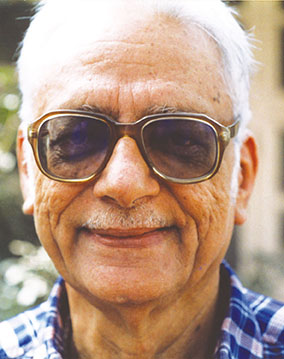
"Soli was a kind hearted man. He did a great deal for the development of contemporary art in Chennai,” remembers S. G. Vasudev, one of the best known artists of his generation. "I still remember going to the gallery in a garage, at Connemara Hotel and enjoying art shows. I still remember him organizing Arnawaz’s retrospective show after the death of Arnawaz.” (She was one of the founding members of the Cholamandal Artists Village, now a suburb of Madras, along with her husband Vasudev.) "One will always remember a smiling Soli,” concludes Vasudev.
This is the image that people retain of the tall, lean and always soft-spoken Soli. It was in this same spirit that his younger daughter Sarala Banerjee and husband Biswajit held a memorial evening to celebrate Soli’s life on his birthday on the April 4, 2015. It also coincided with the 50th anniversary celebrations of the art gallery, now being run by the Banerjees under the name: Artworld — Sarala’s Art Centre.
As Sarala noted: "He always used to tell us, don’t mourn for me when I am gone. Have a party with good food and drinks.”
It was not just the bar that was overflowing with good spirits on Soli’s birthday. The walls were also filled with the works of many of the artists that Soli had exhibited in his lifetime. Most poignant of course was a watercolor, a self-portrait by Husain, a long-term friend in the heyday of the Daruwalas’ success in bringing art to Madras. This was a time when their gallery had moved to a gracious old Madras mansion set in a wonderful garden owned by another well known Parsi family in those days, the Belgaumwallas.
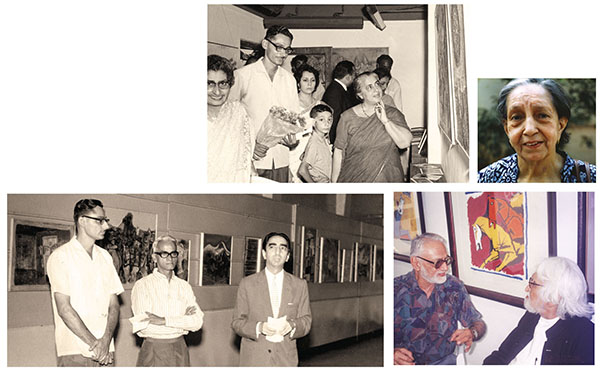
(Top): Soli Daruwala; (clockwise, from above): Daruwala with Mary Clubwala Jadhav; Moti Daruwala;
M. F. Husain with Daruwala; Jamshed Bhabha, artist Palsikar and Daruwala
The Husain show was of his famous Mother Teresa series. It was an immediate success. No one would have known that the gallery would soon face a period of uncertainty because of their closeness to Husain, when unscrupulous elements tried to damage their record by offloading a number of pirated copies of the master’s oeuvre. It’s perhaps in that troubled period that Soli showed his true mettle, overcoming the turbulence and never losing either his faith in art, or in the artists who stuck by him, not the least being Husain himself.
"Both my parents knew what a struggle it was to run a gallery,” remembers Sarala. "They would work late into the night to keep up with the orders that their framing business required. They were the first people to bring quality framing to the city.”
Soli had acquired this expertise working for the Chemould Gallery in Bombay that was established in 1963. For years after opening the Sarala Art Centre in 1965, the framing enterprise was what sustained the couple. It must be kept in mind that in those days, the only pictures that people in Madras framed where those of family Gods and those taken at the then popular photography studios, what were known as "marriage portraits,” "graduation portraits” and "ancestor portraits.”
Sarala shares some of the family history. Soli was four years old when the Daruwala family that had been living in Nairobi returned to India. On their arrival in Bombay, they were met by Soli’s father’s aunt and uncle. They were a childless couple living in comfortable circumstances in an apartment at Masters Chambers, near Metro Cinema.
According to family legend, the young Soli blurted in Swahili: "Why does he have such a huge stomach?” His parents instantly declared that he was saying how kind they were! Almost immediately, Soli was adopted by the grand-aunt and uncle. His parents had five children in all and life was a struggle for them. The grand-uncle was able to provide Soli with a good education. However, Soli missed his real parents dearly.
When he came to know of the Mother at Pondicherry, through a couple known as Shyam and Tehmi Lakdawala, he made up his mind to go to Pondicherry and the Aurobindo Ashram. By that time, he had already been married to Moti Rana; her sister had married his older brother. The Mother’s influence has been a constant one in the lives of the Daruwala family. Their elder daughter Shernaz and Sarala were admitted early into the Ashram School and imbibed the unique educational system initiated by Shri Aurobindo and the Mother. Son Fersos was sent to a residential school established by the Maharaja at Sandur in Andhra Pradesh.
"What I remember most about my dad was that he would do all the work around the house, but most particularly the daily market shopping for the household,” remembers Fersos, who runs his own shop selling leather accessories.
"He had an eye for beautiful things. In the early days, he would travel all over the South and had a collection of early Tanjore Paintings and bronzes that he would sell to sustain his business. People also brought pieces of art for him to buy. He was not acquisitive, and he loved sharing his love for art with others.”
The face of contemporary Indian artists in Madras for 50 years, artists remember Soli as a genial host. "He would know of our needs before we could articulate them. He would always put a Rs 50 note into our pocket and say, ‘Go, and buy a drink!’ when we left his gallery. But more than that he allowed us to talk about our work and share our joys and hopes with us. That was a time when no one took our work seriously,” commented another artist.
Soli Daruwala was a patron of the arts in the South, a kindly soul and a true friend in the service of contemporary art.
The amiable art connoisseur is survived by his wife Moti, daughters Shernaz Verma, and Sarala Baneerjee, and son Fersos.