With great truth and regard: The Story of the Typewriter in India edited by Sidharth Bhatia. Published in 2016 by Godrej Archives, Plant 19A, Godrej and Boyce Manufacturing Company Limited, Pirojshanagar, L. B. S. Road, Vikhroli (West), Bombay 400079. (The book is distributed by Roli Books, M-75,Greater Kailash Part 2 Market, New Delhi 110048). Pp: 304. Price: Rs 2,500.
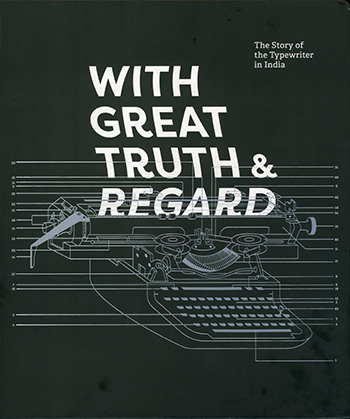
Writing in the foreword to the book dedicated to his father Naval (Naoroji), Jamshyd Godrej, chairman, Godrej and Boyce says: "Without (Naval’s) boundless energy, unflinching passion and steadfast perseverance, this journey (to become the first Indian company to "manufacture an all-Indian typewriter) would have been impossible.” Sidharth Bhatia’s "The Godrej Story,” one of the 19 essays in the volume that center around this functional machine, illustrates the drive behind the conglomerate’s foray into the manufacture of the machine in the early years after independence.
"The Godrej typewriter had to be as good, if not better than that of the competition,” he asserts, stating that an unpatented American model called R. C. Allen Woodstock was selected to be the benchmark product the company used to develop its first model, the M-9. Introduced in 1955, the M-9 was intended to counter a market dominated by USA’s Remington and Underwood companies. Its production involved 1,800 components made from different metals that required several specialized processes. Many of these components were made in-house. Marketed as ‘The All Indian Typewriter,’ the M-9 was presented to the then Prime Minister Jawaharlal Nehru at the 1957 session of the All India Congress. An archival picture shows Nehru poised to strike the keys of the machine. In yet another picture, Dr Rajendra Prasad, then President of India is shown at what is today’s Pragati Maidan in Delhi, with a similar machine, albeit with a larger roller, suitable for tabulation. The paper sticking out of the machine bears the phrase ‘India can make it’ in large italics.
Bhatia’s essay highlights the struggles of the early days at Godrej: barely 9,000 Godrej machines were sold in three years. Competition came in the shape of Halda, the Swedish company, which had set up a manufacturing facility in Madras by 1956; Naval soldiered on with the setting up of a dedicated production facility to speed up deliveries, "a move that showed both long-term vision and the confidence that Godrej would ultimately succeed.” The next model, M-8 hit the market in 1958, "built to last” and faster to use, before collaboration with Buro Machine Werke of East Germany resulted in a new machine, the M-12 with more features like keys for creating horizontal and vertical lines. An advertising campaign "around the idea of sturdiness,” though the newer models were actually lighter than previous models, saw annual sales averaging at 4,600 between 1965 and 1970.
The AB model, named after the company’s founder Ardeshir, was designed for speed, with annual sales zooming to an annual average of nearly 18,000 between 1971 and ’79. The PB model, named after Naval’s father Pirojsha introduced in 1979, was claimed to be "light as air.” The Godrej Prima which came next offered 15 typefaces, including Urdu, Sinhalese and Dzhonka (Bhutanese). In 1991-92 sales peaked at 57,000 units. Godrej had a market share of 50% in 1993, with the machines being sold in Thailand and Indonesia as well. Though 70,000 machines were sold in 1996, the writing was on the wall: computers were about to take over on a large scale. The production line, which was moved in 2002 from Vikhroli in Bombay to Shirwal in Maharashtra, was shut in 2009 as "demand had reduced to uneconomical levels.”
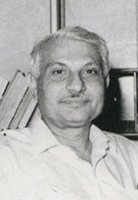
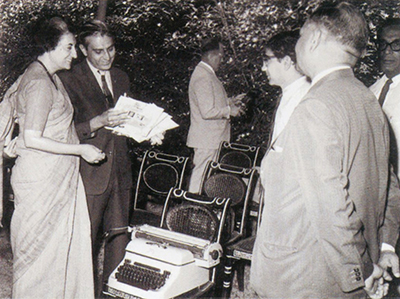
Naval Godrel; Sohrab Godrej (2nd from l) presenting the M-12 typewriter to then Prime Minister Indira Gandhi
Social change
"Right in the beginning, (Dr) Pheroza Godrej had made it clear that the book was not to be limited to the story of the Godrej typewriter but, more importantly, had to bring to life the wider role that the typewriter has played in India,” according to Bhatia’s note at the start of this hardbound tome. Pheroza’s mandate seems to have been achieved: the volume offers different perspectives on the machine with essays from various contributors on different aspects of the typewriter. Essays include how it was portrayed in movies (including the snippet that the only Hindi film song that offers a paean to the typewriter is from Merchant-Ivory’s Bombay Talkie) to how it marked a shift in news gathering and dissemination ("speed was what separated thinking journalists from mere typists”). Articles on, and interviews with those who have had close associations with the machines are included, in addition to the essays.
The book offers interesting insights into the proliferation of typewriting and stenography schools and stories of women who joined the work force as typists and clerks. A special supplement in The Times of India from 1955 reproduced in the tome highlights the "menace of ‘lady typewriters’” and explains that the British government took the initiative of employing a couple of ladies in their Inland Revenue Department. "They wore celluloid cuffs and high stiff collars and were locked in a room and fed through a hatch,” the supplement elaborated, possibly facetiously. As compared to the US and the UK, women in India were slow to join the typing labor force, we are informed. The initial domination of this field by Anglo-Indian and Goan women in the typing pool gave rise in the 1960s to the entry of the exalted ‘secretary to the boss.’
In the first essay in the book on "The rise of the Indian typewriter,” David Arnold, professor emeritus at the University of Warwick and author of Everyday Technology: Machines And The Making Of India’s Modernity, writes that between 1910 and 1950, India imported half a million machines. The number would be higher if one took personal portable typewriters into account, he states, as these "entered the country as personal effects and were not included in the official trade statistics.” He narrates the story of a Parsi writer of hate-letters to the Viceroy and the King-Emperor in 1915 whose identity was discovered via his distinctive signature — a broken letter on his typewriter, when compared with letters mailed by him through the General Post Office.
Other Parsi vignettes from the book: A battered Olympia, frame held up with sticking plaster, is "used to type some 300-odd medicine bottle labels every day” at the Parsi Homoeopathic Pharmacy, notes an article. Busybee’s (journalist Behram Contractor) odes to "Underwood, my first wife” are reproduced; columnist Bachi Karkaria’s contribution includes a description of her foray into the then chauvinistic world of newspaper journalism a-litter with the typewriters of the newsroom.
A variety of typefaces in the articles, some with minor typographical errors retained, some with editorial markings kept, are used throughout the volume. The section separators are designed with colorful pages, quotes and quips. Some would say the varying font colors and sizes distract from smooth reading of the content, though. Advertisements for sales and servicing of the machine and paraphernalia like typists’ chairs, carbon papers, ribbons and coffee machines down the ages from the Godrej Archives are cleverly interspersed with the essays.
The battered Olympia in use at the Parsi Homoeopathic Pharmacy;
a cartoon by Mario Miranda; Sidharth Bhatia
There was a need to "get everything perfect when you learnt on a typewriter,” as error correction was tedious compared to a computer, reminisce Puran Davar, Silloo Chichgar and Arzan Rikhye, office bearers at Bombay’s Davar’s College, founded in 1900. This is a note that will resonate with many old-timers. The thought is echoed by writer Ruskin Bond, who has used his Olympia for over 50 years on which he has written "about 80 novellas, 200 short stories and countless articles.” He finds it an efficient way to write: "The typewriter forces you to pay attention.”
Heavy reading? Not really. Though, if you intend to read it lounging in bed, beware, it weighs 1.6 kg and can damage your wrists! All told, a wonderful add-on to the bookshelves and coffee tables of social scientists and lovers of the graphic arts alike.