Besides the elegant Rusi Modi and
swashbuckling Rusi Surti, four other Rusis
made a mark in the sport
Kersi Meher-Homji
The name Vijay has enriched Indian cricket for decades. We had the legendary Vijay Merchant, Vijay Hazare and Vijay Manjrekar from the 1930s to the 1960s whose achievements have been written about in letters of gold.
But what about the Rusis: the stylish Modi and the swashbuckling Surti?
Rusi Sheriyar Modi was a prolific scorer in the Pentangular for Parsis and for Bombay in the Ranji Trophy. A wristy stroke-player, he combined elegance with a voracious appetite for runs. Tall and lean, he was the first batsman to score 1,000 runs in a season in the Ranji Trophy and his feat of amassing 1,008 runs at an average of 201 in 1944-45 remained unsurpassed till 1988.
Born in Bombay on November 11, 1924, he hit a record 215 for Parsis against Europeans in the Bombay Pentangular in 1943-44 and remains the only batsman to record five successive hundreds in the Ranji Trophy. He followed this remarkable feat with a brilliant unbeaten 203 in the third and final unofficial test against the Australian Services team at Madras in 1945-46.
He toured England in 1946 and scored 1,196 runs in a wet English summer. He made his Test debut in the Lord’s Test, scoring an unbeaten 57 in the first innings. He was less successful in the next two Tests.
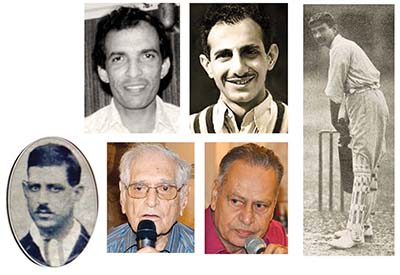
Clockwise from above l: Rusi Surti, Rusi Modi, Rustomji Meherhomji,
Rusi Jeejeebhoy, Rusi Cooper and Rustomji Jamshedji
He missed the tour of Australia in 1947-48 due to illness but was at his sublime best in the series against the West Indies next season, scoring 560 runs which remained an Indian record until Manjrekar surpassed it in 1961-62. He scored at least a 50 in all five Tests, including his only Test century in the second Test at Brabourne Stadium, Bombay in December 1948.
He will forever be remembered for his aggressive 86 and his 139-run partnership with Hazare in the thrilling final Test of February 1949, also at the iconic Brabourne Stadium.
India needed 361 runs in 395 minutes to win the Test but fell short by only six runs with one wicket remaining. India would have won but the West Indian fielders engaged in time wasting tactics. It would have been India’s first victory in Test cricket. In many ways this Test reminded me of the recent Brisbane thriller between India and Australia which India won by three wickets in the final pulsating minutes.
But after the Bombay magic of 1949, Modi’s Test career took a plunge. Although he played unofficial tests against two Commonwealth teams and one each against England in 1951-52 and against Pakistan the following season, he was never again the commanding figure at the crease. He however continued to play with much success for Bombay and scored 2,696 runs at an average of 81.69 with 10 centuries. In a two-decade-long first class career he amassed 7,509 runs (at 53.63) with 20 hundreds. In 10 Tests he scored 736 runs at 46, hitting one century.
He tragically died following a fall at the Brabourne stadium on May 17, 1996. He was 71. His artistry when batting will always be treasured.
A flamboyant left-handed all-rounder, Rusi Framroze Surti was referred to as the poor man’s Garry Sobers who is recognized as the greatest all-rounder in the history of cricket. Surti could bat like a millionaire, bowl like a miser and field like a superman. He was India’s first agile fielder. Even a short innings by Surti gave endless pleasure. He was a panther on the prowl.
To see him perform in the middle in the 1960s was like sipping a glass of champagne, lots of bubbles and fizz with a glorious aftertaste.
Born in Surat on May 25, 1936, he played the Ranji Trophy for Gujarat and Rajasthan before getting selected for his first Test against Pakistan in Bombay in December 1960. His last Test was also in Bombay, against the mighty Australians in November 1969.
In 26 Tests he scored 1,263 runs at 28.70, took 42 wickets at 46.71 (best figures being five for 74) and 26 catches. But it was his intensity that caught the eye. In the 1969 Bombay Test remembered for an ugly riot, he had an on-field argument with Australian captain Bill Lawry.
Surti had toured the West Indies in 1962 under the captaincy of Nari Contractor. Before Contractor was almost killed by a chucking bouncer from Charlie Griffith in a match against Barbados, four Parsis represented India in the first two Tests on that tour. They were Surti, Contractor, Polly Umrigar and Farokh Engineer. Thus 36% of the team comprised Parsis who were barely 0.00007% of the Indian population (70,000 Parsis from one billion Indians). Amazing! Unfortunately, ever since Engineer retired in 1974, no Parsi has played Test cricket for India.
Surti was a big success when touring Australia and New Zealand in 1967-68 under the captainship of the Nawab of Pataudi. We then saw a mature Surti, not flashy but doggedly consistent. He outscored all Indians on that combined tour by scoring 688 runs at 45.87 in eight Tests.
In the final Test against New Zealand at Auckland he made 99, which sadly remained his highest Test score. Summed up New Zealand writer Dick Brittenden, "Surti looked the best of them as a batsman and comparisons made with Garry Sobers were in many respects valid. For watchfulness and subconscious elegance, he stood alone.”
The next season he was invited to play Sheffield Shield for Queensland, the first Indian to be asked. Soon he was hitting the headlines. Against Western Australia in Perth in 1969 he scored 63 and took six wickets including the hat trick. It was the first hat trick taken by a Queensland bowler in the Sheffield Shield. In the 1980s he represented Australia in an indoor cricket match as a wicket-keeper, something even the great Sobers did not achieve in his career!
Surti was a respected coach for top clubs in Queensland.
My wife Villie and I hosted him when he visited Sydney. He enjoyed dhansak cooked by Villie. She also taught his sons Percy and Kaizad prayers for their navjote.
When I asked Surti about his most exciting moment in cricket he mentioned neither a Test nor a Shield match. He said, "My finest hour was in 1975 as a batsman in the semi-final of Channel 0 Knock-out Tournament played between Easts and University. The ending was nail-biting. Universities made 175 and we (Easts) were in strife at five for 58 when I entered. But soon I pulled my leg muscle and retired. I returned as last man when Easts needed 41 to win in 27 balls. In a dramatic countdown we added 16 runs in one over, 13 by me.”
Frank O’Callaghan wrote in Courier Mail, "Surti was in charge, dominating the strike like a military strategist.” He would have made an excellent T-20 player.
Once in the 1980s, he took me round the Brisbane cricket ground. Everyone at the venue recognized and greeted him Aussie-style, "Good-dai Rossi Serti.”
He died after suffering a stroke in Jaslok Hospital, Bombay on January 12, 2013. He was 76. His passing affected me deeply as he was a personal friend. I found him to be a straightforward person who would take no nonsense from anyone yet would go out of his way to help a friend.
Tributes poured in for the swashbuckling and popular all-rounder. None better than by the ever popular Engineer who said, "Rusi Surti was more popular than I.”
Other Rusis/Rustomjis from India
Rustomji Perozsha Meherhomji was the most attractive batsman of his time, his cover drives and square cuts were a delight to watch. Born on March 4, 1877 in Bombay he toured England in 1911 with the All India team and was the most successful batsman scoring 1,227 runs hitting three centuries with 150 against North of Scotland as his highest. Cecil Headlam wrote, "The best batsman of the side, his (Meherhomji’s) batting is stylish and confident, his hitting clean and hard, and he has some beautiful shots past cover and extra cover.”
He was a prolific run-getter for Parsis against the Europeans in the Presidency matches from 1901 to 1916, hitting 99 in 1903 and 100 in 1907. Test cricket (India’s first ever Test was played in 1932 when he was 55) came too late for him else he would have shone out there. But his nephew Kharshed Rustom Meherhomji played one Test for India in 1936 as a wicket-keeper.
Rustomji passed away in Bombay on November 14, 1943 aged 66.
Rustomji Jamshedji Dorabji Jamshedji made his Test debut at the age of 41 years, 27 days and remains the oldest Indian to play his first Test. He impressed in his only Test, against England at Bombay in 1933-34. A left-arm spinner, Jamshedji took the wickets of well-known batsmen Charlie Barnett, Bryan Valentine and Leslie Townsend in the first innings as England piled up 438 on their way to a victory by nine wickets. He caught Townsend brilliantly off his own bowling which made Wisden Cricketers’ Almanack comment, "There was nothing better in the match than the catch made by Jamshedji.” His bowling action reminded British writers of Hedley Verity, the legendary English spinner. In first class cricket for Bombay from 1922 to 1939 he took 134 wickets at an impressive average of 22.12, his best figures being 7 for 61.
Born in Bombay on November 18, 1892 he died, aged 83, on April 5, 1976. Jamshedji will be remembered as the first specialist spinner to play Test cricket for India.
Rusi Sorabjee Cooper was an eye-catching batsman who played with great success in India but had less luck during a brief spell with Middlesex. In 1943-44 and 1944-45 for Bombay in the Ranji Trophy, he had excellent batting averages of 76.60 and 91.83, with two 100s and five 50s. In the final he scored 52 and 104 and Bombay won the Ranji Trophy. He did not turn out in first class cricket again until 1949, making eight appearances for Middlesex in three seasons but averaged only 19.63.
In 22 first class matches from 1941 to 1951, Cooper totalled 1,205 runs at an average of 52.39, hitting three centuries, his highest score an unbeaten 127. In Ranji Trophy matches he added valuable runs with Modi. Who knows, had Cooper decided not to migrate to England, he could have represented India.
Born on December 15, 1922 in Bombay, he is alive, aged 98. A century awaits him.
Rusi Ardeshir Jeejeebhoy, a talented wicket-keeper, was born in Calcutta on December 2, 1942 and is alive aged 78. In 46 first class matches for Bengal from 1965 to 1973 he scored 496 runs at 10.33, took 104 catches and stumped 30. He was selected to tour the West Indies in 1971 with the Indian team as a wicket-keeper but was not selected to play a Test. So near yet so far!
What a versatile team the above Rusis and Rustomjis made: Jamshedji a left-arm spinner, Modi, Meherhomji and Cooper, prolific batsmen, Jeejeebhoy, a wicket-keeper and left-handed Surti, an all-rounder who bowled medium-fast, batted aggressively and fielded like an acrobat.
I do hope Cooper and Jeejeebhoy have a chance to read this tribute and comment on it.