The flight from Bombay to Sri Lanka takes off at 2.45 a.m. The lights of the cities we fly over dazzle like a million diamonds encrusted in gold. Above us, the inky sky is rent by flashes of lightning streaking across in wild abandon — a breathtaking sight — though for April it denotes bad weather! Two hours later we touch down at Colombo’s Bandarnaike Airport. Our stay in Sri Lanka has been arranged through a travel agent who provided us with a guide-cum-chauffeur for the entire trip. Denver Hamer, smart, affable and charming, awaits us at the airport. His car is smart too, a Toyota Prius Hybrid, so we are assured of a comfortable ride into Kandy, 115 km and three hours away. However, it takes us much longer as we stop to see the sights along the way. It’s a scenic drive through dense forests, banana plantations and coconut groves. No high-rises to mar the neat skyline, just quaint cottages hugging the sides of a silky smooth surfaced road.
Our first stop is the Pinnawala Elephant Orphanage at Rambukkana, 80 km from Colombo, which opens at 8.30 a.m. We are early and Hamer suggests we stop for breakfast at the Elephant Safari Park close by. However, as the Sri Lankans are celebrating Avurudu, their New Year, that entire week, the canteen is closed. Nevertheless our guide arranges for the staff to serve us tea which comes along with sweets that have been prepared in their homes for Avurudu. We are impressed — everything is served in a fine china tea-set — and we are in the middle of nowhere! After breakfast, Hamer suggests we experience an elephant safari. While we are mulling over it, we see a visitor riding an elephant bareback, her legs stretched across the pachyderm’s enormous torso, with the handler sitting behind her! That’s enough for us to politely decline. Besides, the cost of a 15-minute safari can be hard on the wallet! However, we do go to see the elephants being bathed in the river by their mahouts.
Finally, we are at the orphanage. It was started in 1975 by the Department of Wildlife on a 25-acre coconut farm on the Maha Oya River to care for baby elephants abandoned in the jungle. The orphanage, which started with five calves, has expanded into a breeding center and today boasts the biggest herd of elephants in captivity in the world.
Although there is a huge crowd of restless tourists, we are not allowed to enter for about half an hour because the Chief Minister is conducting the traditional Avurudu oil anointing ceremony in which 100 elephants take part and which is not open for the public. Avurudu coincides with the beginning of the agricultural cycle and the ritual of anointing of the head with oil is dedicated to Pattini, the goddess of fertility. An Avurudu table laden with fruit and sweets is placed for the elephants. Unfortunately, due to lack of time, we are unable to witness the elephant race which will be held here later in the day as part of the Avurudu celebrations.
The initial wait has been worth our while. Never before have we seen such a large assemblage of adult elephants and their young roaming about freely on 12 acres of grassland in scenic surroundings — a backdrop of mountains overhung with white clouds in a grey-blue sky and coconut trees in the foreground. There is not much natural fodder, so even as we watch large quantities of food — jackfruit, coconut, kitul (jaggery made from the sap of the fishtail palm), tamarind, branches and grass — are brought in by the truckload and fed to the elephants who consume 14,000 kg of food per day! A large elephant actually pushes one of the trucks from behind! At 9 a.m., for an additional charge, visitors are encouraged to bottle-feed the calves in the milk shed where gallons of milk vanish in a jiffy! This is not a normal practice, merely a tourist attraction. The calves are playful, friendly, inquisitive and come right up to the railing to be petted, but like all youngsters they can be naughty too! A calf twirls its trunk round a visitor’s camera and flings it to the ground as we look on in disbelief and horror. There are more elephants in another open field. It is amusing to see the calves gambol playfully, pushing and shoving each other. Visitors assemble on a raised platform to feed adult elephants, again for an extra charge. The elephant does not take the bunch of bananas offered in its trunk but instead opens its mouth wide. Needless to say, the fruit disappears with lightning speed!
Additionally, at the orphanage injured elephants like Seema, whose leg was partially blown off during Sri Lanka’s ethnic conflict, are rehabilitated.
The elephant bath is scheduled for 10 a.m. Hamer makes sure we reach a little early so we have a good vantage point from which to watch this spectacle. We perch ourselves on the premises of Pinnalande Restaurant along the river bank so that we can get a good view of the elephants as they approach and also while they are in the river. It is amazing to witness the majestic beasts obediently walking in single file the 400 m distance from the orphanage to the Maha Oya River for a two-hour bath through a street lined with shops mostly selling products made of elephant hide or elephant poop! Here, the elephants are not bathed by the mahouts, but are encouraged to go into the river and frolic in its muddy water. One elephant, more fastidious than the others, scrubs himself behind the ears and under his chin with his trunk! Because of the heavy rain the river is full and to our disappointment only a few of the larger beasts have been brought, not the entire herd.
We leave rather reluctantly to continue our journey to Kandy. En route we halt at the New Paradise Spice and Herbal Garden in Uthuwankanda, famous for the best spices and herbs in Sri Lanka.
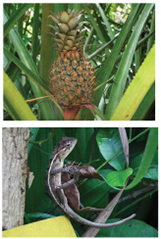
Sri Lanka’s indigenous medical system is more than 5,000 years old. A qualified herbal doctor greets us at the entrance and takes us on an educative and informative awareness tour. He points out different herbs and plants and explains how these can be used to cure several ailments. There are at least 29 different recipes prepared from these plants to improve health and enhance beauty without the side-effects of allopathic medicine. There is a recipe for a healthy curry and another for a hair removing cream, which supposedly stops the growth of unwanted hair permanently after a number of applications! Ingredients are obtained from fruits such as wild bananas and pineapples, spices like white, brown and black pepper, herbs such as citronella which is a natural mosquito repellent and red, yellow and green coconuts.
Besides the plants, we capture on camera a giant snail and a lizard, though the good doctor is mildly irritated at this interruption to his erudite explanations; but no garden is complete without creatures such as these. At the end of the tour we sample some refreshing spiced tea — a concoction of cardamom, ginger, cinnamon, cumin and hill country tea flavored with vanilla essence which is brewed and blended in our presence. All products can be bought from a store on the premises but the steep price acts as a deterrent.
There are no more stops on the way to Kandy. We are relieved because the moment we arrive at our hotel all we can think of is hitting the sack. It has been a rather tiring night and morning, but there are no complaints — the elephant orphanage was an amazing experience and the garden visit well worth our while.
Sri Lanka is an expensive destination, even though their currency is weaker than ours (SL Re 1 = INR 0.42). Entrance to the elephant orphanage is Lankan Rs 2,000 for foreigners and Lankan Rs 1,000 if one is from a SAARC (South Asian Association for Regional Cooperation) country.