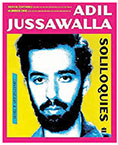
Soliloquies: Conversations & Poems by Adil Jussawalla. Published in 2025 by Fourth Estate, an Imprint of HarperCollins Publishers India, Cyber City, Building 10-A, Gurgaon 122002, India. Pp: 134. Price: Rs 399.
Soliloquies is divided into two distinct sections: the first is an engrossing interview of Adil Jussawalla by his friend, the poet Jeet Thayil; the second comprises a collection of soliloquies from Jian, a play Jussawalla wrote at the age of 17.
Since then, Jussawalla has published several volumes of prose, but he remains a poet at heart. He has been honored with the Sahitya Akademi Award for his poetry collection Trying to Say Goodbye and was named Poet Laureate at the Tata Literature Live! Festival in 2021.
Adil Jussawalla: early struggles
Thayil proves to be an excellent interviewer. He breaks away from the monotony of a chronological format, moving back and forth in time, making the interview both meaningful and informative. Success, however, came at a price for Jussawalla. The beginning of his career was far from easy. When he wrote Jian in London, where he was studying, he was grappling with a breakdown, the deprivation of a sexual life, and overwork at the school of architecture. He experienced a sense of deep alienation as a foreigner in England. No producer showed interest in the play, likely because its structure, centered on soliloquies (monolog), made it difficult to stage. This period of struggle culminated in the one mystical experience of his life — at Gladstone Park — when he felt himself "merging into the sky and the grass… undergoing something so ecstatic that when the tears flowed, it was because I wanted it to stop.”
Before this, Jussawalla had experienced a phase of "dropping out.” He abandoned his "A Levels” at The Cathedral and John Connon School in Bombay to study architecture in London. Finding it unfulfilling, he opted to complete his "A Levels” in London and was accepted into University College, Oxford. But he failed his exams in Old English and Latin, left Oxford, and came back to Bombay — only to realize his mistake and return to Oxford again.
On the literary front, he faced more setbacks. British author E. M. Forster read Jian and advised him to return to architecture. British novelist Angus Wilson was not dismissive, but said the subject held little interest for him. Jussawalla later wrote another play, a verse drama called Floodwaters, set in India, but it too met with little success. He abandoned a novel mid-way. To make ends meet, he worked at several odd jobs — cleaning carpets, polishing surfaces, working as a supply (temporary) teacher in schools for working-class children or those with learning difficulties. Eventually, he completed a course in teaching English and taught at a language school on Shaftesbury Avenue. He recalls one particularly unruly class where he met a charming ballet dancer, Veronik Joannides, who later became his wife.
Thayil draws Jussawalla back to his childhood, revealing the many nicknames he was given. As a forceps baby, his father called him Quasimodo (the protagonist of Victor Hugo’s novel, The Hunchback of Notre Dame); his mother called him Grumpy, as he often failed to respond to her; a mathematics teacher at his school dubbed him Atlas for his quiet demeanor. Not excelling in sports, he found refuge in drawing, which helped him cope with feelings of isolation and became a way of grounding himself.
Writing came much later. Although he excelled in school compositions and was praised by his teachers, he never seriously considered a literary career. It was only after his architecture plans in London failed that he turned inward and began to write poetry. He immersed himself in London’s vibrant theater scene — buzzing with the works of the Angry Young Men, a group comprising British novelists and dramatists — and joined protests for nuclear disarmament. Playwrights like John Osborne and Henrik Ibsen likely influenced the writing of Jian.
But publishing poetry has always been a challenge. Many poets had completed manuscripts but found no publishers. In 1976, Jussawalla, along with poets Gieve Patel, Arvind Krishna Mehrotra and Arun Kolatkar, founded Clearing House. Four of their books were published that year.
The second half of Soliloquies presents selected monologs from Jian. Jian, the protagonist, speaks to family members in prose, but his inner thoughts are revealed through soliloquies in free verse. His father, a priest, represents the religious orthodoxy Jian seeks to escape. A "would-be mystic,” Jian renounces his family, leaves home, and surrenders to another reality.
From the opening verse, the tension between Jian and his father is palpable. Disillusioned with his family’s religious values, Jian seeks his own truth. Soliloquies opens with the jarring phrase "bastard father,” reflecting Jian’s emotional turmoil. His father’s interference has brought him only "pain and fear and illusion.” The alliteration in "Dissolution, darkness, despair” mimics the sound of nails being hammered into a coffin — capturing the suffocating atmosphere from which Jian is trying to escape.
Does he yield to his father’s authority, or pursue his own path?
"Forgive me if I had to choose
The light and not your shadows,
It was my greater love.”
The book is enriched with photographs taken by Jussawalla himself, his sketch of the view from Veronik’s bedsit in London, and handwritten stage directions for Jian — personal touches that make this a deeply intimate volume.
Over the years, Jussawalla has become increasingly reclusive. The idea of a biography — or even an autobiography — would likely be anathema to him. Yet, in this interview, he speaks with remarkable honesty and openness — on everything from his earlier addiction to cigarettes and alcohol to bisexuality. We owe a debt of gratitude to Thayil for conducting this interview, which offers a rare insight into the mind, life and art of Jussawalla. FIRDAUS GANDAVIA
Gandavia holds a doctorate in English literature and is a retired chartered accountant. He is a compulsive reader of fiction.