Aerialist Philippa Vafadari rises from the stage to present meaningful theater under her BandBazi banner
Parinaz M. Gandhi
An Alzheimer’s patient, suddenly started speaking in a foreign tongue which no one in his family could comprehend. Along with the loss of many other faculties, the Zoroastrian gentleman in the UK seemed to have lost his ability to speak English. With all modes of verbal communication blocked, the level of despair rose. The unexpected arrival of Philippa Vafadari at the home for the aged brought the old man some consolation for, realizing that he was talking in Farsi, she started conversing with him in that language until tears started rolling down his cheeks.
While he found a confidante in Vafadari, she drew inspiration from his story for her next theatrical venture, Mindwalking under the BandBazi banner.
Philippa Vafadari in scenes from Love Indeed (above) and (left)
Bandbazi is a Farsi word for trapeze, says Vafadari who chose to train as a trapeze artiste after studying English literature at the London University, and theater at the Royal Scottish Academy of Music and Drama in Glasgow. Tired of being typecast for similar non-British roles, Vafadari who wanted "to be in charge, in control,” launched BandBazi as an entrepreneurial initiative that ties trapeze with theater. It is an award-winning, Brighton-based, multicultural, performing arts company and charity that gives a voice to disenfranchised groups, and challenges stereotypes through its productions, education workshops and community projects. "As well as putting on mind-expanding performances, BandBazi provides an outreach program that fosters self-expression through artistic practice,” notes a write-up in Irandokht, posted on the web.
As creative director of BandBazi, Vafadari was in Bombay in the third week of June 2010 to scout for the lead actor to portray the senior citizen’s role in Mindwalking that will premiere at the Brighton Festival in May 2011. Written by Tanika Gupta and directed by John Binnie, Mindwalking will be produced in association with The British Council, The Arts Council, Clyde Unity Theatre, Norden Farm Centre for the Arts and The Brighton Dome and Festival, as per a brief audiovisual introduction to the play.
"We have met six older actors today, all but one of whom are Parsi. So far they have been fascinating to talk to about their lives and experiences,” related Vafadari in her post on the web on June 17, 2010 pointing out how acting in the Bombay theater is different from England "because it is very poorly paid most people have other professions.” In contrast, theater in the UK is largely funded by the government. "But this year the arts councils lost 73 million pounds of government funding due to recession. So maybe the time has come for us to look at corporate subsidy,” she declared. Among those she had interacted with were Sam Kera-walla, Sohrab Ardeshir, Darius Shroff, Shahvir Irani… "Three of the actors we meet today will be invited to a workshop with us over three days… It’s a packed schedule but we want to make the most of our time here.” In her mail she was looking forward to her meetings with the Parsi Press and a dinner hosted by Dolly Thakore, mother of Quasar Padamsee of Q Theatre Productions, where 15 guests were expected, "all either writers, poets, actors or directors…” She was also hoping to convince Khushroo Suntook, CEO of the National Centre for the Performing Arts to book their show next autumn.
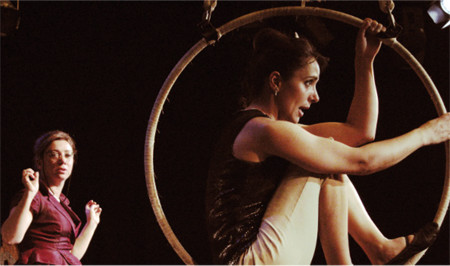
Philippa Vafadari in a scene from Breakfast at Audrey’s
Although she was in Iran two years ago, she says, "Sadly in no way can I share my work there.” Mindwalking, set in the 1950s, depicts a Zoroastrian who is married to a non-Parsi. His wife is not accepted by the family, and after his interfaith marriage he too is rejected by his community. Vafadari could empathize with the main character for her father Shahrokh Vafadari is an Iranian married to a non-Parsi, Elizabeth Anne. He insisted that their three children (the other two being Justin and Rebecca) speak perfect English. "I taught myself Farsi,” says Vafadari, happy to share her father’s roots. When researching for an authentic background, she interviewed three respected Zoroastrians of UK: Jehangir Sarosh, Rusi Dalal and her father.
Married to David Churchill, an architecture photographer, their civil marriage 14 years ago was followed by a Zoroastrian ashirwad ceremony on May 15, 2010, along with two other intermarried couples as part of a triple wedding. "I wanted to assert my cultural identity,” Vafadari candidly cites her reason. David appreciates that the "Zoroastrian religion is not didactic…that the Zoroastrian tenets offer a code of morality without being dogmatic.”
They would like their seven-year-old daughter Minoo and 10-year-old son Hardy to be initiated as Zoroastrians too. Both the children asked her to buy them a farohar from India, mentions Philippa. In Iran, flaunting of a big farohar is viewed as being against the regime, she says. Familiar with the customs and traditions observed in Iran, she tells us how Zoroastrians carry fruits to the disused Towers of Silence. Since dead bodies are now buried in Iran instead of being laid in the dakhmas Zoroastrians feel the birds should be offered some alternative in the form of fruits.
Themes concerning Iran feature frequently in the stage shows presented by the Anglo-Iranian actress. In Suzy Soraya she dealt with issues raised by Iranian women in exile in Scotland. Nearly Mine was about a mother and her teenaged son fleeing Tehran for a new life in Brighton. BandBazi runs a diverse educational outreach program throughout the year teaching a range of theatrical skills. Workshops cover trapeze, creative writing, circus skills, movement and physical theater, dramatic improvisation and storytelling, as mentioned on their website. BandBazi’s inclusive Youth Circus Theatre evolved from the "Above and Beyond” project that ran from 2006-2007. It is an inclusive multicultural youth theater supported by the Baring Foundation to develop work with asylum seekers and refugees but is open to all. The group has created several pieces of devised theater for public performance which have incorporated trapeze, bungee, rope, physical theater, street dance and other elements.
In an interview with Refugee Week, June 14-20, 2010, Vafadari reported that currently her favorite fictional character is an Iranian refugee living in Holland who features in Kader Abdola’s work My Father’s Notebook. For future community cohesion she was optimistic that her work with the refugees and asylum seekers would bring together "a broad mix…from different backgrounds and situations…and find that they can trust each other.”
From left: Shahrokh Vafadari, Philippa Vafadari and David Churchill
BandBazi focuses on showcasing the issues of women, minorities, people of different sexual orientations and others negatively affected by societal stereotypes. Among their popular productions was Love Indeed devised and performed by Matt Costain and Vafadari. "Inspired by Shakespeare’s Antony and Cleopatra and the first passionate meeting between Elizabeth Taylor and Richard Burton, Love Indeed is a heady drama performed 20 feet in the air,” noted their publicity literature.
Vafadari’s one-woman show In Audrey Hepburn’s Arms was a sell-out success when it toured England and Scotland in 2004-05. How was Hepburn depicted? By placing her in a trapeze high above the world to show that she was both fragile and strong. Bolstered by this encouragement Vafadari chose to play Audrey Hepburn again in Breakfast at Audrey’s, a joint collaboration between Clyde Unity Theater and BandBazi. It is an aerial drama that deals with the anorexic cinestar at the height of her Hollywood thinness as seen through the eyes of a grieving mother.
Whilst enjoying the riveting roles that come her way, Vafadari has announced her future plans: "My long-term aspiration is to retire, write a book, grow vegetables, garden and make jam! This is at least 20 years away, however!”