The decorative arts and
international influences were
deliberated on the second
day of the seminar on
Mughal art and culture
Farrokh Jijina
"Every cup and dagger is exquisitely wrought… yet we focus on the visual arts (painting and calligraphy),” according to Dr Kavita Singh, professor at the School of Arts and Aesthetics at Jawaharlal Nehru University, referring to the decorative arts of the Mughal period, the subject of the working sessions on the second day of the seminar on "The art and culture of Mughal India” at the K. R. Cama Oriental Institute on January 8, 2017. "It is an error... that we do not focus on this important product,” she rued.
"Whenever the Mughal sovereign would travel, for pleasure or on military campaigns, a miniature town of sumptuous tents assembled from luxurious textiles would accompany him,” according to the theme paper written by Roda Ahluwalia, academic advisor to the conference. Works of art in precious stones, enameled jewelry set with precious gems, ornate sword hilts, metal work and carpets "reiterated the magnificence of a wealthy empire,” according to Ahluwalia.
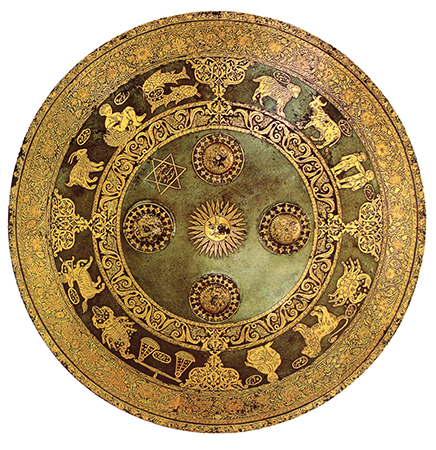
Shield of Akbar, steel with gold damascene
Parrot-headed hilt of sword with steel blade
Jade vessel decorated with gold wire and leaf and rubies
Decorative Islamic art works made their way to the Chinese courts in the period 1796 to 1820, according to Susan Stronge, senior curator in the Asian department of the Victoria and Albert Museum, London. Her talk, the first of the day, was titled "The lapidiary arts in the late Mughal empire.” Displaying pictures of the decorative items amassed by soldier of fortune-cum-commander in chief of British India, Robert Clive, some of which were appropriated from the Mughals, Stronge quoted Clive as saying "God, I stand astonished at my own moderation” — so high was the lure of the decorative arts. The earliest artifacts were made of jade, according to the curator, while semi precious stones like carnelian and agate and even rock crystal became popular in later years. Jewelled book stands, fly whisks and perfume bottles were highly treasured in the zenanas (women’s quarters) of the Mughal courts. As the Mughal court was heading towards disintegration, artisans from Delhi and Agra moved to Faizabad, Lahore and Lucknow which in later years became centers for the decorative arts. Cautioning that art historians are generally swamped with artifacts allegedly made in the Mughal period, she cautioned that "verifiable provenance is essential.”
Approximately 4,000 volumes containing about 6,000 works in Arabic, Persian and Urdu, referred to as the Delhi Collection, are housed in the British Library. The Collection that became part of the India Office Library in 1859 was the subject of Ursula Sims-William’s lecture titled "The imperial library of the Mughals with particular reference to the British Library collections.” Ruing that the Collection contains very few of the more well-known works of the period, the lead curator of the Persian collections of the British Library mentioned that the bulk of the Collection dates from the 18th and early 19th centuries. Most seals on the manuscripts are that of Jehangir, and very few from later periods, with that of Hamida Banu’s, a powerful wife of Humayun’s, appearing once. The curator showed images of a copy of the Shahnameh that carries the seals of Babar, Jehangir, Shah Jahan and Aurangzeb, indicating continuous ownership of the precious volume for nearly two centuries. A few manuscripts had had notations of when they were inspected, for example "Ardibehesht month of so-and-so year.” The collection of books and manuscripts was dispersed when the Persian monarch Nadir Shah sacked Delhi in 1739. Some part of the collection was "sent to Persia, but it was mostly looted or sold.” There was a resurgence of interest in learning in the later Mughal period, but the libraries were again sacked by the British during the Revolt of 1857 where, quoting an eye witness account, she said "the streets were lined with destroyed manuscripts.” What remained made its way to the British Library, said Sims-Williams.
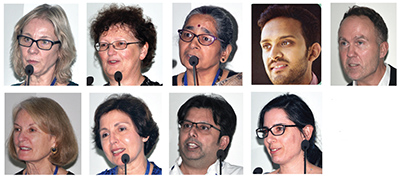
From left, top row: Susan Stronge, Ursula Sims-Williams, Dr Anamika Pathak, Vivek Gupta,
Dr Finbar Barry Flood; second row: Dr Sheila Canby, Dr Gulu Necipoglu-Kafadar, Dr Sunil Sharma, Dr Yael Rice
The National Museum in Delhi houses a "sizeable collection of the decorative arts and artifacts made from various materials” from the Mughal era, according to the next speaker, Dr Anamika Pathak. In her talk titled "Khilt, royal camp, cultural exchanges: splendid decorative art objects of the Mughal period,” the curator of decorative arts and textiles department of the Museum rued that most of the artisans who worked on the objects that characterized the luxurious lifestyles of the rulers were largely anonymous, unlike the painters who were somewhat known. The artisans who worked in the royal karkhanas (workshops) made decorative objects for the emperors as well as for the distribution at khilt ceremonies (festivities to honor courtiers with robes and ornaments). Illustrating the fact that the Mughals "brought the gardens indoors,” Pathak showed a design of a carpet in a floral pattern from the Albert Hall in Jaipur. The speaker displayed images of one prized item from each of the reigns of Akbar, Jehangir, Shah Jahan and Aurangzeb to illustrate that artifacts were most ornate in the reigns of Shah Jahan and most austere during the time of Aurangzeb. During the reign of Aurangzeb, "no gold was put to use in the decorative arts – sword hilts became simpler,” said Pathak.
The "sub-Imperial” city of Burhanpur situated on the north bank of the Tapti river in present-day Madhya Pradesh, 340 km southwest from the state capital of Bhopal was the focus of Vivek Gupta’s talk on "Splendor of the city, Nagarshobha: Objects in motion from Mughal Burhanpur.” The city devolved to the Mughals when Akbar seized it in 1601. Shah Jahan spent a lot of time in Burhanpur and his queen Mumtaz Mahal even died there. Ruing that the city never became famous as the other imperial city, Agra, Gupta informed the audience that Burhanpur "enjoyed a specific prestige in the 17th century (textile) trade,” its products reaching Poland, Bulgaria and Jerusalem. The qanats (tent linings), floor coverings with poppy motifs, and altar cloths from the city were popular with Armenian traders, said the assistant curator for Islamic and South Asian coins for the American Numismatic Society, New York.
Cultural confluences
Dr Finbar Barry Flood, junior professor of humanities, New York University, chaired the afternoon’s working session on the interaction of the Mughals with the contemporaneous Ottoman and Safavid empires, "the only chairperson of the four working sessions who did not present a paper.”
"The art and culture of the Safavids (who ruled Persia between 1501 and 1722) were emulated by other Muslim courts as the epitome of high culture,” according to Ahluwalia. The Ottoman empire established in 1293, which reached its golden age between 1520 and 1566, "the most powerful potentate in the Middle East was known for its encouragement to carpet weaving, tiles and miniature painting,” she comments in the seminar brochure.
The first speaker for the afternoon of January 8, Dr Sheila Canby, curator from the Islamic art department of the Metropolitan Museum of Art, New York, speaking on the topic of "The Shahnama of Shah Tahmasp and its impact on Mughal painting,” said that four Persian artists from Shah Tahmasp’s (r. 1524-76) court joined the kitabkhaneh of Akbar between 1559 and 1566. Illustrating her talk with a picture of Noshirwan (the legendary Persian king) ascending the throne, Canby wondered if it was inspired by actual events. Another image in her presentation depicted an outdoor feast of the kind that is common in the Shahnama.
Drawing parallels and pointing out differences between the Ottomans, the Safavids and the Mughals, Dr Gulru Necipoglu-Kafadar, professor of Islamic art at Harvard University talked about "Transregional connections: architecture and the construction of early modern Islamic empires.” Both the Mughal and Ottoman courts were Turkish-speaking and Arabic was the official language. In both, the power was highly centralized with the throne, and religion controlled by the state. The Ottomans built huge complexes with mosques at the center — the Mughals did not; the Persian Safavids preferred to have a complex with a shrine at the center, she said, referring to the Imam Reza Shrine in Mashad, Iran. Both the Safavids and Mughals distanced themselves from their earlier capitals with the construction of new cities (Isfahan in Persia and Shahjehanabad in India); the Ottoman capital rose from the ruins of Constantinople, she said, but the Safavid and Mughal capitals were the dreams of individuals (Shah Abbas and Shah Jahan, respectively). The professor concluded her talk by saying that all three empires considered themselves superior to their medieval predecessors – "all had a deep sense of pride in their architectural heritage.”
The Hindu mythological romance of Nala and Damyanti from The Mahabharat was but one example of "Indian (Hindu) romances that fascinated Mughal India,” according to Dr Sunil Sharma, professor of Persianate and Indian literature at Boston University. The scholar was speaking on "The Indian woman in a Persianate world: comparisons across Mughal, Safavid and Ottoman literary and visual cultures.” Interpretations of the love tale by Abu al-Faiz, Akbar’s poet laureate found favor with generations of Mughals who "permitted” such depiction to show religious tolerance. Showing an image from Safavid times, Sharma said that it was not clear whether the artist was trying to depict the Persian festival of sadeh or sati, the self-immolation of a Hindu widow. What was clear, he said was that "the heroine of the picture represented India — recently subjugated in the Battle of Kandahar.” While in the Ottoman world, Indian women do not feature heavily, ("none would want to lie with them,” he recited from an inscription in a picture) the professor believed that the large number of paintings of Indian women emerging from the Safavid salons was on account of the "growing conservativism” in the Persia of those times.
According to Dr Yael Rice, assistant professor of the history of art and Asian languages and civilizations, Amherst College, Massachusetts, Mughal relations with the Ottomans have not been studied with the same depth as those with the Safavids. Displaying a picture from Jehangir’s atelier that showed the emperor in the same frame as Shah Abbas of Persia titled "Dream of Jehangir,” she explained that this depicted the aspirations of that Mughal emperor. In her lecture on "Rum (Rumi) on the horizon: the spectre of Ottoman sovereignty in Mughal court paintings and manuscript production,” she said that the "Ottomans loomed large in the Mughal imperial psyche.” She based this observation on the many generic references to the Ottomans in the Akbarnama. The Ain-e-Akbari acknowledges that the Turks were ahead of their Delhi counterparts in gun-power and that their navy was superior to that of the Delhi emperors. "Cultural and political competition may have even provided the impetus for each court to produce highly illustrated manuscripts and albums,” she suggests in the abstract of her paper.
The two-day seminar ended with a vote of thanks by Dr Nawaz Mody, joint honorary secretary of the Institute.