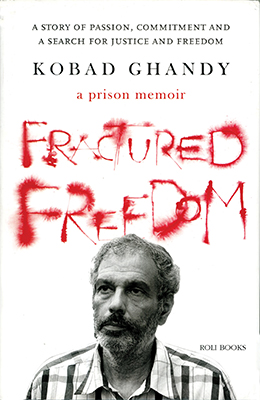
Fractured Freedom: a prison memoir. Published in 2021 by The Lotus Collection, an imprint of Roli Books Pvt. Ltd., M-75, Greater Kailash II Market, New Delhi 110048; email: info@rolibooks.com; website: www.rolibooks.com. Pp: xiv + 294. Price: Rs 595.
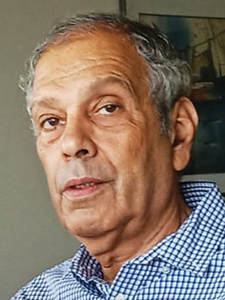
Kobad Ghandy’s (pictured) memoir, Fractured Freedom describes a 10-year-long journey as an undertrial prisoner, as he makes his way through seven jails in five states. The prison memoir begins on September 17, 2009, a day like any other. Ghandy has
come to Delhi hopeful of having his many medical problems attended to: prostrate (sic), orthopedic and hypertension. What follows is a scene worthy of a Bollywood film. Ghandy, 62 years old, who had just bought some computer supplies, is brutally assaulted, flung to the ground and then abducted. The only charge against him was that he was a member of the banned Communist Party of India (Maoist); it was the media which went overboard suggesting he was one of their top leaders.
What compelled an upper middle class Parsi to abandon a life of luxury to champion the cause of the underprivileged and to enmesh himself in the Communist and Naxalite movement? The seeds of this can be traced to 1972 when Ghandy was a student in London studying to become a chartered accountant. While conducting a corner meeting in a working class area in London, he and his friends were assaulted by skinheads. He was arrested and, in spite of being innocent of the violence, the judge unfairly sentenced him to three months’ hard labor. This was not his first encounter with racism; he had witnessed this at the Young Men’s Christian Association premises at Warren Street where he was lodging as well as during the performance of his audits. At this time, the atmosphere in London was seething with demonstrations against the Vietnam War and Ghandy sought answers to the injustices in society by reading extensively on racism and India’s colonial legacy at the British Museum Library.
Hence, it is no surprise that Ghandy presents a scathing attack on the British rule in India. He mentions the cutting off of the thumbs of weavers, a fact that has been oft repeated though I am not sure as to the historical veracity of the same. Ghandy holds Sir Winston Churchill entirely responsible for diverting food from the starving Indians to British soldiers "at the height of the Bengal Famine which took four million lives in 1943.” But, once again, some historians feel that part of the blame could also be attributed to speculation by Indian traders and mismanagement by the Bengal provincial government.
Ghandy presents a lively account of his happy years as a student in Doon School and a life of comfort and luxury in Bombay, ferried to St Mary’s School in his parents’ car and swimming at the Willingdon Club. His meeting with Anuradha Shanbag, the love of his life, is sensitively described and their relationship is further cemented by their mutual passion for social causes. Kobad portrays Anuradha, who later became his wife, as a person full of warmth, feeling and simplicity totally committed to the cause of social upliftment and her profession as a teacher without any self-interest or thought of career progression.
Kobad finds it impossible to stand aside and remain silent when, on his return to India, he is forced to witness, in the very heart of Bombay, "sprawling slums with absolutely no infrastructure or facilities like water or electricity, let alone proper latrines,” excruciating poverty, the inhuman treatment of Adivasis and Dalits and the non-existent system of healthcare. He firmly believes in the words of scientist Albert Einstein whom he quotes: "The world will not be destroyed by those who do evil, but those who watch without doing anything.” Close to the elite area of Worli Seaface where Kobad lived was Mayanagar, a slum where the inhabitants were deprived of basic facilities and forced to buy water. Kobad organized the youth and campaigned against the slum’s mafia dons. It is a pleasant surprise that, thanks to the spark he lit and the efforts of the slum development committee, Mayanagar has since been replaced by apartment blocks with toilets and running water whereas Premnagar, a neighboring slum, languishes with no improvements.
After several successful endeavors to unite the laborers, Anuradha and Kobad relocated to Nagpur in 1982 — a city at the heart of the Dalit movement. They made downtrodden individuals aware of their rights and organized them to fight for better working conditions and higher wages, especially in the Vidarbha region which is an important coal mining district, taking a special interest in the Dalit movement and writing several articles to improve their lot. Similar movements were started successfully in Andhra Pradesh and Jharkhand. This finally took a toll on Anuradha’s health and she expired due to falciparum malaria on April 12, 2008, which Kobad terms as "the worst night of his life.” His relationship with Anuradha, "her qualities and her commitment to the oppressed, as well as the love that blossomed between us” was the most important aspect of his life.
The author maintains that in none of his activities, which were in the service of the underserved, were his actions illegal. He is very critical of the police and the government which twist the legal system to their own benefit and allow criminals to fleece the country of several thousand crores of rupees but "imprison sincere activists working for the poor.”
It is the second section of the book which is the most interesting as Kobad recounts his decade-long imprisonment. Before entering Tihar he was stripped and searched and all his personal effects were taken from him. "There was an insistence on recording one’s ‘caste’ (and) removal of footwear before entering an officer’s room ‘like in a mandir.’” One is made aware of the conditions in Indian prisons, the frequent and inhuman transfers from one prison to another and particularly the lack of any facilities — even hospitalization for prisoners like him who were suffering from multiple health issues.
But he presents a very balanced view of life in the prison. If some of the staff were cruel and vicious, the Tamilian staff was more sympathetic and friendly. He is welcomed by Afzal Guru, a Kashmiri separatist, imprisoned for his role in the 2001 attack on the Indian Parliament. Kobad describes his relationship with Guru in a vivid and sympathetic manner. Through their friendship and discussions, he learnt about the Kashmir situation, the more progressive aspects of Islam and Sufi philosophy. In Guru, Kobad presents a brave man who walks to the gallows boldly and without fear, showing concern for the staff till the very end by requesting the officers to take care of them. Kobad never loses his wry sense of humor and presents a very human and sympathetic picture of the inmates: "many were actually afraid of ghosts and djinns and did not wish to sleep alone at night.”
What is remarkable is that despite the long and unjust incarceration, his poor health and the general conditions of prison life, Ghandy often sees the brighter side. There is a librarian, a good Samaritan, who provided him with books. He is shown kindness by other prisoners in unexpected ways: Chadda Bhushanam, an educated tribal had clothes stitched for him and ordered Ayurvedic nutritional supplements; Ganesh, a Naxalite, postponed his departure with the sole motive of settling Kobad in; Sikh leaders offered their "system of phoning” in Hazaribad Central Jail where even the superintendent and the doctor were very kind. If he meets fanatical Muslims and Khalistanis who try to convert him to their way of thinking, he also meets several other interesting prisoners as well: Sanjay Chandra of Unitech, an accused in the 2G scam, the directors of Reliance and Sudheendra Kulkarni who was an aide to former Prime Minister Atal Behari Vajpayee, to name a few. He meets several dons: Kishan Pehlwan, who had committed several murders, Fazlu Rehman, who was employed by Bollywood actress Shilpa Shetty to recover her dues, and Brijesh Singh, worth thousands of crores, imprisoned for taking revenge for his father’s killing.
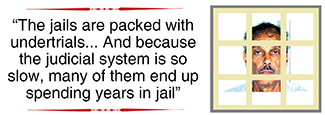
Kobad is very critical of the justice system where "the jails are packed with undertrials more than convicts; people imprisoned even before they have been proven guilty. And because the judicial system is so slow, many of them end up spending years in jail.” Though he is censorious of lawyers who would cheat their clients, the prisoners, by deliberately delaying cases as a means of extorting extra fees from them, he is very appreciative of his own lawyers, especially Rebecca John and her team, who worked pro bono and tirelessly in his defence. Patiala’s senior most advocate, Brajendra Singh Sodhi argued his case and refused to take any money. Several judges also are praised: Justice P. K. Jain who allowed Kobad to have his cataract operation at the All India Institute of Medical Sciences and was even kind enough to remember and inquire about the operation; Justice Reetesh Singh who would notice Ghandy’s poor state of health and never failed to ask how he was.
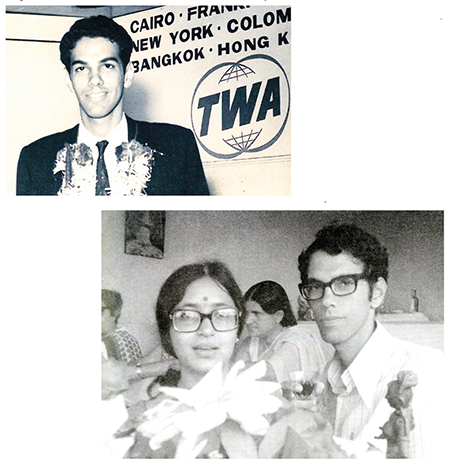
Top: Kobad Ghandy; center: at his departure for the UK; right: with wife Anuradha
In the final section the author debates whether communism would succeed in solving the problems of society. He vehemently disapproves of the present system which is "untenable and getting more and more unjust; more and more inhuman; more and more unequal; more and more destructive of everything; with the political class becoming increasingly uncouth, vile, uncivilized and fascistic worldwide.” He is saddened that communism has almost disappeared in the world today but he is confident that "no other economic system has appeared that is more just and sustainable than the communist project.” He has no doubt that, like the phoenix, communism will rise from its own ashes provided certain steps are taken to reinvent the concept in a new environment of freedom and with a fresh set of values; most of all its aim should be universal happiness.
What makes Fractured Freedom remarkable is not Kobad’s perceptive and comprehensive view of his prison life; what is exceptional is that after all the trials he has suffered, he can write about his experience in a positive and balanced manner, without bitterness, giving credit to several individuals who helped him through this dark period. In fact, it is this very attitude to life which must have come to his rescue during the 10 years of imprisonment.
FIRDAUS GANDAVIA
Gandavia holds a doctorate in English literature and is a retired chartered accountant. He is a compulsive reader of fiction.