A kind and gentle mentor not only to patients but also to his students,
Dr Noshir Wadia was fondly remembered on his birth centenary
Dr Pilloo Hakim
"Dr Wadia never ever tired of work
Built up his department with zeal and did not shirk casework
Wrote books, published papers, did his best
But, patients always came first, above the rest.”
After his training and work experience as a registrar at a London hospital, the first Asian to have held this position, when Dr Noshir Wadia returned to Bombay in 1957, he joined his alma mater as honorary consultant neurologist and succeeded in establishing a separate department of neurology. I was fortunate to be his first resident. He ingrained in his residents the importance of obtaining a thorough history from the patient, followed by a detailed examination and a tentative diagnosis for every case. Meticulous records were kept. The department grew and earned a formidable reputation mainly due to the time he devoted to it.
There was an electromyography (EMG) machine in the plastic surgery department at the J. J. Hospital. When Dr Piroja Irani was appointed as honorary physician, the EMG machine was used to expand the scope of diagnosis. Irani abandoned her plan of completing her MRCP (Membership of the Royal College of Physicians) in pediatrics and became a part of Wadia’s life.
The pioneer was in the forefront of developing neurology in the private medical sector when he joined the Jaslok Hospital as a consultant in 1973. He had an inquiring mind and used every opportunity available from the volume and variety of cases he saw daily at the public J. J. Hospital to seek the cause and effect of various neurological problems (diseases) from patients who came to him for treatment. Among these were manganese poisoning in miners, myelopathy (spinal cord injury) associated with congenital axial dislocation (abnormal positioning of neck vertebrae), tubercular, spinal meningitis and Wilson’s disease (causing copper build up in the body). His seminal contribution was identifying the site and cause of an autosomal dominant cerebellar ataxia (a genetically inherited condition that causes deterioration of the nervous system) with slow eye movement. His work was published in prestigious international journals. He wrote a book on neurological practice from the Indian perspective, the second edition of which was released by the current World Foundation of Neurology president Prof Raad Shakir in 2014, two years before Noshir’s demise at 91 years of age.
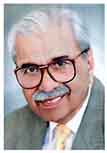
Dr Noshir Wadia: seminal contribution
A recipient of many awards, he was bestowed the Indian National Science Award and the S. S. Bhatnagar Medal for excellence in General Science, the Dhanvantari and Padma Bhushan. He accepted the awards graciously, but what was more meaningful and satisfying for him was the gratitude of his patients.
Noshir was a kind and gentle mentor not only to his patients but also to his students. He gave freely of his knowledge and his time, providing encouragement to help them to establish their careers and hoping that they would pass on these principles to the next generation. To this day, I thank him for my diagnostic abilities as I look at his photograph on my table at the clinic, reminding me of the nobility of our profession.
Centennial commemoration
To mark his 100th birth anniversary a commemorative program was organized at the J. J. Hospital auditorium on January 18, 2025.
Prof Tandon from the All India Institute of Medical Sciences, New Delhi was the first to join online, followed by Dr Arjan Das from Madras, both of whom had been associated with Noshir. They spoke of his academic credentials, humility and desire to share his knowledge with colleagues. Dr Shorji Tsuji from Tokyo expounded on how Noshir had coordinated with him, giving him full credit for their work on spinocerebellar ataxia and its relationship with conjunctivitis.
Dr Bhimsen Singhal, who had been Noshir’s registrar and then assistant honorary in his unit, working with him for several years, spoke about their close and warm relationship, and the first series of cerebral angiography done in cases of TB (tuberculosis) meningitis which showed narrowing of the vessels and the presence of exudate (fluid that leaks out of blood vessels into nearby tissues).
Dr Shrinivas Desai spoke about the close relationship which he shared with Noshir when working with cases of atlantoaxial dislocation (misalignment of first and second vertebrae in the neck) which are closely related to skeletal muscle neuropathy and how, following an early diagnosis, treatment would be initiated and further ingress of the disease reduced.
Thereafter Dr Farokh Udwadia, a doyen in the medical field, alluded to the good training Noshir had received from Lord Russell Brain at London’s Maida Vale Hospital. His careful, initial clinical evaluation and accurate diagnosis would be confirmed with relevant tests.
Dr Sarosh Katrak, who had worked from his initial training phase with Noshir, and thereafter as assistant honorary for several years at both J. J. and Jaslok Hospitals, gave a detailed account of the early stages and difficulties in documenting eye movements, and how Noshir made him seize an opportunity to send the brain of one such patient for post mortem by Dr Dorab Dastoor, neuro pathologist, for careful and accurate documentation of the findings.
Brief messages were also sent by Prof Shakir from UK, who had worked with Noshir for some of his pioneering work, and Wolfgang Grisold, president of the World Federation of Neurology (WFN), who bestowed on Noshir the WFN medal, a rare honor indeed.
Drs Noshir and Piroja Wadia
Dr Noshir Wadia receiving Padma Bhushan from then President of India Pratibha Patil
Dr Peter Mishra from London mentioned how he had always admired Noshir which had motivated him to take up neurology. He was constantly amazed by his idol’s scientific approach, enthusiasm and passion for work.
Dr Kailas Bhatia from The Institute of Neurology, London and Dr Katpal from Indore praised him for his integrity, kindness both with patients and students, his positivity and his ready help to all those who needed him.
The last tribute was by Piroja, his colleague and his college sweetheart, whom he later married. Noshir’s rare qualities of kindness and patience were extended to both his family and his patients to whom he devoted ample time. He also believed in the goodness of individuals. Piroja said: "In fact I always used to tease him that God had made special rose colored glasses for N. H. Wadia which he put on his nose first thing in the morning and took off last thing at night.” Piroja said that this warmth and softness were evident since childhood.
Born in Surat, India on January 20, 1925 to Hormusji and Dinamai, Noshir was the fourth of five siblings. From childhood, he yearned to become a doctor. He joined St Xavier’s School and, as he himself stated, though not brilliant, by dint of hard work he went to St Xavier’s College and then realized his dream of entering the Grant Medical College and the J. J. Group of Hospitals to join the medical profession. He obtained his MD (doctor of medicine) with flying colors, went to the UK, and was successful in completing his MRCP at the first attempt in 1952. Neurology became his passion, his initial training being with G. F. Rowbottom in Newcastle, and subsequently between 1952 and ’54 under legendary neurologist, Brain.
Piroja also referred to an incident in 1961 when returning from a conference in Argentina, by a quirk of fate Noshir happened to be in Lisbon. In retaliation for the Indian annexation of Goa that year, he was imprisioned and held hostage for two months by the Portuguese. When he was released and landed in Bombay all the resident doctors flocked to the airport with the Grant Medical College (GMC) flag to welcome him. Seeing the skull and crossbones on the flag, his sister-in-law threw a garland over it to ward off the evil eye.
Noshir was happiest in the corridors of the J. J. Hospital among the sick and the poor, surrounded by his students. He is survived by his wife Piroja and stepson Kaikushroo.
With inputs from Drs Piroja Wadia, Sarosh Katrak, Bhimsen Singhal and Pettarusp Wadia.
Ode to Dr Wadia
Dr Noshir Wadia, for none other is he
Than the Father of Indian Neurology
Many syndromes has he documented to date
Then worked hard to find their cause and their fate
To do the best for his patients was always his aim
He taught us, his students, the rules of the game.
Neurology and neurosurgery were in their infancy then
No MRIs to guide us, nor even CT scans
Good history taking is what Dr Wadia stressed
To make a tentative diagnosis it is still indeed the best
The hours of documentation, I’ll never forget
When as his houseperson I had no time to rest
Lucky was I to have had that opportunity
For till today it guides my diagnostic ability.
Many awards he received, and with them fame
But humble he remained, they were only a name.
Dhanvantari among others, and Padma Bhushan too
Sir, we will always be truly proud of you.
Though he loved his work, it was indeed not his whole life
For Piroja, whom he always cherished, became his wife.
Difficult to believe how the years have flown
Your students too have certainly grown
The values you taught them will always remain
To pass on to others, down memory lane.
Extracts from a poem penned by Dr Pilloo Hakim on Wadia’s 90th birthday celebration