The installation of solar panels at Masina Hospital will ensure
uninterrupted power supply, monetary saving and sustainable energy
Masina Hospital (MH) has joined the growing list of elite environmentally friendly, healthcare facilities by installing solar panels at their Byculla premises. "We have the potential to do much more,” stated Dr Vispi Jokhi, the Hospital’s chief executive officer addressing a small gathering of donor representatives, well-wishers, those involved with the solar project, executives and staff of the 121-year-old, 270-bed, cosmopolitan charitable institution on February 18, 2023.
The occasion was the inauguration of the solar system by Firoze Bhathena, a director of the Shapoorji Pallonji Group (SPG) and Zarine Commisariat, the group’s corporate social responsibility (CSR) head. SPG donated the amount to install the 51.87 kilowatts per hour system comprising 140 solar modules installed atop the Moos Memorial Centre and Kharas Memorial Centre buildings on the eight-acre Hospital complex. [In March 2022 SPG had financed a 14-bed renal dialysis center (see "Masina’s high-end services,” Parsiana, March 21- April 6, 2022)]. Shapoor Mistry is the chairman of SPG and also of MH. His grandfather, Shapoorji was also a trustee of Masina.
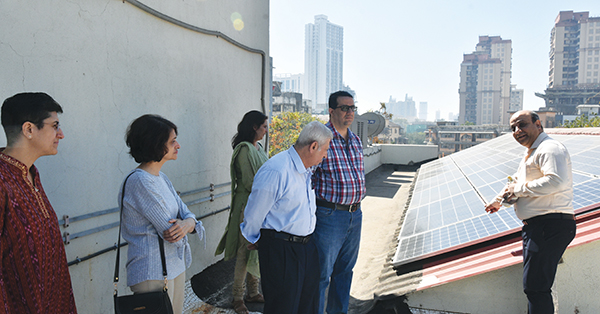
Burgis Bulsara explaining the working of the solar panels
L-r: Kitayun Rustom, Dr Vispi Jokhi, Zubin Jasoomani, Burgis Bulsara,
Dr Rashneh Pardiwala, Zarine Commissariat and Firoze Bhathena
"This system is expected to generate 72,618 units of electricity in the first year and is projected to generate 16,61,078 units over 25 years,” notes a write up on the project by the Centre for Environmental Research and Education (CERE) that collaborated with SPG and partnered with Avesta Solar to install the system. MH will save "approximately Rs 6,53,000 (USD 7,907) in electricity costs annually while offsetting” approximately 58.09 metric tons of carbon dioxide in a year. The fifth generation Canadian solar panels have a life of 25 years provided they are well maintained and kept clean. The system should result in a total saving of Rs 1.49 crores (USD 180,408) over the next two-and-a-half decades, at today’s rate per unit, states the write-up. That savings will be channeled towards providing better health care to patients, said Jokhi.
"Very few hospitals in Bombay run on solar power,” said Dr Rashneh Pardiwala, co-founder and trustee of the 20-year-old CERE (see "Greening the environment,” pg 122). "We are extremely grateful to SPG,” for supporting our ventures. "We always reach out to Zarine who says let me check with Mr Bhathena.” Pardiwala recalled that the biodiversity park in Raigad district established in 2016 was funded by SPG (see "Ecological Eden,” Parsiana, October 21, 2016). "So many students come to study,” said Pardiwala who holds a doctorate in environmental management from Edinburgh University. "They don’t know that bamboo is a type of grass.”
Addressing the gathering Bhathena modestly said he was only the medium for channelling the donations. "The credit goes to somebody else,” the Pallonji family.
CERE co-founder and trustee Kitayun (Katy) Rustom said she had been born in MH. "The hospital kept a room on the mezzanine floor locked for my grandmother and her two sisters. All their deliveries, surgeries and subsequently their childrens’ deliveries, surgeries, etc took place here...and the room was opened only for our family. My grandmother had 12 kids, her sisters had six each.”
Burgis Bulsara, a director of Avesta Solar, explained to the guests who accompanied him to the roof of the Kharas building how the system worked and that the excess power generated by the panels was fed back to the electricity grid for which the Hospital was monetarily compensated. During the monsoons "the overall average generation of power drops by 50-60% depending on the site location/monsoon pattern/cloud conditions,” he noted. "The solar panels initially degrade by two to three percent in the first year and then 0.7% each year from second year onwards.” The panels have a 25-year warranty. In the summer months average generation starts early in the day, before 8 a.m., Bulsara noted.
Pardiwala stressed the importance of keeping the surface of the panels clean as dust could hamper the absorption of the sun’s rays. Bird droppings have to be wiped off expeditiously as the acid in the feces could corrode the panel’s sensitive cells.
Jokhi mentioned to Parsiana that after segregating and treating the Hospital waste, it is used to generate gas for cooking in the Hospital’s kitchen.
Researchers state that due to healthcare facilities usually being large energy consumers, "they are typically major emitters of greenhouse gas emissions,” as noted an article in the British newspaper, The Guardian of October 13, 2022, titled "Inside America’s groundbreaking solar powered health facility.” Citing power outages and uncertain weather conditions, a 2021 report issued by the California Hospital Building Safety Board pointed out that "solar power was fast becoming essential for healthcare ‘sustainability and resilience’ as climate change increasingly threatens traditional energy sources.” When power failed and a diesel generator designed as a backup did not function, Santa Clara Valley Medical Center in San Jose, California had to cancel surgeries and direct ambulances with emergency cases to other facilities.
In Bombay, The B. D. Petit Parsee General Hospital (PGH) has been using solar heated geysers "for many years,” Lt Gen (Dr) Manomoy Ganguly (retd), PGH’s chief executive officer texted Parsiana on March 2, 2023 in response to our query regarding installation of solar panels. In 2019-2020 they contracted Sterling and Wilson "to install solar panels (to generate electricity) on top of our kitchen building and nurses’ quarters.”
The Dr R. N. Cooper Hospital in Vile Parle and the Kohinoor Hospital in Kurla have installed sustainable energy equipment. Wri-india.org in March 2022 wrote about a hospital in remote Jharkhand that turned to solar power to improve services for patients. "Till as recently as 2017, nurses in the labor room had to use halogen lights for phototherapy,” the superintendent of Premjyoti Hospital, Dr Benedict Joshua is quoted as saying. "We did not have a reliable power source to run the baby warmer.”
Harnessing the rays of the sun then makes life more secure for those confined to healthcare units.