Dinshaw Avari is the third generation from the
family to head the Karachi Parsi Anjuman Trust Fund
Parinaz Gandhi
"In community matters, all views must be considered and then decided jointly. It has to be by consensus as we are all working for the community and not our own business. In my own business I can give a direction unilaterally if required,” believes Dinshaw Avari, the newly elected chairman of the Karachi Parsi Anjuman Trust Fund (KPATF).
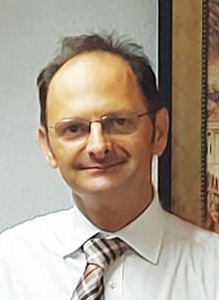
He was unanimously elected as KPATF trustee in March 2023 following the demise in January of his father Byram who was chairman for nearly 35 years. In an email interview with Parsiana, Dinshaw stated, "I have never been a trustee but I used to be involved informally from time to time to help my late father Byram.” His co-trustees include Soli Parekh, Furengeez Tampal, Ardeshir Marker, Khursheed Kotwal, Homi Khambatta (honorary secretary), Pouruchisty Sidhwa (honorary treasurer) with Minoo Bhadha as Anjuman manager. "All the current trustees have been occupying their seats for several years so I must defer to their experience and knowledge in community matters,” acknowledges the 55-year-old chairman, the youngest on the board. On an average the trustees meet twice a month.
"The issues the Anjuman is facing today are very different from the time when my late grandfather Dinshaw Avari, after whom I was named, was chairman. At that time there were around 8,000 plus Parsis. Today there are, in my estimation, nearly 800. We are not a declining population, we are a dying population! What we do as a trust board will be aimed at these demographics,” emphasized the current chairman knowing their decisions "will affect the Parsis of Karachi in the coming years.”
Dinshaw shared with Parsiana the findings of the survey undertaken by the Karachi Zarthosti Banu Mandal (KZBM) in 2022, according to which Parsis in Pakistan number approximately 1,060. This includes 11 non-Zoroastrian spouses and 38 youngsters studying abroad. Another 32 Parsis are shown as residing outside Karachi (anjumans in Quetta, Rawalpindi and Lahore are yet functioning). Hence, according to the survey, 979 Parsis remain in Karachi, of whom 40% are believed to be aged over 65.
Among the issues that the trustees will decide is an insurance scheme for all community members. In Byram’s time, the Parsi Clinic had been started to cater to the aging population. "Now we have to not only take this facility forward but enhance it along with other facilities for our aging community,” states Dinshaw. Presently the Arman Home as a not-for-profit old persons’ residential facility at the Dinshaw B. Avari Colony is run by the KZBM. In the next decade this Home could be expanded to cater to the increasing aging and single population of Parsis, recommends Dinshaw. "Aging mobeds and nassessalars are a major concern,” more so when it is difficult to find replacements. "Elevator access for the elderly at Parsi colonies” will also need to be kept in mind.
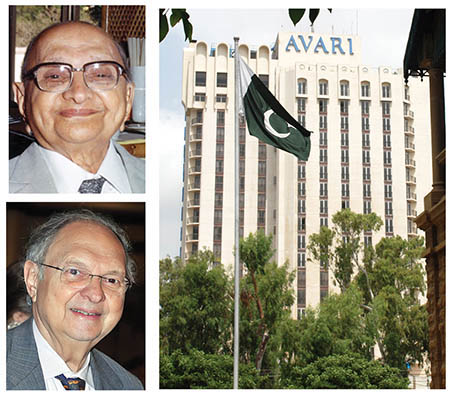
Top: Dinshaw Avari; Dinshaw Sr (above) and Byram Avari; Avari Towers
Assistance will be rendered to Parsis who choose to migrate. With community numbers rapidly declining in Karachi, the trustees will have to decide on how best to "protect community assets, rationalize the Trust properties and use the proceeds for community welfare… To directly understand the concerns of residents and to explain the trustees’ views, town hall meetings should be restarted,” recommends Dinshaw. "With declining numbers, there is a surplus of housing. The problem that arises for the Trust is the maintenance and upkeep of these old structures, even though there is no one living inside. We have to nevertheless spend money to preserve and maintain them, which in itself is a drain on the resources. The colony flats are all on tenancy contracts.”
Already staring at the KPATF trustees are major issues like property tax; waterproofing of roofs at the Jamshed Baugh Colony; replacement of solar lights and renovations to the guards’ quarters at Avari Colony; replacement of water and sewerage pipes; pye dog menace; welfare of mobeds and nassessalars… Besides the Doongerwadi property, also owned and maintained by the KPATF are the Dossabhoy Wadia Dar-e-Mehr and three residential buildings — Khajurina Building, Kothari Building and Anjuman Building — located in the agiary complex.
Anjuman additions
"My grandfather’s greatest contribution was protecting our Doongerwadi from illegal encroachments by initiating a housing colony (Avari Colony) around the southern perimeter. The northern part of Doongerwadi was already protected by the Cyrus Minwalla Colony,” related Dinshaw. During the senior Dinshaw’s time, the dakhmas were cleaned with help from Bombay nassessalars and the bones placed in an astodan nearby, recalled the grandson.
Among Byram’s manifold initiatives for the KPATF, Dinshaw named the Parsi Clinic first. It was started in 2015 on a ground floor flat at Anjuman Bagh to offer free consultation, medicines, laboratory tests, radiology, surgery, ophthalmic treatment, hospitalization and orthodontics for children. "This proved to be most successful in looking after Parsis during the Covid-19 pandemic,” observed Dinshaw.
Last year, under Byram’s stewardship, the KPATF got an electronic lifter installed at the Doongerwadi to aid the senior nassessalars. By changing the geographic entrance of Doongerwadi to a safer part, security at the Avari and Minwalla colonies was enhanced. Two years ago the Dossabhoy Wadia Dar-e-Mehr was reconstructed when a section of the roof collapsed. Innumerable Parsi families migrating to Canada acknowledge the support extended by Byram to help them settle and be self-sufficient.
Community organizations like the KZBM, Hommie and Jamshed Nusserwanji Mehta Trust, Feroze and Shernaz Bhandara Charitable Trust, Noshirwan Naman Trust, to name a few, "are all working towards one objective — taking care of Parsis.” From the interest on investments made by these trusts, the community’s medical, educational and food needs are met. The costs of hospitalization, medicines, tests, etc for all Parsi Covid cases were borne by the KPATF and the other trusts, stated Dinshaw.
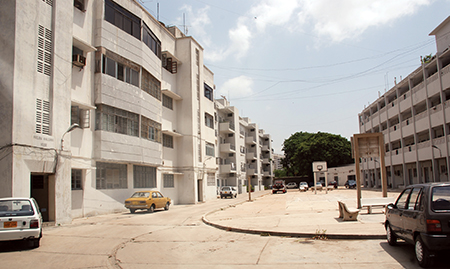
Residential buildings owned and maintained by the Karachi Anjuman
Dakhma in Karachi and electronic lifter to aid nassessalars
Hurdles for hotels
At the Avari Group hotels where Dinshaw has been serving as executive director for the last 33 years, the family ensured that even though the "hotels’ revenues were garroted” during the pandemic, their employees did not suffer. That was the time when social distancing regulations and suspension of flights resulted in the hotels’ restaurants, banquet rooms, meeting facilities, swimming pools and gymnasiums lying idle for want of guests. "We temporarily closed down five of our eight properties, and we had, on average, only seven percent occupancy in our three (functional) hotels, yet our family never asked any staff member to leave… Every single person continued to receive his/her contracted amount,” reported Dinshaw who looks after human relations (HR), security, general administration, revenue management and marketing at the Avari Group. His younger brother Xerxes, also an executive director, is in charge of overall policy direction, finance and taxes, new projects and renovation.
Knowing that there is no concept of unemployment insurance in Pakistan, the Avari family felt compelled to take a loan of Rs 700 million to pay the salaries of the staff, "a liability we are still paying down!” Even small, independent contractors like musicians, etc were paid their monthly stipend although their services were not being used. Further, rent payments from small shops within their hotel premises were waived.
The floods in Pakistan last year, described by Wikipedia as "the deadliest since 2010” with 10-12% of the country being under water, "did not impact the hotel industry as negatively as Covid did,” mentioned Dinshaw. Although the floods were devastating for life and property in the rural areas, the hotels in the urban areas only faced a disruption in the supply chain.
Neither has the devaluation of the rupee (which has fallen over Rs 100 in the last two years, currently 1 USD = PKR 285) directly affected any hotels in Pakistan for "once hotels start operations, then 80% of their costs are local-based and not foreign exchange based. What did affect hotels however was an increase of over 50% in electricity and petrol costs as the effect of devaluation made the utility companies pass on their cost increases directly to us.” Thus the secondary effects of devaluation resulted in an increase in transportation and raw material costs.
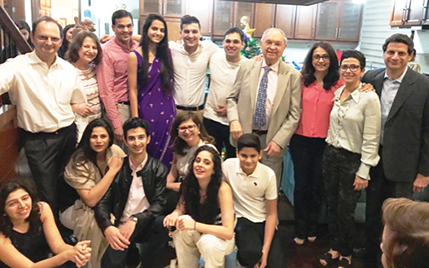
Three generations of Avaris with Dinshaw, Goshpi, Dinshaw Jr,
Byram, Dinaz, Xerxes (standing 1st, 2nd, 6th, 7th, 9th, 10th from l) and
Fareezeh, Byram Jr, Zeena (sitting 1st, 3rd, 4th from l)
Dinshaw (l) and Xerxes as children with Ludwig
Joint decisions
When Dinshaw joined the Avari Group in 1990 he had completed his Bachelor of Law from the S. M. Law College in Karachi and soon thereafter earned his Master of Business Administration from the University of Karachi. Subsequently he has continued to update his knowledge and even five years ago was attending courses, whether at the Curtin University, Australia to earn a certificate in Introduction to the Internet of Things, at the Cornell University, USA to take courses in Hotel Real Estate Investments and Asset Management and another in Marketing Strategy, at the Karachi School of Business and Leadership to study Financial Acumen for Non-Financial Executives.
Since the last two years, the fourth generation of Avaris has also joined the family business. Dinshaw’s 25-year-old son, Byram Jr looks after HR with the father and the operations of the Group’s four star hotels Avari Xpress Gilgit and Avari Xpress Islamabad. Xerxes’s 28-year-old son Dinshaw Jr looks after marketing and the operations of our Avari Xpress hotels in Multan and Faisalabad; and the Avari Boutique hotel in Multan.” Policy decisions are jointly taken by the four of them.
With sailing in his blood, his parents Goshpi and Byram having won a gold medal in sailing at the Asian Games in 1982, Dinshaw enjoyed participating in yachting events and served as office bearer of the Karachi Yacht Club until 2011.
Presently Dinshaw devotes the first half of the day to community matters. Besides taking an active interest in the Anjuman, he is trustee of the Mobed Welfare Trust and since 1990 has been honorary secretary of the Young Mazdayasnian Zoroastrian Association. His new appointments include being a Justice of Peace since March this year. The latter half of the day is spent on affairs concerning the Avari Group from his office in their flagship Beach Luxury Hotel.
He firmly advocates, "It is not for anjumans and individuals to dictate religious policies and practices. We are custodians of the assets of the community; how does that in any way make us competent to pass religious decisions? Religion should be left to our mobeds and athornans. They should be giving the global Parsi community a unified direction. Being an ‘enlightened’ community doesn’t mean we each can interpret the religion individually. Unfortunately, we lack the unified voice from our priestly class.”
To his wife Dinaz and him, prayers are very important. "Even though I do not know the reasons for the rituals and customs connected with the prayers, I follow them. I don’t know the meaning of the prayers; I don’t know why we do what we are supposed to do; however, it was prescribed, hence I do it. What I do get is a lot of peace after my prayers when said sincerely,” acknowledged Dinshaw.
Having opted to remain in Karachi unlike many from his generation who preferred to settle overseas, Dinshaw mentioned, "We were given the choice by our parents but we chose not to.” He is happy that Byram Jr too opted to return to Karachi as will his daughter Fareezeh who is in Toronto currently to gain experience in social work. His nieces and nephews (children of Xerxes as also his sister Zeena Behram Aga) who are not studying overseas are also in Karachi.
Recalling the words of his grandfather who would say, "We are who we are because of Pakistan,” Dinshaw confirmed, "Due to the hard work and sacrifice of our grandparents and parents, we have a comfortable life here (not everyone does) and we are respected as a community and a family.”