Maestro Zubin Mehta was in India recently to receive the Tagore Award, conduct a controversial concert in Kashmir and entrance Bombay audiences with his panache
Sherene Vakil
In felicitating Zubin Mehta with the Tagore Award, we are not only honoring a distinguished son of India, but we are recognizing his untiring efforts, over the decades, to convert music into an instrument of peace and harmony,” noted President of India Pranab Mukherjee on September 6, 2013 while presenting the Tagore Award for Cultural Harmony to the 77-year-old internationally acclaimed music conductor in New Delhi. "He has made it his mission to bring hope and reason wherever there is conflict and discord. To audiences across the world, Zubin Mehta has brought a message of optimism and conviction about the shared destiny of humankind. His name is synonymous with amity and faith,” Mukherjee added.
"I accept this award in utter humility; in the end I am just a simple musician,” Mehta responded in his acceptance speech. "His (Tagore’s) aura has always been with us. Indians are proud of his legacy,” the honoree acknowledged. He informed those present that though he had been away from India for six decades, he had given up neither his nationalism nor his love for Indian food, reported The Hindu on September 7, 2013. Expressing unhappiness over the fact that Mahatma Gandhi was never awarded the Nobel Peace Prize, he mentioned: "I wish they would consider giving it to him (posthumously); who deserves it more than our Mahatmaji?” Referring to the concert slated to be held in Kashmir the following day, he made the plea: "We need all your blessings for playing in Kashmir, we will be playing from our heart.”
Local musicians who played with Mehta
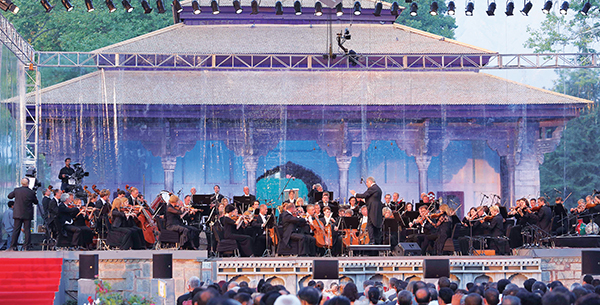
Indeed, the Ehsaas-e-Kashmir (Feel of Kashmir) concert was performed "from the heart” and as per schedule on September 7, 2013 by the Bavarian State Orchestra from Munich under Mehta’s baton at the historic Shalimar Bagh near Srinagar’s Dal Lake for 1,500 invited guests. Despite objections and resistance from several quarters, the musicians and organizers had remained steadfast in their resolve to make the concert a reality. An initiative of the German Embassy in New Delhi, the genesis of the concert lay in the desire expressed by Mehta to perform in that strife-torn state when he received the Commander’s Cross of the German Order of Merit, the highest award bestowed by the German President, mentioned The Indian Express (IE) of August 25, 2013.
Hurriyat Conference chairman Syed Ali Shah Geelani, the separatist leader who first raised the flag of protest against the concert called for a complete shutdown and civil curfew on the day of the performance. He also endorsed the plan to host a parallel concert on the same day. Titled Haqeeqat-e-Kashmir (The reality of Kashmir), "This (concert) will be a tribute to the resilience and struggle of Kashmir’s people,” stated convener of the Jammu and Kashmir Coalition of Civil Society (JKCCS) Khurram Parvez. "We believe that Mehta’s Ehsaas-e-Kashmir is aimed at obfuscating the ground realities of the Valley. Our event will project the reality of Kashmir,” he reiterated, as reported by IE on September 2, 2013. It was planned to be held at Lal Chowk a few kilometers from Shalimar Bagh.
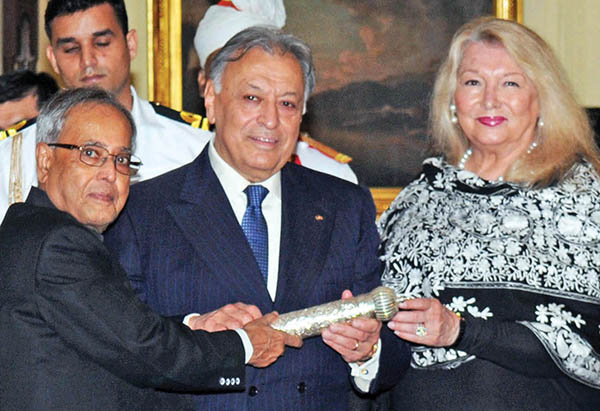
President Pranab Mukherjee, Zubin and Nancy Mehta
Chairman of the other Hurriyat (M), Mirwaiz Umar Farooq too claimed that the environment in the Valley was not conducive to such recreational events, reported Mumbai Mirror (MM) on August 27, 2013. He appealed to the international community to be mindful of the ground realities and argued that the money spent on chartering aircraft for the musicians and their expensive musical equipment, and hosting them in five star hotels could instead be used to build better hospitals.
On a positive note, Jammu and Kashmir chief minister Omar Abdullah was quoted by MM on September 3 as saying: "Everybody has a political opinion, but we must remember that music is part of Kashmir’s culture.” He also stressed that he was not opposed to holding any event in the state, so long as it was peaceful. The day after the concert IE reported that Abdullah, in the context of the separatists’ opposition to the event, said: "Would I do it again, if I am given a chance, yes I will... We hope that the music from here will lift our spirits and lighten our souls for a better tomorrow.”
At an earlier press conference in Delhi German Ambassador Michael Steiner had averred: "This concert is for the people of Kashmir. Beethoven, Haydn and Tchaikovsky, played by a world acclaimed maestro and one of the best orchestras of the world in one of the most enchanting places in the world: this is a wonderful cultural tribute to Kashmir and its warm-hearted and hospitable people,” noted a report in IE on August 25.
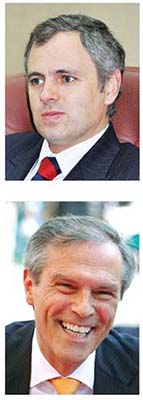
Chief Minister Omar Abdullah;
(below): German Ambassador Michael Steiner
Senior journalist Sherna Gandhy, writing for rediff.com on September 6 was less than complimentary. "In Parsi Gujarati we have a term for what Zubin Mehta is trying to be — a dayo kagro, an overly earnest do-gooder bordering on the hypocritical. Music may cross many boundaries… but to try and make out like it can soothe major international conflicts or reconcile sworn enemies, is nothing short of farcical,” she wrote. Referring to his earlier concerts in Tel Aviv and Nazareth, for the Israelis and Palestinians respectively, she maintained "it hasn’t changed anything on the ground. Both concerts gave Mehta a publicity boost, as all controversy does, and some bleeding hearts congratulated him as some kind of apostle of peace… but the bitter conflict continues unabated.” Similarly, in Kashmir, had the local population "been dying to hear Beethoven, Haydn and Tchaikovsky, and had been prevented by politicians from doing so, I would whole-heartedly back apro Zubin. But most… would have happily passed the rest of their lives in blissful ignorance. But then apro Zubin would not have got his chance to strut and fret his hour upon the stage,” she fumed.
The government of Jammu and Kashmir provided three-tier security to Mehta and his over 100 musicians, with the area from the airport to Shalimar garden fortified by police and paramilitary forces.
The floriculture department that manages Shalimar Bagh refurbished the garden to create a stage for the large orchestra. Art and heritage lovers objected to the erection of platforms in the garden on the plea that it interferes with the original architecture of the 17th century garden created by Mughal Emperor Jahangir, reported The Free Press Journal (FPJ) on September 1.
Interestingly, for two months prior to the concert 20 musicians playing the santoor, rabab and sarang had been practicing a Kashmiri folk tune composed by Srinagar-based santoor player Abhay Sopori at the Jammu and Kashmir Academy of Art, Culture and Languages. Simultaneously, over 5,000 miles away in Munich, the same tune was being rehearsed on violins, violas and cellos by the Bavarian State Orchestra, mentioned IE on September 4. The two orchestras came together to open and conclude the concert with fusion music.
"It was much more (than expected). It turned out to be an occasion which we will be proud of,” is how Mehta described the Ehaas-e-Kashmir concert to The Times of India (TOI) on September 9. "If Kashmir wants me again, I will come back,” he said, adding in grammatically incorrect Hindi, "Geelani sahib, hum to aapka dost hoon (I am your friend)… I wish all of our opposition would have come and enjoyed the music.” Mehta also promised that his next performance would be not just for elite invitees but for all, and free of cost. The maestro told MM on September 9: "Next time I will perform for more Kashmiris, maybe in a stadium. Shalimar Bagh was offered to us and how could I say no to such an incredible atmosphere?” In fact, he was so entranced by the natural beauty of the place that he expressed the desire to own a house on the Zabarwan Hills which formed the backdrop to his concert, mentioned FPJ on September 9. Sadly, this wish can never be realized as non-Kashmiris are not permitted to own property in Jammu and Kashmir.
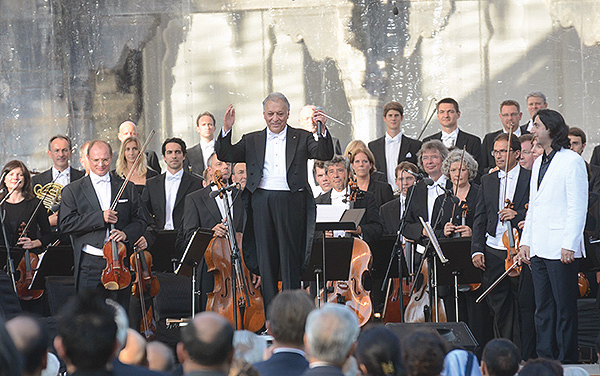
Acknowledging the applause
The 90-minute concert has proved a milestone for Prasar Bharati (PB) as it was the first outdoor event in the country to be transmitted live to 104 countries in high definition (HD). For this broadcast PB, the German Embassy and the Eurovision Consortium signed an agreement on September 2. The recording copyright will remain with PB and there is a likelihood that they may come out with DVDs later, as per a report in IE on September 3.
"As soon as I step into this city I feel wonderful. I feel at home,” Mehta said on arrival in Bombay following the Srinagar concert, mentioned TOI on September 9. Bombay was where he grew up and began his musical training under his violinist-conductor father Mehli Mehta. "Now I come here only once in two years.” Two concerts at the National Centre for the Performing Arts on September 9 and 10 enthused audiences who were regaled by the Bavarian State Orchestra playing a string of classical symphonies and violin concertos. It was a "real treat” said art gallerist and conservation activist Pheroza Godrej, who has attended many of Mehta’s concerts in the past, reported TOI on September 11. Businessman Shiamak Marshall, who was present with his son and daughter-in-law, noted: "The twin concerts were significant for Bombay not only because of the way Mehta presents his music but also because he was from here. He lived here, was educated here.” Marshall had also attended the concert in Kashmir. "The way he conducts the orchestra, presents his music… there is panache to it.”
Proceeds from the Bombay concerts are earmarked for the Mehli Mehta Music Foundation which imparts training in western classical music to over 200 children in an effort to discover and nurture new musical talent.
While in the city of his birth, Mehta visited his alma mater on September 11 to kick-start celebrations on St Mary’s High School at Mazagaon completing 150 years by unveiling the logo for the events. Father Kenneth Misquitta, principal told Hindustan Times (HT) on September 7 that it would be "a double delight for the school” and that the students might even perform a special rendition of the school anthem for the eminent alumnus.