The director and cast speak about
their preparations for portraying
characters in the film that highlights
the dying culture of Irani cafés
Kashmeera Sambamurthy
Bun maska is like vada pav,” explained Neeraj Udhwani, scriptwriter and director of Maska, when asked by Parsiana on email on April 1, 2020 about this mouthwatering snack that plays a major role in the film that released on Netflix on March 27. Every Irani café has its own way of preparing it, and munching on bun maska along with a cup of piping hot chai is pure delight, he added. "Not everyone opts to eat a full Parsi meal. Bun maska is something even vegetarians can enjoy. This is what led to finalization of the title,” said the writer.
Having scripted the 2012 movie Meri Dad ki Maruti, Udhwani debuted as director with Maska for which he also wrote the screenplay. The film describes the journey of a young Parsi lad, Rumi Rustom Irani, whose dreams of being the next Boman Irani of Bollywood fame are in direct conflict with his legacy of continuing to run the family’s ancestral Café Rustom. Rumi is played by Prit Kamani who debuted with Rajshri Productions’ Hum Chaar, released on February 14. In Maska, Rumi is shown discovering his true forte as managing a restaurant and accepting the truth that certain talents are passed on from one generation to another.
A Gujarati from the Jain community, Kamani mentioned that the Gujarati spoken by Parsis differs from what the Gujaratis speak, so he prepared for the part by studying those nuances. "Rumi is a young, innocent boy and the filmmakers saw this quality in me when I auditioned for the role. To play Rumi I had to learn how to chop vegetables, knead dough and despite being a vegetarian, I had to also learn how to handle eggs, chicken and clean prawns,” said the young actor. The film, that showcases culinary delights like sali kheema and patra ni machhi, also explores concepts like universal connect and Ikigai (a Japanese concept meaning "a reason for being.”)
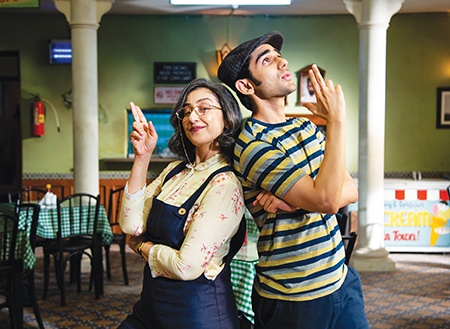
Manisha Koirala and Prit Kamani enacting the roles of Diana and Rumi Irani Photos: Netflix
By hanging out with Arish Bhiwandiwala who had acted in Agneepath (released in 2012) and Vaspaan Shroff (stills photographer of the film) and other Parsi friends, Kamani was able to listen to and emulate their expressions and accent. He also researched why Parsi lads are often termed "Mamma’s boys.” He visited Kyani and Company, Café Colony, Café Irani Chai and Irani Chai Wale and was all praise for Parsis, their honesty and transparency.
Kamani learnt why bun maska became a popular part of Parsi cuisine. An Irani once told him that bun was the first thing customers bought. "With chai, people like to have bread, so for extra taste maska is used as a topping. We serve it along with tea to earn a little extra since it’s affordable and with the addition of currants it becomes a treat.”
Seasoned Bollywood actress Manisha Koirala, who plays Rumi’s mother Diana, stated she did not delve into any cultural aspect when she was offered the role. "One does not get deeply involved in what’s going on, and some amount of experience does contribute to portraying the cultural aspect. I saw the movie as a way of connecting with Parsi culture. Through Maska, I got to visit Irani cafés for the first time,” Koirala said.
Diana, who is very voluble and utters abuses at the drop of a hat, is portrayed as lovable, but aggressive in the matter of protecting her family café legacy and passing it on to her son Rumi. To gain authenticity she had the support of coaches, Ritesh Kant and Monaz Ranina who helped her emotionally blend into the character. "Ritesh helped me understand how Diana’s mind works, and I would rehearse during breaks while shooting for a film in America. Monaz would send me voice notes on Diana’s lines,” she added. With Monaz, the duo visited several community centers, bars and bakeries. "When I realized the extent of the contribution the Parsi community has made to Bombay, it helped forge an emotional connect to the character I played,” explained Koirala. Wanting her portrayal to be organic and from the heart, Koirala was sensitive about not caricaturing Diana. "When we are not familiar with a community, we actors tend to portray it superficially. We try to copy what others are doing, or use some degree of mockery,” she said.
After the demise of her husband Rustom, played by veteran Bollywood actor Javed Jaaferi, Diana ran Café Rustom single-handedly. Born and brought up in Bombay Jaaferi had observed people while traveling in trains and buses. "Whether they are Sikhs, Sindhis, Christians, Parsis, Muslims or Maharashtrians, I have

friends from all communities. How they behave, their accents and the cultural identities have been collected and stored in my data bank. But, to play a role, additional homework is always required,” he observed. Appearing as a friendly ghost in the film, he felt that Maska highlights the importance of family values. The All India Dance Championship winner (in 1988), who has savored bun maska since childhood, elucidated that there are two types of Irani cafés: Parsi Irani cafés and Muslim Irani owned cafés, both types known for their chai with bun maska.
Nikita Dutta of television and Kabir Singh fame plays Mallika Chopra, an aspiring actress from Ludhiana who lives life on her own terms. Despite repeated attempts to reach her, Dutta remained unavailable.
Shirley Setia, Pyjama Popstar sensation from Auckland, New Zealand, essays the role of Persis Mistry, a blogger-cum-author of a coffee table book on Irani cafés. She got the hang of Parsi culture and cuisine before the film and during the shooting. To play the role she had to understand how bloggers and photographers are wired and undertook photography workshops with Shroff, the stills photographer. Being an introvert, she found it difficult to converse with strangers and ask them about their lives and stories, so she was given scenes where she was trained to get into the skin of the onscreen blogger. She also had to work hard on her diction to get rid of her foreign accent. She explained, "Persis has great listening skills and is empathetic by nature. Facing losses early in life has matured her sense of understanding.”
In a recent tweet, Dr Simin Patel, a historian who is currently working on a book on Irani cafés revealed she found it surreal to find herself being portrayed as Persis on the screen. Every feature of hers was mirrored in the character. Patel, who is also the founder of Bombaywalla Historical Works, an organization that creates awareness about Bombay’s heritage structures and social history, said, "I’m not sure whether they have copied me, but one cannot make a movie on Irani cafés without Googling for two or three hours and being introduced to the book (I am currently doing) and to Miss Bombaywalla. It is unlikely that Maska is based on an Irani café with a girl writing a coffee table book without having any background knowledge of my oeuvre.” Udhwani maintains it was sheer coincidence as the script had begun taking shape in 2016. But Patel had started on her book in 2014.
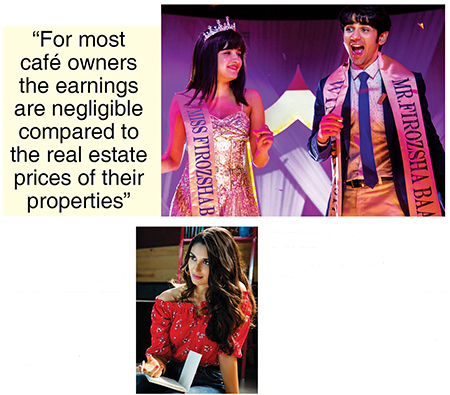
Top, clockwise from l: Shirley Setia as Persis Mistry,
with Kamani; Nikita Dutta as Mallika Chopra
The interiors of Rustom Café in the film closely resemble Kyani and Company Kamani attested that the set designers had the structure of both Kyani and Jimmy Boy in mind while designing the set. While Jimmy Boy and a few Irani cafés in Matunga permitted shooting on their premises, permission was denied by Britannia and Company, Kyani and Sassanian Boulangerie. Udhwani recalled, "I approached the Irani café owners and told them the purpose of my visit. It was difficult to ask them for permission to shoot or to take an appointment for interviews or meet-ups.”
During the early 1950s, there were around 350 Irani cafés in the bustling city. Very few survive today. "I learnt that for most of the café owners the earnings are negligible compared to the real estate prices of their properties. There is no point in hiking the prices on the menu. People cannot afford it. I think some owners sell their properties to multinational chains such as Starbucks or McDonalds,” said the director. Many younger generation Parsis chose to move to the USA or Canada due to the difficulties involved in looking after and running the cafés day in and day out.
Udhwani has seen Shehnaz Café opposite Shanmukhananda Hall in King’s Circle, and Bastani and Company at Dhobi Talao as well as others closing down permanently. "I guess practicality scores over sentimentality!” he exclaimed.
Apart from chronicling Irani cafés, Maska also questions the common belief that if one chases one’s dreams, one will become successful. "Is chasing dreams enough? I wanted to explore how many are able to become the next Sachin Tendulkar or Shahrukh Khan,” Udhwani stated. The director believes films and pop culture encourage youngsters to follow their goals, chase their dreams and attain success. "Rumi is living a dream without realizing where his expertise actually lies. In wanting to be an actor, he is looking at the end result without understanding what the essential requirements are to become one.”