The acute shortage of nurses in the country needs to be tackled effectively
Who is to blame for the shortage of qualified nurses in India? This became a point of contention at the inauguration of the two-day International Conference on Nursing Education held by the Indian Red Cross Society Maharashtra State Branch (IRCSMSB) on September 6 and 7, 2013 at the IRCS Homi J. H. Taleyarkhan Hall in Bombay.
As versus the norm set by the Indian Nursing Council (INC) of one nurse to four patients, the ratio in India was closer to 1:70, noted INC president Dileep Kumar. While Sri Lanka had around 19 nurses for 10,000 people and the United Kingdom 94, India had a dismal 10. There is a shortage of around 7,00,000 qualified nurses in the current five-year-plan period.
In order to give an impetus to people to take up nursing, he said the government run hospitals were offering starting salaries of Rs 35,000. The private sector in contrast paid between Rs 10,000 to Rs 15,000. Some privately run hospitals, however, have "started giving more.”
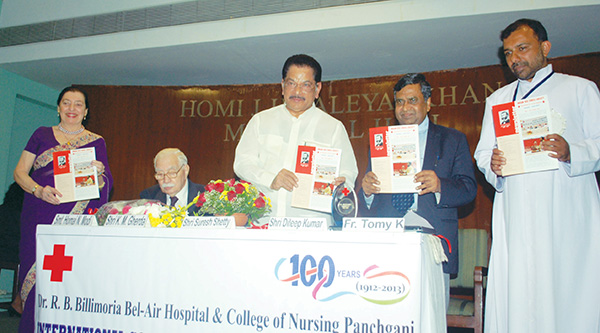
Homai Modi, K. M. Gherda, Suresh Shetty, Dileep Kumar, Fr Tomy Kariyilakulam
In his keynote address Kumar lauded the 240-bed R. P. Billimoria Bel-Air Nursing Hospital in Panchgani which pioneered treatment and care of HIV patients in India and runs the Nursing College in collaboration with the University of Illinois at Chicago. Bel-Air is under the management of IRCSMSB and run by the Missionary Congregation of the Blessed Sacrament (MCBS). The Conference was held to mark Bel-Air’s centenary. The celebration was kicked off on March 15, 2013 at the 44-acre medical complex in the Western Ghats (see "The blessings of Bel-Air,” Parsiana, June 7, 2013).
Maharashtra minister of Health and Family Welfare and IRCSMSB vice president Suresh Shetty claimed "everyone blames the government” for the scarcity of doctors and nurses but the Medical Council of India and the INC "have to take their share of the blame.” They stipulate such stringent regulations for establishing medical and nursing colleges that it was impossible to meet them. One such requirement was 25 acres to start a medical college. "Imagine getting even five acres in a city like Mumbai or Pune…They have to relax the criteria without compromising on the quality of education.”
Regarding the lack of doctors in the rural areas, Shetty remarked, "Seventy percent of doctors don’t want to do rural stints.” The Bombay High Court had specified that specialists had to serve in the rural areas. "Can we force them to go?” When doctors are asked to serve in tribal areas for which they are awarded 20 additional marks, they agree to go but then through "VIP influence” approach the authorities with a request, "Saheb transfer kara lo (Sir, please transfer me).”
The minister alleged that nurses were being exploited in the private sector. Aside from low salaries, they were asked to pay deposits of Rs 50,000 to Rs 60,000 and made to hand over their original nursing qualification certificates to the employers. Amid some murmurs of dissent, Shetty clarified these were "not regulations but the practice…the management says ‘no’ (that such practices do not exist) but the girls in the field say ‘yes.’ We have to get elected every five years so we know the pulse at the grassroots level.”
To curb these malpractices, the government had passed the Clinical Establishment Bill "with all good intentions” but its implementation in Maharashtra was being obstructed by the medical profession. The private sector claimed they did not want government interference in their field.
Fr Tomy Kariyilakulam, director of Bel-Air, likened the topics discussed to "touching a live wire.” Referring to the acute shortage of nurses, he called for "innovative strategies.” He bemoaned that though the Bel-Air College of Nursing had applied for admitting an additional 1,500 students, the government was not processing the application.
He noted that Bel-Air was paying its nurses more than the corporate run hospitals in Bombay. He lamented that nurses who were trained for six months to treat patients in the Intensive Care Unit "walk away” if they get a better opening elsewhere. One had to balance "human rights” against the "concern about the patient.”
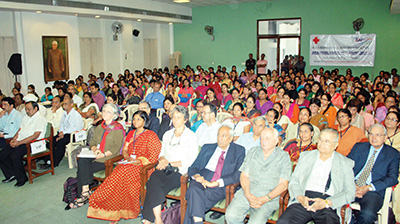
A section of the audience
K. M. Gherda, chairman IRCSMSB stated that Bel-Air is "a role model for HIV treatment.” IRCSMSB honorary secretary Homai Modi informed the gathering that the governor of Maharashtra K. Sankaranarayanan who was to inaugurate the conference could not do so as his brother-in-law had expired. But in a message published in the souvenir for the conference, he noted, "Nurses are the backbone of the healthcare profession. They care, they cure and reduce the sufferings of millions of people every day. Through their silently efficient work nurses render invaluable service to humanity. In order to achieve our much desired goal of ‘health for all’ we need more doctors and nurses to serve in all parts of the country, especially in rural areas.”
Dr S. P. Aggarwal, secretary general of the IRCS, in a message published in the souvenir narrated a brief history of nursing. "In earlier times, although the Romans had superb military hospitals and (the) Arab empire also had hospitals, the standards for nursing care were very poor. During the middle ages the monasteries were almost the only places in Europe where hospitals could be found. In the 16th century, Henry VII destroyed nearly all monasteries in England and from then on, nuns did most of the nursing that was available. This is why nurses today are called sisters.
"Nurses bind human society with a bond of care and affection. The nursing profession is a fine example of national integrity as nurses serve humanity without prejudice of caste, color, creed, region or language. The concept of nursing has diversified over the years and it is no longer confined to the hospitals and patient care alone. Today, nurses are the sheet anchor of our total healthcare delivery system. In many countries, e.g. Thailand, nurses have shown the implementation of health promotion for the betterment of society, which is reflected in the health indicators for everyone to see. Community partnership for healthy work environment is essential for health promotion.”
Modi thanked Tomy for his assistance in organizing the two-day seminar with around 200 participants and 25 speakers. Participants were taken on a visit to Bel-Air on the third day.
A write-up on the conference sent along with the invitation to the Press noted "as there have been no proper structured attempts to address the shortage of doctors in rural areas, the role of nurses to address this issue needed to be discussed. An overhaul of the Nursing Education System and a serious attempt to build an empowered nursing force can effectively help to change this scenario.
"Health problems of rural India require a community based approach with a focus on prevention and promotion of good health rather than a prescription based approach.
"It is not necessary to have MBBS doctors for proper implementation of health strategies. If nurses are empowered they could be far better equipped to handle health problems of the rural sector.” The note also refers to India "emerging as a global destination for medical tourism” and the need to enhance and retain experienced nurses.
A souvenir on Bel-Air and an IRCS newsletter were released at the function.