The renal dialysis center is a precursor to the Hospital providing kidney transplants in the future
Text: Farrokh Jijina • Photos: Jasmine D. Driver & Sarosh Daruwalla
With the opening of the Masina Hospital’s 14-bed renal dialysis center funded by Shapoorji Pallonji Investment Advisors Private Limited (SPIAPL), the medical institution has taken one more step towards providing "high end medical service regardless of religion or class of the patient,” noted chief executive officer (CEO) Dr Vispi Jokhi. He was addressing a gathering at the inaugural function on March 3, 2022 at which Pallon Shapoor Mistry was the chief guest. Dialysis is the process of removing excess water and toxins from the blood in people whose kidneys can no longer perform these functions naturally.
Housed in building number three at the side of the heritage structure that crowns the eight-acre estate, the new facility also has a secluded area for sero-positive (infectious agents which are life threatening and which are transmitted through blood) patients. A separate room is provided for those seeking privacy during treatment. The Hospital is moving towards "the new Masina,” observed Jokhi, highlighting the "improved infrastructure, the best human relations processes and a focus on revenue to ensure sustainability,” among others. The opening of the center is the "first step” on the road toward providing kidney transplants in the future, he stated.
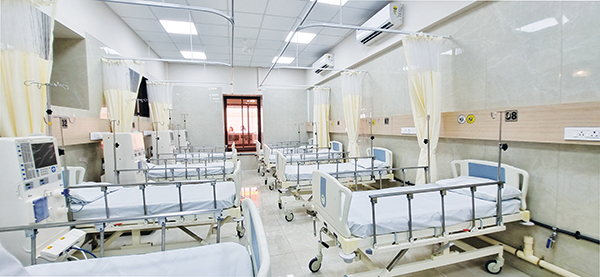
Ready to serve patients with kidney disorders
Foreground, from l: Dr Gustad Daver, Pallon Mistry, Burjor Antia
The ribbon at the entrance to the facility was cut by Mistry, and Hospital trustees Burjor Antia and Jimmy Parakh. Managing trustee Homi Katgara was not present. The machines were formally inaugurated by head of the Hospital Advisory Board, surgeon Dr Gustad Daver, former dean of Grant Medical College and Sir J. J. Group of Hospitals and present medical director and head of surgery at Sir H. N. Reliance Foundation Hospital and Research Centre, senior consulting nephrologists Dr Madan Bahadur and Dr Chandan Chaudhari. Helpful staff members including deputy nursing superintendent Kshitija Jadhav and others explained the technical details about the running of the center to the 50-plus audience in a walk-through.
As one enters the unit, on the right is the reverse osmosis plant, "the heart of any dialysis unit.” A plaque reveals an interesting factoid: "The amount of water consumed in dialysis for any patient who takes two to three dialysis sessions a week for up to three years is more than the amount of water an average person would consume in a lifetime of 70 years.”
"The quality of dialysis has a direct effect on the quality of life and the longevity of life in a patient of chronic kidney disease… Cutting costs in the short term does not help and in fact the patient lands up paying a higher price in terms of increase in morbidity and mortality,” stated Jokhi. To be managed by the Hospital’s own team (it was outsourced in the past), the facility is compliant with norms set by regulatory bodies AAMI (Association for Advanced Medical Instrumentation), ISO (International Organization for Standardization) and NABH (National Accreditation Board for Hospital and Healthcare Providers), stated the write-up from the Hospital.
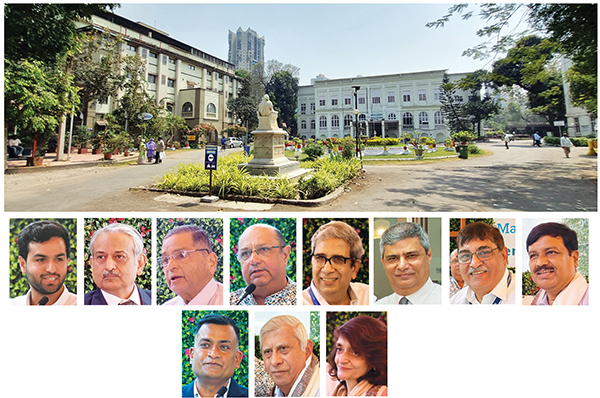
Top: Hospital complex; from l, 2nd row: Mistry, Daver, Antia, Jimmy Parakh, Dr Vispi Jokhi, Behram Khodaiji,
Dr Satyendranath Mehra, Dr Madan Bahadur; 3rd row: Rajesh Agarwal, Firoze Bhathena, Zarin Commissariat
Pricing is competitive. "It will be 15-20% lower than other charitable hospitals,” Jokhi told Parsiana after the event. Plans are afoot to start nocturnal dialysis for working patients, when the facility’s currently planned three sessions per day are fully booked. The Hospital will "offer programs and packages to help the underprivileged, in keeping with their mission to become the first choice for value and excellence in healthcare,” stated the write-up.
In his welcome address, joint CEO Behram Khodaiji, while emphasizing that the creation of the unit has been a team effort, lauded the efforts of Daver for his "pivotal role in planning and designing the facility.” Antia, who has been associated with the Hospital for four decades, referred to the 120-odd-year history of the Hospital, its humble beginnings and its transformation into a modern multispecialty facility. The senior trustee emphasized the Pallonji family’s four-generation nexus with the Hospital, starting with Pallon’s great-grandfather. Pallon’s father Shapoor is also a trustee of Masina. Lauding the Hospital management, Pallon assured the Hospital of his support and that of the SP Group in its endeavors. "My family is thoroughly invested in Masina,” he observed. He expressed his thanks to the SPIAPL CEO Rajesh Agarwal.
In his address, Parakh referred to the "metamorphosis” at the Hospital and was confident "that in the next few years the Hospital will rank amongst the best in the city.” He gave the analogy of the life span of an eagle which, when past its prime, reportedly sheds its beak, claws and feathers to regain strength and soar again. A mention was made of the contribution of the World Zoroastrian Organisation Trusts that have regularly assisted the Hospital.
A lengthy felicitation of donors, well-wishers, doctors, vendors and Hospital staff preceded light refreshments. Among those felicitated were Agarwal, Firoze Bhathena, director, SP Group, Dr Meera Arora, medical director, Central Railway, Zarin Commissariat, corporate social responsibility in charge at SP Group, a representative of St John’s Ambulance, and donors Cyrus and Vera Bagwadia. The vote of thanks was provided by medical director Dr Satyendranath Mehra.
The 280-bed Hospital is believed to be the oldest private hospital in the city. "We exist to provide services to all strata of society,” ended Jokhi’s note.