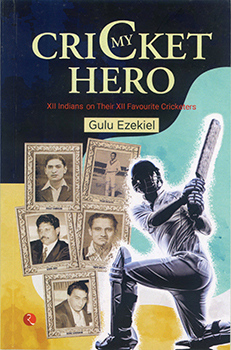
My Cricket Hero: XII Indians On Their XII Favourite Cricketers by Gulu Ezekiel. Published in 2022 by Rupa Publications India Pvt. Ltd, 7/16, Ansari Road, Daryaganj, New Delhi 110002. Pp: x + 102. Price: Rs 195.
I imagine Gulu Ezekiel (pictured) in the pandemic-induced lockdown at a loose end, when an idea occurs of a compilation of cricketing icons as perceived through the prism of a pre-adolescent 12-year-old’s eyes. He draws up a list of cricketers and  contributors, pairs them, and voila, you have this slim tome of essays, My Cricket Hero. What this lacks in heft of pages and research, it makes up in memories of Indian cricketing greats of the last century and the perilous and uncertain times and environment in which they practised their art and craft, with little financial recompense.
So you have an eclectic collection of pen portraits of Polly Umrigar, Chandu Borde, Eknath Solkar, Sunil Gavaskar, Salim Durani, Vijay Hazare, Gundappa Viswanath, Kapil Dev, Dilip Sardesai, Tiger Pataudi, Motganhalli Jaisimha and Mohinder Amarnath in no discernible sequence of merit. And the essayists are a mixed bag of journalists (Suresh Menon, Kersi Meher-Homji, Rajdeep Sardesai) commentators (Fredun De Vitre, Narottam Puri), Board Officials (Prithvi Raj Man Singh, Amrit Mathur), a poet (Keki Daruwalla), a filmmaker (Ramesh Sharma), a book editor (Karthik Venkatesh), a corporate executive (Hemant Kenkre) and the author himself.
It is difficult to single out an essay for praise or criticism. Some are heartfelt and personalized, such as Rajdeep on his father Dilip, and Kenkre on his cousin Gavaskar, benefitting from a close family relationship. Man Singh on Jaisimha, one of the most charismatic yet tragic figures of Indian cricket, is a comrade’s ode, having shared a dressing room in the Hyderabad team. De Vitre has done his research on the taciturn Borde who was a sharp contrast to the aristocratic Pataudi.
Both Daruwalla on Umrigar and Meher-Homji on Hazare are lyrical and from an earlier era, when Indian cricket was in its teething stage.
What is missing, however, is a subtext, in Indian cricket as it was back then. An overarching commentary on the state of the sport until almost 1983, when India won the World Cup, would have been invaluable to provide a context, especially to those unaware of the early contribution of these veterans. Those weaned on T-20s (Twenty 20 internationals) and ODIs (one-day internationals) have no awareness of what these cricketers went through. A cricketer today could earn more in one match than what most of the cricketers profiled in this book would earn in their playing lifetimes.
 These players subsisted, then, on the munificence, first of the maharajas and then of the corporates, holding employment in Tata, Mafatlal, ACC (Associated Cement Companies) and the Railways, attending office in the morning and practising at the nets in the afternoon. There were poor allowances, no phalanx of support staff, no dietary or physical fitness regimens and, more important, no protective gear. It was pure commitment and love for the game, blood, sweat and often tears at the vagaries and whims of selectors. It was only with the advent of television revenues and the gumption of a Gavaskar, Dev and Bedi to stand up to the administrators for players’ betterment and security that has led to this happy situation where disadvantaged boys and girls from small towns aspire for a career in cricket. Thus, these pen portraits are all the more poignant, especially for those like this reviewer who frequented the maidans watching Kanga League or Ranji Trophy matches at the Brabourne (and, for a brief period, also wrote the score books for a local team, Parsi Cyclists, led by Nari Contractor in the rain-soaked Kanga League, and made a mess of it).
For those of us steeped in nostalgia and for those who have a little knowledge of the noble game of cricket before the present incarnations of ODIs and T-20s, Rs 195 in purchasing this book will be well spent.
MANECK DAVAR
Davar is chairman of publishing house Spenta Multimedia and published Wisden Asia Cricket under licence from Wisden, the bible of the sport.