With USD 20 in his pocket, Adil Govadia set off in 1982 for a three-year bicycle trip across the world
Farrokh Jijina
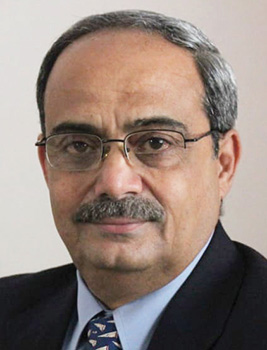
Since dreams don’t cost a penny and because there are no limits to the dreaming mind of the youth, in 1980 I decided to visit the next Olympic Games (1984) in Los Angeles on a bicycle,” narrated 65-year-old Bangalore-based corporate mentor Adil Govadia. "I had no intentions of breaking any record. I simply wanted to travel like a free bird, witness the Olympics and live my dreams,” he gushed in an email to Parsiana. Setting off from Nagpur in late 1982, Govadia, then 28, returned to India after 32 months, having traversed approximately 40 countries and 11,000 km.
Family friend Kaikee Kharas, who with Rustam Ghandi and Rutton Shroff completed a nine-year cycling tour around the world in the 1930s-40s (see "Perilous pedaling,” pg __), was a great source of inspiration till his last day, narrated Govadia. Kharas died in 1994. He was a "gutsy, determined and humorous individual. He… often spoke to me of his cycling exploits around the world. Those stories of his ruggedly harsh journey through the deserts of the Middle East, the dense jungles of Africa, spending time with the aborigines in Australia or persisting through the extreme cold of Europe ever remained etched on my mind when I too undertook the strenuous route into the unknown. Kaikee Uncle strongly encouraged me to take the first step as he believed that everything else would follow,” wrote Govadia.
Preparing for the long journey was strenuous, stated Govadia. In his imagination, the future "conjured up a kaleidoscope of scenarios” of him crossing the great Middle Eastern desert, or ascending the Alps in extremely difficult blizzard conditions, or assuaging hunger pangs in a jungle by hunting animals with a bow and arrow. "The dreamer’s fantasies were endless and so was the determination to succeed!” he exulted.
Government permission was required to leave India on his shoestring budget. "Traveling on a bicycle for an unlimited duration of time…is a reason for raised eyebrows,” wrote Govadia. Visa procurement was another major hurdle. "Due to the uncertainties of traveling by cycle, I was unable to obtain visas in advance for various countries as I was not sure of my arrival date in a given country,” he noted. Armed with US, French and British visas, Govadia decided to obtain permits for other countries upon reaching the country’s entry-point. "This exercise was often tormenting given the uncertainty. I was once refused visa to a particular country (known for beach tourism) and was asked to petition for the same through the Indian embassy in another country. And when I finally did manage to get the visa it was for four days only from the date of entry! How is one expected to cycle through a country within four days?” he asked rhetorically.
With Afghanistan, which fell right in the proposed route, occupied by the USSR, "the war looked like a conspiracy against me personally,” Govadia communicated. So, he flew to Dubai and set off from there. With leave of absence from his employers (pharmaceutical company) Smith, Kline and French for three years, Govadia left home armed with a specially imported 10-speed Japanese bicycle lovingly named "Flying Pigeon,” USD 20 in his pocket, as well as "very high expectations.”
According to the traveler, major components of his luggage were a light weight tent, one pair of extra clothes, a sleeping bag, emergency medicines, tools and spares, introductory letters and a camera. "I also carried my kitchen along — a small frying pan, plastic plate, spoon, salt and pepper, tea bags, sugar, gas-lighter, water bottle and a Swiss army knife. Although I carried the bare minimum, at times my Flying Pigeon looked absurdly over-loaded,” he informed Parsiana.
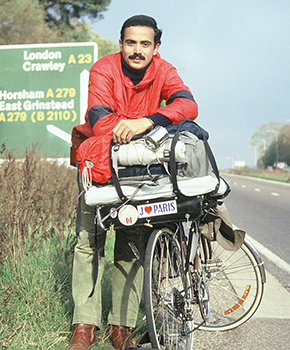
Adil Govadia (top and above) en route to London with the Flying Pigeon
Clockwise from top: Govadia at the site of the 1984 Olympics: "dream come true;"
seated (center) with Philadelphia city officials; holding the Olympic Torch with an American athlete
(l) Kaikee Kharas and (r) Jal Bapasola: cyclists of yore, sources of inspiration
Packing a bicycle is an art that one improvises through experience, according to Govadia. "First and foremost, one has to fill empty spaces in a manner so as to prevent rattling. It is very easy to pack empty spaces (in your bag) with socks, bandages, toilet rolls, gloves etc, but remembering the ‘geography’ of such a stuffed pack is difficult and at times embarrassing. Imagine your stomach rumbling and you urgently need to ease yourself behind a bush and you keep pulling out socks, gloves, bandages and everything else except the toilet roll!”
After travel through the mid-East, Europe, Canada and the USA, which included a stint in jail and strip-searches for narcotics in Eastern Europe, Govadia reached Los Angeles in time for the 1984 Olympics. To earn money, he had shelled boiled eggs in Athens for 80 drachmas (approximately one USD) a day; lifted crates in a Frankfurt supermarket; unloaded pork from trucks. In Paris he had five different jobs each day: from cleaning toilets and washing cars to selling newspapers and working in an animal boutique. In London, he washed utensils and chopped onions during the evenings and distributed leaflets door-to-door by day. In the US, he worked mainly at Indian restaurants in New York, New Orleans and Houston.
"At San Francisco, I visited the Golden Gate Bridge Park from where the Olympic Torch was passing en route to Los Angeles. It was here that I met mayor Dianne Feinstein over a cup of tea, who, upon learning about my cycling expedition, graciously permitted me to hold the Torch.” Govadia noted that the 1984 Olympics were widely considered to be financially the most successful modern-day Games not only due to low cost of construction but more so because of huge corporate funding. Businesses were approached to sponsor the journey of the Torch from the east coast of USA to the west by expending a predetermined sum on a per km basis. "Since every km run by an athlete was sponsored by some corporate house or another, I was permitted to hold the Torch and not run with it,” said the cyclist.
"By the time I reached the Olympic village, I was lighter by 11 kgs in weight but sharper, stronger and more spirited. I had traveled through over 40 countries, clocking several thousand kms (lost count) of pedal-power through rain, heat and snow.” As the Olympic flames burst into life high over the Coliseum and the Games were under way, "I thanked God for making my dream come true,” wrote Govadia. He could see the events free thanks to well-wishers who presented him with passes to selected events "thus making my trip very fulfilling, rewarding and gratifying,” he stated.
Govadia, an ordained priest, noted that his parents, Jehangir and Najan, were a great source of inspiration and encouragement, not only during the preparation stage, but also through his three-year sojourn. "My father suddenly passed away in his sleep one night when I was still cycling somewhere on the west coast of US. It was much later that I learnt of his passing away. I thus returned home midway from my world tour (without moving onwards to Australia) to my grieving mother,” he ended.