She always knew that she did not really belong to her typical Dadar Parsi Colony family. It was not easy being the first generation after Independence; yesterday’s freedom fighters were fast turning into cynical politicians and many around her were feeling that the Brits had departed prematurely. Although her two elder brothers were tough lads, nurtured on the famous railing which spewed a love for fast cars and boorishness, and her Parsi school in the Colony had mostly Parsi students, she had a natural sensitivity and oodles of empathy for the underprivileged. Attending St Xavier’s College honed her liberal values (in those days Elphinstone College was academically much ahead of Xavier’s which was considered more of a fun place), and the Tata Institute of Social Sciences, comparable with the best in the West, equipped her mentally for the challenges that she would later face. Her postgraduation in medical and psychiatric social work earned her a Fulbright scholarship, and more importantly, knowledge of active philanthropy.
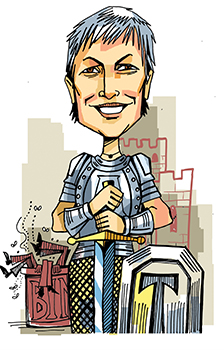
Illustration by Farzana Cooper
Not satisfied with two sons, her father had desired a third. Girls are for procreation, he said. Life would educate him otherwise. He was an aspiring entrepreneur who founded a small engineering solutions business. A Cambridge educated Parsi lad from Karachi, who knew the old man’s elder son well, tossed a lucrative career with a multinational, and became a manager of this fledgling business. Urbane, suave and soft spoken with a lingering English accent; he was the antithesis of the Colony haanda (lout). The cerebral sense of humor twinkling in his eyes ensnared our heroine into matrimony. She did marry early and she did procreate too. The second daughter died in infancy; one girl and a boy survived.
Her husband, who would soon be known as a visionary entrepreneur in India, aspired to take his father-in-law’s business to new heights; the latter and his son resisted. His wife believed that her husband was right, which led to acrimony in her father’s home. The couple borrowed and bought off the father, who then diverted his unspent energies on more colorful things, right up to his 80s. The business would metamorphose into an engineering giant, known for its stellar integrity and its philosophy of empowering every manager. Articulate and erudite, her husband delighted the management world with his wit and wisdom in the many speeches he delivered and the articles he penned. HR (human relations) was then not such a buzz word. She contributed, by heading the HR function of the company. Truly egalitarian, the couple introduced radical policies for staff welfare. Courting simplicity, they travelled abroad too by economy class, even though the business was prospering. Innate humility was reflected in their frugal life style. His only weakness was for his whiskey and his cigarettes; and some rare steak. He allowed himself, though, to be entertained by one of his loud mouthed officers, who was like a court jester relieving the stress of his intellectual boss over several drinks.
Their blissful lives were rudely shattered when he suffered cerebral hemorrhage and had to relearn the alphabet, letter by letter. With proverbial calm, she tended his broken body and his frustrated spirit, understanding his anger at his helplessness. Almost miraculously, he recouped to lead his organization to greater heights, including a very successful public offer of shares. His new found status as a billionaire made not a dent in their approach to life. Her only grievance was his continuing love affair with his evening tipple and smoking. Their children were even more humble and self-effacing than their parents. The daughter, a first class chemical engineer from the Imperial College London, interned with the company.
Early one morning, in the company’s guest house at Bombay, he woke up excitedly, at the thought of meeting his wife and children returning from England. An immaculate dresser, he decided to put on a new pair of socks. As he was wearing the second sock, he dropped dead on the bed. She managed to greet the many mourners without any exhibition of grief; only the pain dancing in those pretty eyes. Her son, a sensitive soul, also working with the company like any junior officer, and her sensible daughter, dignifiedly dealt with the sudden death. Within months, her bedridden mother-in-law breathed her last.
She did not have much time to mourn. Though professionally managed, the company looked to her for leadership. Apart from HR, she was unfamiliar with the intricacies of the giant business. She promoted his next in command as the managing director and became the chairperson of the company. Once a darling of the stock market, the share price began to plummet. Every empowered head of business thought he was the monarch of all he surveyed. Her consensual style led many to believe that she was weak and would not assert herself. She had to deal with a rather old-fashioned and pompous board of directors, some of whom displayed a prima ballerina attitude. Yet the smile did not leave her face. Until one evening, returning harangued from the office, she sipped tea, staring at the slow flowing river outside her bungalow, when she was informed that her son had perished in a car crash, driving from Goa with a company colleague. Barely had the ink dried on the thank you letters the lad had written to those condoling his father’s death. Within days, she visited the dead colleague’s widow, to console her.
She began to distil grief into compassion. She was not an atheist; maybe an agnostic. She did benefit though from undergoing a Vipassana course of Zen meditation. She had no religious or spiritual belief system to fall back upon (decades later, she would jokingly refuse to be a candidate for trusteeship of the Bombay Parsi Punchayet on the ground that she did not wear a sudreh or kusti. Her rock solid daughter, her son-in-law and the two tiny grandchildren were the support system. In 14 months, three deaths had turned her into the lone occupant of a once bustling house. With a personality dripping charm, and many silent admirers, she could have restarted life.
When destiny snatches a child, it wants to make you a parent of many children. She dedicated herself to charities for street children, for teaching the illiterate and for informed motherhood. Not that she had oodles of spare time. The management transition, after her husband, was tottering. In a company which had fierce pride in its integrity there were persistent murmurs about the honesty of one or two in the top professional management. The decrepit board was no help either. One of her younger directors though advised her to make a surgical strike. She had this uncanny ability to know whom to trust. In a span of weeks, she replaced the surprised managing director, obtained the resignations of all the other directors (most of them reluctantly), appointed a new independent board of eminence, dissolved the empire building of a few entrenched senior managers, retained a world class management consultancy to revamp the loss making units and instil a change in thinking. The wife had done what the genius husband could not.
In the decades that followed, the company regained its pristine glory, while remaining a beacon for corporate governance. She then ceded the chairmanship in her daughter’s favor, who, in turn, though fully qualified professionally, ceased to be an executive. The family remained only to safeguard the interest of all stakeholders.
She hated mere ceremonial positions, and as head of one of the country’s leading trade associations, she openly expressed her great revulsion at the 2002 Godhra anti-Muslim riots, from a public platform. Her forthright views stunned other captains of industry and many in her inner circle cautioned her about the price she would have to pay. She could not care less for the consequences. A very powerful minister would later, only half-jokingly, tell his colleagues, in her presence, that "this lady has made me grey much faster.” She had unwittingly but deservedly acquired a national stature. For her stellar work in corporate governance, intelligent philanthropy and the courage to voice uncomfortable opinion, she was nominated to be a member of parliament (where she struck friendship with the cricketing legend, Sachin Tendulkar and the siren of the yesteryears, Rekha). The nation also conferred upon her one of the highest civilian honors.
None of the above made any difference to her modest lifestyle (enjoying her papeta pur eedu cooked by her long-time maid) or her innate humility and soft-spokenness. Perhaps when the self is immersed in the cauldron of great pain, compassion is an inevitable byproduct. The Forbes’ billionaire continued to travel in a rickety car and wear the same cotton sari. The purpose of her incarnation, to teach the world that pain is inevitable but suffering is optional, had been achieved.
Berjis M. Desai is a lawyer in private practice and a part-time writer. He considers himself an unsuccessful community activist.