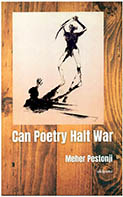
Can Poetry Halt War? by Meher Pestonji. Published in 2024 by Ukiyoto Publishing, Ukiyoto House, College Street, 15 Bankim Chatterjee Street, Calcutta 700073. www.ukiyoto.com. Pp: 66. Price: Rs160.
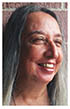
War, and especially the effects of war on civilians, has occupied the concerns of Meher Pestonji (pictured) for some time. In 2023 she published a collection of 14 short stories entitled Being Human in a War Zone. And now she has released a collection of more than 30 poems: Can Poetry Halt War?
She has no illusions, no hesitation in saying: unfortunately, it cannot. However, often in life, when confronted with a problem, one needs to take a stand and do whatever is within one’s power to confront the issue even if there is no solution:
"Poets write because they need to write.
Artists paint because they need to paint.”
The arts are a constant reminder of the suffering and the loss of one’s family and friends; they energize a hope for a better tomorrow, igniting in us a "never-again resolve.”
In her Introduction, "Vietnam to Palestine,” she notes that despite so many deaths the appetite of the warmongers is not satiated. In a sharp and almost staccato manner she expresses her view that women are killed so that they won’t give birth to babies and babies are killed so that they don’t become soldiers. When only the victor is left, the land will be conquered. Life seems to have become a quest for the survival of the fittest. But this does not have to be the case:
"All we are saying is
Give peace a chance.”
Pestonji’s primary concern is the children who are the casualties of war. With stark imagery, in "Babies in Bunkers” the babies question with agonized cries, quivering with fear, whether they were born to die before they turned five. What sort of future do they have? asks Pestonji, seeing homes on fire, people making desperate appeals to be rescued from under debris? The skies which were once blue are now black with smoke, the lullabies for the children have been substituted by "bomb, sirens, screams.” Not only have these children lost their parents but they are also crying and dying in a war which is being fought "WITHOUT (THEIR) CONSENT” (capital letters of the poet).
War, says Pestonji, is like a wheel which never ends. It leaves behind it not only people without countries, but also children without parents and women without husbands. When truce is finally achieved at great cost to human lives and peace treaties are signed, how does it help? asks Pestonji:
"the woman who has lost her family
the man who has lost his leg
the girl left blind.”
These are the victims of war; but what can be said about the culprits, the politicians who do not fight but sit in their secure offices ("Politicians”)? She accuses them of spreading far-fetched untruths and playing with the emotions of the population repeating and blasting lies, creating fear and consequently, "Cripple capacity/ to think ("Propaganda”). If weapons continue to be manufactured, wars will have to be fought to ensure they are sold, says Pestonji unequivocally. It is thanks to such people that democracy is dead — the politicians have reduced it to a governance by the greedy "playing war games with/ people pawns ("Democracy is Dead”). Pestonji is equally critical of the United Nations (UN). In her poem "UN Stop War,” She uses rhyme to express the horror of the casual and ineffectual attitude of the U.N. and the complete alienation of the so called "pampered princes” from all over the world living in an unreal fairyland of "glittering halls and banquets galore,” mouthing empty and meaningless platitudes to resolve conflicts.
In the poem "Terrorist…?” Pestonji questions who the "terrorist” is. Some can name Hamas, the Vietcong or the Naxalites. Who decides who the terrorists are? Do we term them as enemies merely to claim the right to invade and conquer? She makes a very valid point when she states:
"Terrorist for you
could be a freedom fighter for me.
Patriot for you
could be terrorist for me.
There is no ‘objective truth.’”
But is all hopeless? Is there no solution to the problem? Pestonji strongly believes that people should not be divided by caste and creed. Every human, brown, black or white, must unite and remember that regardless of race, religion or country, war entails the spilling of the red blood that runs through the veins of every man — blood which unifies rather than divides.
Pestonji is an author, playwright, journalist and social activist. With this collection she seems to have found her footing as a poet. These poems are accessible and the message is a cry from the heart. We should ban meaningless wars and live together "undivided by narrow, nationalist identities.”
F. G.