Under a new lease agreement with a Reliance company, the heritage
premises of the Framjee Cawasjee Institute will be preserved
Parinaz Gandhi
Shorn of the hoardings and banners that for years defaced the heritage structure, the dignity of the Framjee Cawasjee Institute (FCI) is being restored. Soon there will be fountains in the compound and floodlights to accentuate the grandeur of the edifice built by architect Shapoorjee N. Chandabhoy, nearly a hundred years ago. Standing at the junction opposite Metro Cinema where six busy thoroughfares meet, the Institute at Dhobitalao has been a mute witness to the relentless traffic at the intersection and swathes of pedestrians who prefer to dodge honking vehicles instead of availing of the little used underground walkway.
Once the municipal and civil permissions are obtained, even the interiors of the Institute will be transformed. For, in lieu of the year-long sales of garments and shoes that were regularly held there by Future Lifestyle, a new leave and license agreement has been drawn in favor of Reliance Abu Sandeep (RAS) Pvt Ltd whereby designer labels like Abu Jani-Sandeep Khosla will find an avenue to showcase their upmarket outfits.
For the Institute, the new lease agreement with RAS will fetch them a monthly income of nearly Rs 30 lakhs as compared to the three lakh rupees they were getting from Future Lifestyle that was part of the Kishore Biyani Group, revealed Homi Ranina, seniormost trustee at the Institute. His co-trustees on the board are Dr Rati Godrej, Farhad Aibara, Nozer Mistry, Yusuf Nagarwala and Divya Kashyap. The trustees have entered into a leave and license agreement for "we don’t want anyone to claim any right,” stated Ranina.
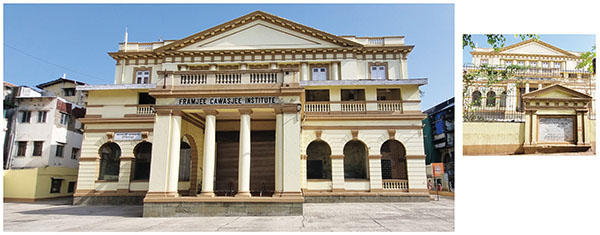
Above l: Framjee Cawasjee Institute; (above r) plaque acknowledging the
benefactor’s largesse in rebuilding the Framjee Cowasjee Tank
Photos: Jasmine D. Driver
Portrait of Framji Cowasji Banaji Photo: Farrokh Jijina
The People’s Free Reading Room and Library Photo: Jasmine D. Driver
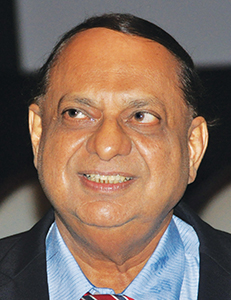
inset: bust of Framji Cowasji Banaji; below: Homi Ranina
This additional income would help maintain the building, erected in 1925, in a sound condition and additionally leave surplus to pursue the Institute’s scholarship program. Once a popular venue for public meetings, over the years the hall had fallen into disuse. The People’s Free Reading Room and Library on the premises continues to be well patronized. It is most frequented during examination season when several economically disadvantaged students living in one room tenements and others find it conducive to study here peacefully, observed Ranina.
For using the facility, the students pay Rs 500 per month or Rs 5,000 for a year. Open seven days a week at 9 a.m., students can sit here until 7 p.m. from Monday to Saturday, and until 1 p.m. on Sundays and bank holidays. While the library has a good collection of books, these are not much in demand as students prefer to depend on search engines and other online references.
When Parsiana visited the Reading Room, the entrance to which lies on the eastern periphery of the Institute building opposite Kyani and Company, there was an unexpected power failure. The unfrazzled students though continued to work with the limited natural light and ventilation on the ground floor premises. They showed no signs of restlessness or distraction as they remained immersed in their respective books and laptops.
Other organizations using space at the Institute are the World Alliance of Parsi Irani Zarthoshtis that has its office on the first floor, and Parsi Times, on the third floor in the annex building behind the heritage structure.
Last year the Institute was able to disburse more than two crore rupees (USD 242,640) as scholarships for higher studies in India to members of all faiths. Scholarships of Rs 30,000 to 40,000 (USD 364 to 485) each are given to meritorious students for higher studies in STEM (science, technology, engineering, mathematics) subjects. "Old subjects are no longer relevant in this day and age. A BA or BCom is of little value now. You can’t even be sure of a peon’s job after that. Machine learning, artificial intelligence, robotics are the subjects with better career prospects. Unfortunately, our community children don’t want to go into these subjects,” remarked Ranina.
The trustees are not in favor of using funds to encourage studies overseas. They have noticed that often students who are unable to secure admission in reputed institutions here, opt for foreign universities. More so if they have families willing to spend Rs 40 lakhs to 50 lakhs (USD 48,528 to 60,660) per semester for overseas studies.
Though it bears a Parsi name, FCI is "not a Parsi institute,” clarified Ranina. As stated on a plaque on the premises, its first trustees were Vishvanath Mandlik, Khurshedji Cama, Ganpatrao Bhasker and Sorabji Framji with Ardeseer Moos as the managing trustee. The old building of the Framji Cawasji Institute (the spelling in use then) was founded on February 22, 1862. The new building erected on the site of the reclaimed Framji Cawasji Tank was opened for public use by the Governor of Bombay Sir Leslie Wilson on January 13, 1925. At that time the trustees were Sir Dinshaw Wacha, Sir Jamsetjee Jejeebhoy, Jehangir Petit, Sir Hormusji Dinshaw and Dr N. A. F. Moos. In honor of the largest benefactors, the upper hall at the Institute was named The Sir Shapoorji Broacha Hall, and the Bombay Native General Library (originally established in 1845), accommodated in the rear hall and rooms on the ground floor, was named The N. M. Wadia Library.
Popular with the public
"For considerably over half a century Framji Cowasji Banaji was one of the most zealous and indefatigable promoters of moral and physical improvement and advocated a system of instruction which enabled the pupil in after years to earn his bread,” noted his brief life profile in Parsi Lustre on Indian Soil. "(As) one of the greatest of Bombay’s scientific agriculturists, the efforts he made on his estate at Powai in Salsette earned for him the title of ‘Lord Leicester of Western India.’ His intelligence, kindheartedness, benevolence, philanthropy, honorable as they were, were only surpassed by his stern integrity, candor, truth and perfect frankness for which throughout his crowded life he was so conspicuous. In him, the Parsis lost an enterprising and industrious sethia and the Bombay Presidency a good and great man,” added Parsi Lustre.
Two compilations with information on Banaji had been thoughtfully brought out for Parsiana’s reference by the librarian at the Reading Room, Gulshan Cooper. They were Framji Cowasji Banaji: A Great Parsi by Behman Sorabji Banaji, published in 1920 and Famous Parsis: Biographical and Critical Sketches of Patriots, Philanthropists, Politicians, Reformers, Scholars and Captains of Industry, first published in 1930 and reprinted in 2004. From there it was gleaned that on his passing away in 1851, Framji was the first Indian in whose honor a public meeting was convened where Hindus, Mahomedans, Parsis and Christians assembled together to raise a memorial to his valuable services "as a permanent testimony of the love and honor which the public of Bombay bore towards him.”
As per the resolution put before the public meeting at the Town Hall by philanthropist and educationist Jagannath Shankersheth: "He was not a scholar and for the last 10 years of his life he was not a wealthy man; indeed he secured the esteem and love of all who came within his influence… What were the qualities which now we esteem and love which he possessed of all the inhabitants of Bombay? His eminent good citizenship… Framji Cowasji exercised that virtue more than others of his countrymen; he was a steady good citizen, bold enough to speak out his opinion and energetic to do his country good. These virtues we are desirous to see universal.”
Framji was instrumental in founding the Native Public Dispensary. Appointed to the Native School Book and School Society, he opened the first Anglo-Gujarati School in the city under the name of the Native Education Society and served as director for 28 years. In 1836, he endowed a school for religious training called the Zand School. Besides being a member of the Students’ Literary and Scientific Society, he was also a member of The Elphinstone Institution and donor to the Grant Medical College. The cleaning, deepening and rebuilding of Dhobi Talao outside the Fort walls was yet another example of his largesse. The tank was subsequently known as Framjee Cowasjee Tank "by order of government to commemorate the late Framjee Cowasjee’s liberality in expending a large sum of money on its reconstruction in the year 1839,” reads a plaque with the message inscribed in English, Gujarati and Marathi on the peripheral wall of the Institute.
Though not born to affluence, Framji diligently worked as an agent under the tutelage of a family elder and went on to own six sea-going vessels (see "Of cultivation and compassion,” Parsiana, August 21, 2017). The lands leased to Framji spanned seven of the original 66 villages on Salsette Island and included Powai, Saki and Vikhroli. The first Indian to subscribe to the share capital of the Great Indian Peninsular Railway, he was also a co-founder of the Bank of Bombay and the Bombay Times that later evolved into The Times of India. Among his other accomplishments were the introduction of gas lighting at his residence in Mazagaon. Further, the women of his family were among the first to be educated.
Trusted and funded
Framji’s benefactions to the Parsi community included the building in 1845 of the Banaji Atash Behram at Charni Road in memory of his parents Cowasji and Jaiji, funded jointly with his brothers Curshedji and Rustomji and his nephew Dadabhai. In 1831 he had financed the construction of a dakhma in memory of his daughter Dinbai. Prior to that his donation of Rs 500 (six dollars) in memory of his deceased son Edalji had served as a nucleus for the Rawan Fund at the Punchayet, reported Sapur Desai in his History of the Bombay Parsi Punchayet 1860-1960.
As recorded in the landmark 1908 judgment by Justice Dinshaw Davar in Petit vs Jeejeebhoy, "In 1823, four members of the Punchayet — Wadia Hormasji Bomanji, Framji Cowasji (Banaji), Wadia Naoroji Jamshedji and Jamsetjee Jejeebhoy — were appointed trustees for the purpose of taking care of the Punchayet moneys.” Though trustees of funds only, they also managed the three dakhmas, a sagdi, and sagdiwala’s house at Doongerwadi and the nasakhana at Fort.
Prior to that, the Punchayet monies were kept by the Davar famly until 1811 and by Hormasji Bomanji Wadia between 1812-1823, according to Desai. He further referred to a crisis in 1836 when "The moribund Punchayet was under attack by three prominent trustees — Naoroji Wadia, Framji Cowasji and Cursetji Maneckji.” Framji Cowasji has been described as "a reformer of a moderate type…(who) had frequent wordy strifes with his colleagues on the Punchayet board in the best interests of his community.” He nevertheless continued his association with the Punchayet until his death. But before the first formal trust deed of 1851 was formulated with five trustees — Sir Jamsetjee Jejeebhoy, Naoroji Wadia, Cursetjee Jamsetjee, Maneckji Limji and Maneckji Nusserwanji Petit — Framji Cowasji had died.
"Dereliction of duty”
Framji Cowasji had been entrusted with Punchayet funds in 1823. Two hundred years later, the Punchayet finances are in a precarious condition. If a charitable organization like the Framjee Cawasjee Institute can manage to effectively raise and use its funds, can the Bombay Parsi Punchayet not succeed too?
When we asked Ranina, former BPP trustee and a legal expert on taxation, on how the BPP’s financial crunch could be salvaged, he suggested raising the parking charges in Parsi colonies. "If the Bombay Municipal Corporation can levy fantastic charges, upwards of Rs 70 for parking on the road for one hour, why can’t the trustees charge Rs 8,000-12,000 per month when there are thousands of cars, including Mercedes, Toyotas and Audis, parked in Parsi colonies that provide security within the compound?
"Trustees could be held guilty of dereliction of duty for not charging rates which are market related. But the trustees don’t want to do it because they are worried about their vote bank and relatives. If any occupants protest, let them go to court and challenge” the levy, asserted Ranina.
He was critical of the "hundreds of flats kept locked in baugs by people settled abroad who are happy to pay three dollars (Rs 250) a month as rent! They are taking advantage of the old, outdated Rent Control Act that gave protection to the poor and needy in Bombay. The purpose of these flats is to be occupied. Why can’t the trustees take action? Throw them out.” Being a trustee of The Zoroastrian Building Fund that owns a residential colony at Chikalwadi, he mentioned they are taking possession of flats lying vacant and offering them on leave and licence, at a higher fee, to those who would use them.
Ranina also failed to understand why there has been no progress in the construction of the ownership building at Godrej Baug which can fetch the Punchayet a corpus of around 100 crore rupees (USD 12.1 million) even if it is sold at Rs 50,000-60,000 (USD 606 to 728) a square foot, a price considerably lower than the market rate (Parsiana has learnt that this building is to be torn down and reconstructed). .
If the Punchayet funds are augmented "this would help in the maintenance of Doongerwadi, pay salaries to the staff and use the balance for charity. For the elderly (indigent) Parsis, instead of giving them doles, send them daily meals. That is the best form of charity,” he is convinced.