The Tatas, Freddie Mercury & Other Bawas: An Intimate History of the Parsis by Coomi Kapoor. Published in 2021 by Westland Non-Fiction, an imprint of Westland Publications Pvt Ltd, 1st Floor, A Block, East Wing, Plot No. 40, SP Infocity, Dr MGR Salai, Perungudi, Kandanchavadi, Madras 600096. Pp: xi + 308. Price: Rs 699.
The foundational contribution of the Parsi community to industry, science, arts, social reform and philanthropy is too well-known to bear repetition but Coomi Kapoor’s (pictured) The Tatas, Freddie Mercury & Other Bawas: An Intimate History of the Parsis is a 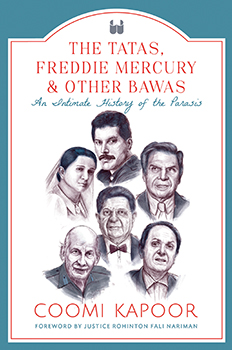 welcome addition to the literature on the Parsis. This book is largely a celebration of the material and cultural legacy of the community, and while much of the ground she covers will be old hat to many senior Parsis, her offering will be of great interest to the younger generation unfamiliar with its own history, and perhaps only dimly aware of the great contributions of its forebears.
The author begins with an introduction to her family and its origins. Kapoor’s interest in the history of her community and her own roots began during a visit to Sanjan, Navsari, Udvada and Surat. On being asked if her ancestors hailed from Navsari or Surat, she had to confess her ignorance. Later, as she explored her family tree, she learnt that her paternal family was from Surat, and her mother’s from Navsari; her maternal grandfather, Dastur Nosherwan Jamasp Asa, was the high priest in Poona.
Kapoor describes the great ancient empires ruled by Zoroastrian kings and also briefly narrates an account of the arrival of the Parsis in India.
The first chapter engages with the Ratan Tata-Cyrus Mistry controversy and the peremptory sacking of the latter in less than an hour. The confrontation made national headlines and set off tremors in the stock market. Kapoor believes that the controversy was a defining moment for the Parsi community. "The histories of the Tata, Wadia and Mistry families are integral parts of the saga of the Bombay Parsis,” Kapoor observes. She says that what added to the drama was the fact that Nusli Wadia sided openly with Mistry against Ratan, his friend and long-time business ally.
Kapoor’s briskly summarized histories of the Tatas, Wadias, Mistrys, Godrejs and the Poonawallas are a delight to read. She recounts a brief history of the Tatas, much of which will be familiar territory for many. However, what many readers will find of particular interest is the role played by the lawyer, financial wizard and real-estate owner, F. E. Dinshaw, in Tata history. A director and financial adviser to numerous companies, including royalty, he also pioneered the cement business in India when he played a catalytic role in the merger of 10 companies to form ACC (Associated Cement Companies) Ltd. When Tata Steel was in trouble and Sir Dorab pledged his wife’s jewelery (including the famous Jubilee diamond) as collateral for a loan, it was Dinshaw who provided the remaining surety. Kapoor also narrates some interesting titbits about his personal life: he had a liaison with a "courtesan of Indo-European stock” and what made it unusual was that he was on intimate terms with the niece of his mistress as well. He went on to sire many illegitimate children including one who closely resembled his father and sat at a certain company’s boardroom meetings under the portrait of his natural father.
 Lovji Nusserwanjee Wadia, Nusli Wadia’s illustrious ancestor was the founder of Bombay’s shipping industry. The Wadia family beginning with Lovji in 1730 led the migration of the influential shipbuilders to Bombay from Surat. Invited by the British to establish a dry dock, he built ships which were of the highest class. The American national anthem by Francis Scott Key was composed on a Wadia vessel, the HMS Minden in 1812, and Hong Kong was ceded to the British in 1842 on another Wadia ship, the HMS Cornwallis.
The Parsis changed from being mere shipbuilders to owners. They bought ships and began trade, first along the Malabar coast, before entering the very lucrative China trade. Lack of caste prejudice, a facility with languages and a reputation for honesty helped them to amass much wealth. The Camas, Banajis, Readymoneys and Sir Jamsetjee Jejeebhoy were all linked to the China trade. With no caste system to weigh them down, and no interdictions on crossing the seas, they participated in the lucrative overseas trade with China.
Huge fortunes were made from the opium trade and a look at Parsi philanthropy shows that the greatest traders in opium were also the greatest benefactors of Bombay. Many of the fine public buildings, colleges and hospitals owed their origin to the liberality and public spiritedness of the Parsis. There are close linkages between the opium enterprise of western India and the creation of early Victorian Bombay. A fact which most discussions on Parsi philanthropy tend to ignore is the role played by profits from the opium trade in the Parsi charity of the times.
Then there was Jeejeebhoy Dadabhoy, an agent, broker, banker and merchant who is known as the father of the industrial age in Bombay. He started a steam navigation company (the Bombay Steam Navigation Company), due to which many more people started migrating to the city. He helped set up the Bombay Chamber of Commerce and also played a role in the establishment of the Great Indian Peninsula Railway. The agiary in Colaba which bears his name is well-known in South Bombay, but perhaps not too many know who he was, and what he did.
The same forces which led to educational and economic progress also led the Parsis to move from a parochial to a national outlook: they were Indians first and Parsis later. The early Parsi leaders, the sethias, had cooperated with the British resulting in them being recognized as leaders of the Parsi community. If the Parsis were considered among the most loyal of colonial subjects, then it was also from their ranks that individuals who would shape the foundations for the self-government of India would emerge.
The rise of the Parsis within the nationalist movement was in consonance with the intellectual maturation and politicization of educated Indians: the careers of the nationalists are examples of the transition some Parsis made to a sense of national identity. Kapoor could have devoted more space to both Dadabhai Naoroji and Sir Pherozeshah Mehta. Dadabhai gets only a brief biographical profile; Sir Pherozeshah none at all. The latter was president of the Bombay Municipal Corporation four times, but was never the municipal commissioner, a post which was reserved for civil servants. This is a common mistake and one which Kapoor also makes.
Described as an intimate history of the Parsis, Kapoor’s book attempts to tell the story of the community by shining a spotlight on its prominent members down the centuries. The cast of characters in her book is both wide and varied, from businessmen, lawyers, doctors, academicians, to politicians and cultural icons like Zubin Mehta and rock frontman Freddie Mercury (born Farrokh Bulsara), who disowned his Parsi roots. Both Mehta and Mercury are more famous outside India than in it; perhaps if there is a poll Mercury might just pip maestro Mehta as the world’s most famous Parsi ever.
The architect of India’s nuclear energy program and the founder of the Tata Institute of Fundamental Research (TIFR), Dr Homi Bhabha, deservedly figures in the "iconic four.” Bhabha was also an artist of rare skill and feeling and could have been a successful painter had he chosen to be one. His paintings adorned the walls of his home Meherangir in Bombay’s tony Malabar Hill. His own talents as an artist made him especially sensitive to the aesthetics of his surroundings, and the two institutions which he established and guided till his death, the TIFR and the Bhabha Atomic Research Centre, Trombay, have a rare beauty reflecting this facet of his life. Theoretical physics was his forte but he could have risen to the top in any of half a dozen other fields. He would have made a brilliant architect, and the TIFR building with its splendid proportions and open spaces stands testimony to his genius for design. It was also filled with one of the finest collections of modern art in the country.
Anecdotes, titbits and unusual details make the book lively and interesting. For instance, we are told that Charni Road derives its name from the grasslands Jamsetjee Jejeebhoy bought for the use of cattle-owners, who were finding it difficult to pay the grazing fees imposed by the British. Jejeebhoy was also responsible for introducing the famous tanchoi sari in India when he sent three Parsi weavers from the Jokhi family in Surat to China to learn the technique of jacquard weaving. Ardeshir Godrej, founder of the Godrej empire, was inspired by the Swadeshi movement to design an indigenous lock; and it was at the prompting of Bal Gangadhar Tilak that he created a quality soap to compete with imported brands. The eccentric Ardeshir once issued a statement challenging any member of the public to break open the new safe that he had designed. Three professional safecrackers tried but met with failure.
Kapoor tells us that Field Marshal Sam Manekshaw was so grievously wounded in Burma in 1932 that the doctor refused to treat the injured soldier, and only changed his mind when Manekshaw’s loyal orderly Sher Singh (a Sikh and not a Gurkha as mentioned in the book) forced him to do so. Nani Palkhivala, who had topped the MA exam at Bombay University, had assumed he would be appointed lecturer. When the post went to a Parsi woman instead, he opted to pursue a law degree because that was the only course still open. The story goes that Palkhivala was so grateful to the woman for inadvertently steering him towards the legal profession that he treated her to a hearty meal every year.
The role of Parsi women in education, philanthropy and in India’s independence struggle, also offers interesting insights into their early emancipation. Parsi women, the author tells us, exhibited two important characteristics: empowerment and a deep social conscience. Among the more remarkable women was Bombay-born revolutionary leader Bhikaiji Cama, best known for unfurling a precursor of the Indian flag at a conference in Stuttgart, Germany, almost 40 years before India became independent. A rebel, she quit her job as Naoroji’s secretary and went to London, becoming part of the extremist wing. Sadly, when she returned to India in the last years of her life, her community ignored her. There are other women as well: Homai Vyarawalla, the pioneering photojournalist; photographer and scriptwriter Sooni Taraporevala; actress Persis Khambatta; philanthropist and ex-MP (member of parliament) Anu Aga; and cricketer Diana Edulji. A notable omission is Cornelia Sorabji, lawyer, author and social reformer who was the first Indian woman to study law at Oxford University. Perhaps the author chose to ignore her because her family had converted to Christianity.
Kapoor also gives us a look into Parsi society and its baugs, the decline in the birth rate, the conservative and reformist initiatives within the religion and the discrimination against women who marry out of the community and the fact that children born of such alliances cannot become Zoroastrians. The author ends on an optimistic note, hopeful that the community will survive despite its steep demographic decline.
The book is written in a racy, entertaining style and holds the reader’s interest throughout, something which is only to be expected when a seasoned journalist uses her skills to chronicle the history and achievements of her community. Kapoor covers a lot of ground in what is a medium-sized volume and deserves to be complimented for the ease and panache with which she has accomplished her task. It is not necessary to read the book from start to finish (although it is something this reviewer advises the reader to do). One can dip into individual chapters with both profit and pleasure: many of the chapters in the book can be read as standalone articles since the book is theme-based and does not follow a linear narrative. That said, I found it a little odd that the Poonawallas are discussed before the Godrejs. There are a few proofing errors, and some minor factual ones which I am sure will be corrected in the next edition of the book. These, however, in no way detract from what is otherwise a riveting read.
BAKHTIAR DADABHOY
Dadabhoy is a Bombay based bureaucrat and author.