"The time devoted to sharpening knives or oiling machines is not wasted …it makes the time spent on work quicker and productive,” stated Ervad (Dr) Ramiyar Karanjia. The principal of the Dadar Athornan Institute (DAI) was speaking at the 190th salgirah celebrations of the Mancherji Jamshedji (M. J.) Wadia Agiary in Lalbaug on June 30, 2024. Karanjia is also the course director of the Agiary’s structured religious course. Expanding on the theme of "Worshipping Ahura Mazda in the jet-set age,” Karanjia was drawing an analogy. "Not devoting time for the health of our mind and spirit is foolish… We end up devoting more time for other chores and work.” Complete focus on the prayers helps. "Two percent of the day (30 minutes) for the betterment of the rest of 98% is not too much to ask for.” Pray in small packets of minutes and seconds, he advised. "These small packets will add up to very handsome reward points in terms of benefits to the mind, spirit and body.”
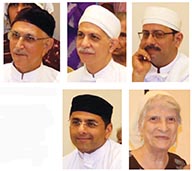
Clockwise from above l: Kersi Limathwalla, Ervad (Dr) Ramiyar Karanjia,
Ervad Kersi Bhadha, Armaity Tirandaz, Viraf Mehta
From l: Meheraaz Delkhah, Parinaz Guard, Rustom Tirandaz
Audience at M. J. Wadia Agiary’s 190th salgirah
"Pray, attune and be ‘linked-in’ with Ahura Mazda,” was the message of Kersi Limathwalla, chairman of the Agiary Trust. Exhorting that one should remember Ahura Mazda "all the time,” he stated, "Clean the mind of negative thoughts, jealousy, anger and hatred… Fill the soul with love, sharing, caring and compassion.” Lamenting the lower attention span in youth, "with virtually zero focus,” Limathwalla cautioned against mental fatigue, low clarity of thought and lower productivity. "This is an age which can be salvaged with farajyat prayers, or Hoshbam, or even by small capsule prayers like nirangs,” he stated.
Chief guest Bombay Parsi Punchayet chairman Viraf Mehta commended the structured religious course run at the Agiary for 17 years, under Karanjia’s watchful eye. "Where is the community youth? Why is the youth so laid back in visiting our agiaries and atash behrams? Why are inter-caste marriages rising so drastically? Will we see a hall so full of Parsi brethren 25 years from now?” Agiary panthaky Ervad Kersi Bhadha recommended the youth start with basic prayers then move on to the more complex ones.
The lighter part of the evening included monajats and a Shahnameh recital by DAI students Barjis Bharda, Ziyaan Turel and Delyaz Panthaky; a song by Meheraaz Delkhah; a ballet performance by Parinaz Guard; a nunchaku (martial arts instrument) display by Rustom Tirandaz. BPP trustee Armaity Tirandaz rendered "a thought-provoking poem on our constant companion — God.”
A hama anjuman jashan led by Bhada and a monajat rendered by Maidyorem Chinoy of the DAI had kicked off the evening. The master of ceremonies was Roxane Desai. Refreshments were provided by Kersi Guzder of Grub Corner and non-alcoholic beverages by Feroze Sethna of Sethna Agro.
The Agiary was established by two businessmen brothers Dadabhhoy and Mancherji Pestonji Wadia in 1834 on their private estate, close to the place where the present Agiary is situated, noted Karanjia. "The brothers personally took care of the fire temple from their funds.” By 1850, the businessmen suffered a setback. In dire need of money, the brothers mortgaged their estate, including the fire temple building. Declared bankrupt, the estate was auctioned in 1851 for Rs 42,000. "The Wadias and the BPP pleaded with the authorities that the fire temple be spared, but the authorities did not agree. The courts decreed that the fire temple building be given away as bankruptcy dues, and the sacred fire be shifted to another place. Moved to the H. B. Wadia Atash Behram for a decade in 1853, one of the brothers’ descendants, Mancherji Jamshedji Wadia, decided to bring back the Agiary near to where it belonged. He had another building constructed. When he passed away just before the building was finished, his sons Nasserwanji and Burjorji completed his work, and the consecrated fire was then shifted there in 1863. "The sacred fire is since burning in this building for more than 160 years…The existing fire temple building underwent a few alterations and facelift in 2007.”
Karanjia told Parsiana later that he had culled out the history of the place of worship from Marzban Giara’s Global Directory of Zoroastrian Fire Temples; past issues of Parsiana; B. B. Patel’s Parsi Prakash and Parsi Dharmasthalo.
F. J