Navjot Altaf – The Thirteenth Place by Nancy Adajania. Published in 2016 by The Guild, 28, 3rd Pasta Lane, Shahid Bhagat Singh Road, Colaba, Bombay 400005; email: the guildart@yahoo.com, the guildart@gmail.com; website: www.guildindia.com. Pp: 314. Price: Not mentioned.
.jpg)
For those who are not familiar with the work of the contemporary artist Navjot Altaf and her involvement as an activist at Bastar, Madhya Pradesh (MP), the last segment may prove to be a key to understanding some of it.
It provides the most succinct image for the intriguing title — The Thirteenth Place — that also forms the visual image on the cover. It’s been called a Pilla Gudi. Described variously as a play-house and a dialog center, the Pilla Gudi takes different forms. At its simplest, it could be called an open-air community center built by and for the people using it. It could be compared to a visual Zen kaon, a puzzle that unravels Navjot’s life as an artist and the astonishing amount of work that she has created over four decades and more.
To make what will certainly be viewed as a frivolous comparison, given the serious nature of Navjot’s work, by the end of this extraordinary study by art scholar and cultural theorist Nancy Adajania, this reviewer was reminded of the character Forrest Gump, in the 1994 film by that name. In the same way that Tom Hanks, the actor playing Forrest Gump, finds himself at the epicenter of actual historical events, Navjot has been at the barricades at some of the critical turning points of post-Independent India’s cultural history. She uses her strengths as a woman artist, with a Marxist perspective, to record, annotate and critique her response in ways that are reproduced in the images and text in the book.
Adajania, who has tracked Navjot with a zeal that is almost as rigorous as the artist’s own trajectory from commercial success in the art world to finding a new methodology of communication with people on the outside of it (one hesitates to call them tribal), has an epiphany when she views the empty space in the circular structure of a Pilla Gudi at Shilpi Gram, MP.
Or as she tells us: "One afternoon during the colloquium, I found myself in a Pilla Gudi built at Shilpi Gram in early 2000. Its open circular form had the effect of stilling the mind, centering the self. As I looked around the circle of 12 concrete seats, I noticed an anomaly in my count. The 12th seat seemed to dip away somewhat -- and there next to it, provisional but no less definite for that, was a break in the pattern, a place of potential: the 13th place.”
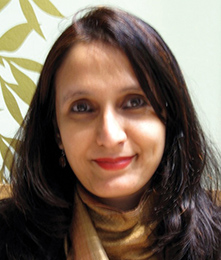
Navjot Photo: Sasha Altaf; (front row, from l): artist Rajkumar, Adajania, artist Sudhir Patwardhan
and Navjot Altaf at the launch of the book at The Guild Art Gallery, Alibaug; Photo: The Guild
The 12 seats could be said to correspond to the different phases in Navjot’s life. Her artistic journey began with her formal education at the J. J. School of Art (1967-1972). Her interactions with the minimalist artist and her contemporary Nasreen Mohamedi was to hone her own approach to creating a formalist approach to design. Her marriage to Altaf, Nasreen’s brother, also an artist and Leftist, was to introduce her to a entirely new way of negotiating the demands of a conventional art education with the incendiary writings and social upheavals taking place in not just the country but the world over.
Navjot’s "Protest Posters” pillorying the war in Vietnam, the one of a local child abandoned on a railway track close to Matunga, the protest marches against the Shah of Iran, against the Emergency, to mention just a couple of instances that stirred the conscience of young artists, theater performers, poets like Adil Jussawala, or activists like Kobad Ghandy, make for a salutary reminder that many were called. They rose, they responded, they sacrificed their lives in some cases (like Anuradha Ghandy, a senior Marxist leader who passed away in 2008), but the question remains: was it enough?
Navjot’s record as an artist as depicted in this book might be an answer. Adajania’s meticulously researched re-enactment of what motivated Navjot is what makes it worthwhile. She bears witness to the singularity of purpose that propelled Navjot into creating her often deeply disturbing and contentious pieces of work.
The writing, however, is not for the fainthearted. Here for instance is just one of the paragraphs wherein Adajania explains her methods: "This little adakatha or digressive by-story is not peripheral to Navjot’s narrative. Rather it sheds light on the many contradictions that an anthropologist or an artist, and their informants or collaborators, have to face in such socially fraught situations. My decision to analyze Navjot’s artist-as-anthropologist approach in the meso-realm between anthropologist Clifford Geertz’s ‘thick description’ and Margaret Mead’s ‘divinatory’ method is meant to keep the paradoxes of artistic research in play without resolving them through neat binaries.”
Fortunately, Navjot’s reproduced works and the photographs of her own warm personality that come out in her interactions with her artist collaborators are just fine. These must be ‘divinatory’ rather than thick descriptions. Now if we can place Navjot in the meso-realm of Forrest Gump we may have gone some way in understanding the text.