Stree Bodh, a women’s journal talked of feminine interests 150 years ago
Mehroo Kotval
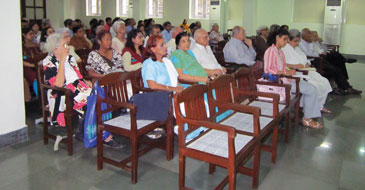
"This paper is a tribute to women who went against social prejudice,” stated Kaizeen Jehangir who along with Devaki Dhuldhoya from St Xavier’s College (SXC), presented a paper titled "Stree Bodh: The Journey Of Educational Progress Of Women” on August 3, 2012 under the auspices of the K. R. Cama Oriental Institute (KRCOI). Stree Bodh (SB), meaning women’s wisdom was a 19th century Gujarati journal. Terming the duo "emerging research scholars,” Dr Nawaz Mody, chairperson of the research committee of the KRCOI spoke of the students’ "hard work and persistence,” that made this research paper possible.
Principal Fr (Dr) Frazer Mascarenhas, who presided over the function, stated that SXC was one of the first colleges to admit women. "The women students were overwhelmingly Parsis… this year is the centenary of admitting women” in the College.
Catering to the times
 The journal’s objective was "emancipation of women through 93 years of its existence.” The publication also dealt with conditions prevalent in the 19th century urban colonial social milieu and trends of the time. The findings of the students were based on 120 issues of SB, examined at intervals of a few years (1858, 1878, 1885-87, 1917-18, 1930 and 1940) between 1857 and 1950 — the years of its publication.
The researchers highlighted the difficulties of female education, partly due to social prejudice and "compounded by dearth of women teachers. Thanks to missionaries, this was somewhat possible. It was the Aryan principle — the Zoroastrian belief of considering ignorance is a curse — that saw Parsi women being educated. Parsis adapted and used the British to further their progress, thus you have the likes of Dadabhai Naoroji, Sorabji Bengallee and K. R. Cama. The first school for girls was established in Bombay in 1824,” the young Jehangir said, the first English medium school was the Alexandra Native Girls’ English Institute in 1862, the current Alexandra Girls’ English Institution Bombay, founded by Manockjee Cursetjee.
Against the backdrop of the first ladies’ magazine — Mercury in England in 1693, which dealt with love, marriage, humor — journals arrived late in India in Gujarati, the first being The Bombay Samachar (1822), followed by Jam-e-Jamshed and Rasta Goftar which catered specifically to men and was pro-British. Satya Prakash was also an Indian newspaper with Parsi clientele.
Weaving in women’s wisdom
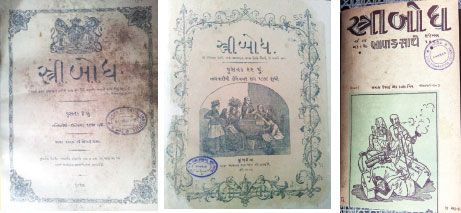 SB was started in 1857 against the backdrop of Indians rising against British rule, with the first editor Behramji Gandhi conscious about not ruffling feathers further. The discourses, only in the vernacular and not in English, catered to a wider readership. The writing was prescriptive as to how to be good women. In 1911, the researchers specified that there were 662 Parsi, 413 Christian, 59 Hindu and 44 Muslim literate women in Bombay. Jehangir and Dhuldhoya stated that illustrations for SB came from abroad. They came to this conclusion as the illustrations do not have Indian context and settings. Pictures, though expensive, were printed in India.
.jpg) SB mirrored what was happening in society at that time. Political commentary was non-existent. Similarly, there were no recipes, no tips for beautification. The two ladies believe this may be so "as women who read SB may never have gone into the kitchen.” The journal also did not touch upon any religious discourses and seemed to be secular. In fact Jehangir labored the point that "there were no stands taken — either social or religious. It was a purely educative journal… Maybe they thought women not capable of critical thinking…”
SB mirrored what was happening in society at that time. Political commentary was non-existent. Similarly, there were no recipes, no tips for beautification. The two ladies believe this may be so "as women who read SB may never have gone into the kitchen.” The journal also did not touch upon any religious discourses and seemed to be secular. In fact Jehangir labored the point that "there were no stands taken — either social or religious. It was a purely educative journal… Maybe they thought women not capable of critical thinking…”
The young ladies observed that education was initially imparted only to royal Indian women whilst western educated women came from all strata of society. They also acknowledged how difficulties faced by women of the past bore fruit for the women of today.
Dhuldhoya, who reads Gujarati, said Gandhi who tried to exert influence, attempted to groom at least one student to succeed him. He wanted a ‘laekawali aurat’ (a lovable woman) in the western mold. He lamented that western women had all kinds of role models but Indian women did not because they were non-political. The editor laid emphasis on topics that would "affect her (the readers’) children,” household tips, information on different countries, on animals and on garbas. One entire issue was on garba ank (dance). Gandhi wrote that women in 1858 in the West had higher status.
"The SB only gave facts about knitting, household duties (what we call home science today), selecting home essentials. There was no coverage about science, mathematics, etc. Today information imparted in journals is part of the education curriculum and is taught,” they expounded. The scholars also noted how Parsis were insulated but had assimilated the culture they lived in, leading to use of language from Parsi Gujarati to Gujarati.
Kaikhushru Kabraji brought in changes as the second editor in the magazine. He wrote an article on whether life is sustainable on the moon. Kabraji was pro-British and believed that Indians "deserved to be taken over by the British.”
It was not before 1885-87 that articles written by women started appearing, the researchers claimed. Kabraji’s daughter-in-law Putlibai wrote in SB as did women from Mysore and Hyderabad. On Kabraji’s death in 1904, Putlibai became editor in 1905, almost 50 years after the magazine’s founding. There was much scepticism about her zeal and competence.
The subscription charges were raised from Re 1 to Rs 2 per annum. Advertisements became more frequent and, therefore, revenue. A supplement for children was added and was confined to education. Contributions to this journal came from Karsanlal Mulji — the only non-Parsi editor in the history of SB — as well as some Parsi benefactors.
Some of the reasons for SB’s closure seem to be that the objective of spreading awareness and educating women in English was achieved by 1950s. Indian men were aware of the power within woman and they had begun to "awaken” the Indian woman "making her aware.” It was a philanthropic journal and started having limited readership.
Learning from the written word
 Articles on what influence women have on children, how to take care of jewelery and children, "differences between then and now” were debated and fleshed out. Horizons expanded by going outside national boundaries. Dhuldhoya commented how subjects debated were superficial and stereotyped women. The young historian stated that SB "became patriotic in the 1930s and by the 1940s it talked of academic achievements of women.” In the ’30s, contributions by women were welcome but authors’ names were not written nor were editorials by women published.
The scholars’ first encounter with reading SB at the KRCOI was so daunting that they almost gave up the project due to linguistic difficulties with old Parsi Gujarati. Dhuldhoya also pointed out how some words typical of Gujarati, not prevalent in Parsi Gujarati like chhé (is), had crept in. The students encountered enough difficulties to stretch their patience — bureaucracy at several steps, permissions to be sought, egos to be pandered to. Only assistance from some helpful persons made the adventure worthwhile.
This project helped the two researchers gain practical knowledge and step out of the education institutional space. KRCOI had in its archives, SB issues up to the 19th century, the others being traced to the J. N. Petit Library in Bombay — these two libraries being the only ones known to possess the journals, documenting the early lives of women mostly by women. The students had no past points of reference for SB to fall back on as this was a pioneering effort. They were staunchly backed by their guide, Fleur D’Souza, SXC’s head of the history department.
Mascarenhas informed the audience that SXC was granted autonomy three years ago "which enabled the College to construct and design our own courses,” initiating students into research. Thus this project was born. These students who undertook the project were interns of history with average grades of 3.6 and 4 and also participated enthusiastically in other College activities.
The neophyte researchers answered questions with aplomb and confidence, commenting on the fact that there is no comparable magazine today, meant only for edification. Mody of KRCOI felt so encouraged with this effort that she is anticipating similar projects based on their valuable archives in the future.