The sleepy, little seaside village was an escape,
a sanctuary, a gastronomic paradise
Zarin Virji
For a little girl living in a cramped flat in Bombay in the 1960s Saronda signified an escape to green fields and blue skies. It was a sanctuary of peace, love and unending pampering by my grandaunt Shirin Ratansha Patel and her majordomo, Savitri Dubla. Every wish was granted even before it was expressed. For a foodie like me, it was a gastronomic delight; I have never tasted better Parsi food than the meals cooked on our wood-fired stove, which later sadly made way for a gas stove. Was it the water or was it the freshness of the ingredients that enhanced the taste?
Top: verandah of the family home in Saronda
Details of carvings on doors
Clockwise, from top: Saronda dispensary; agiary; beach; monsoon pond
Saronda, a sleepy, little seaside village in south Gujarat with a population of 3,000 is largely unknown while its neighbor, Nargol, enjoys better optics and Sanjan, understandably, even more, being the place where Parsis were welcomed after their exodus from present-day Iran. And yet, in my childhood, if one asked any Parsi from Saronda what they thought of Nargol or Sanjan, they would inevitably turn up their noses. Sanjan was in some ways tolerable because the railway station was located there, but Nargol was described as "mosquito-infested with air that made people sick.” The rivalry between Nargol and Saronda was fierce, spilling over into their cricket matches as well. Truth be told, I’m just as biased towards Saronda, my storehouse of pleasant memories.
My paternal grandfather’s house in Saronda was a delightful little cottage, but I hardly stayed there because my grandmother’s sister, Shirin, better known as Silloo aunty, would insist that we live with her in the cavernous heritage home built by the Bhiladwalas, my great-grandmother’s family. This corner house, constructed around the 1750s, is an architectural masterpiece immortalized in the book, Living with Memories — Parsi Dwellings in Early Settlements of Gujarat, co-authored by Snehal Nagarsheth and Pallavi Chilleriga (published by SID Research Cell, School of Interior Design, CEPT University, Ahmedabad in 2009). Other than replacing the cow-dung coated flooring with stone and periodic roofing and whitewashing, the house remains more or less untouched. I’m told eggs and toddy were used to cement the walls, making it stand strong even today. "Stretching along the length of the street at 20 m, the strong presence of the house is enhanced by the beautifully carved exterior of the main door and the exquisite painted fresco on the front porch… Careful observation reveals at least four different designs that have been employed, blending seamlessly into each other, exhibiting the fine skills of the craftsman and the high quality of art,” write Nagarsheth and Chilleriga.
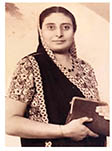
Shirin Ratansha Patel
Diagonally across from this house is the dispensary, established in 1914 thanks to a contribution of one lakh rupees by my great-great-grandmother in memory of her young son, Manchersha Jivanji Bhiladwala. It is a matter of pride that even today The Saronda Dispensary Charity Trust continues to serve not only our village but the neighboring villages as well. During my childhood one Dr Dalal ran the dispensary. He could not only sniff out diseases, but was a gifted storyteller. Every evening we would listen spellbound as he described his cases in the dim light of a lantern; alcoholism, snake bites and tuberculosis being the main culprits that sometimes claimed the lives of his patients. To me, he seemed like a detective and magician rolled into one. The bond between his family and ours has continued into the next generation. About 30 years ago, the dispensary passed into the hands of Dr Bharat Kadu, another able doctor.
As the houses were built close to each other one could not avoid seeing the comings and goings in every household on our street. However, most Parsi houses remained uninhabited until families arrived during the school holidays. During the summer vacations my peers would congregate in our home where we played card games like bhabret and pisnicot. On most days I would be curled up on the easy chair or on the swing on the verandah, reading a mystery book, listening to birdsong, occasionally looking up at the swaying trees. After lunch I would accompany Savitri to her home, a stone’s throw away, where she ate lunch with her bedridden mother, Barsi. Later, Barsi, who had served our family in her prime, would regale me with stories of my ancestors. I loved playing dress-up with Savitri’s half-saris and payals (anklets), a practice not encouraged by my grandaunt.
Evenings meant walks to the beach or the creek, rarely to Nargol. Sometimes the village girls would tag along and we had fascinating exchanges, getting insights into each other’s worlds. Some days I accompanied Manchhi to the well to try drawing out water and balancing a pot on my head or at my waist to carry back to the house, most of the water spilling out before I reached home. Although my family did not keep pets, we always had one or two cats and dogs who "adopted” us. My grandaunt did not fuss over the animals, but I was crazy about them, feeding, caressing and consoling the dogs during their weekly baths. One thing I disliked about the house was the lack of modern sanitation. We had two moris (washing areas) in the house but the toilets were outside. My grandaunt would warn me about scorpions, bugs and bees lurking in the toilet enclosure. I would insist on Savitri escorting me to the toilet during the day but avoided stepping out at night.
Frescos on the front porch
Every season stole into Saronda bringing its own dance and rhythm. The mildness of winter mornings didn’t stop me from snuggling into my razai (warm covering) longer than necessary. Walking to Nargol on the beach in the crisp winter evenings was both invigorating and liberating. As papdi (field beans) was plentiful, umbadiyu was a must-have dish in winters. For the uninitiated, umbadiyu is a delicacy of South Gujarat comprising papdi, raw bananas, eggplant, sweet potato and peas cooked in an earthen pot half-buried underground. It is imbued with a distinct smoky flavor thanks to the cow dung and hay used to fire up the clay pot. Another family favorite was the packed-with-nutrients ghungri, a breakfast special. Cracked wheat, coconut milk, sugar, dry fruit and milk went into its preparation; everything was done at home right from pounding the wheat. Silloo aunty didn’t particularly enjoy the prospect of making ghungri because of the tedious process but she invariably gave in to our appeals. The flowering of the mango trees was watched with great anticipation as it foretold how good the harvest would be, provided unseasonal rains didn’t cause havoc. Once the raw mangoes were ready, Silloo aunty and her string of helpers began to pickle them. From the bland pani nu achar to the fiery methia nu achar and everything in between, our storage room quickly filled up with a number of gigantic pickle jars. She would share her pickles with friends in the village and we carried back to Bombay quantities large enough to last us through the year.
Towards the end of May, bullock cart after bullock cart would carry mangoes of every variety from the farms in Bhilad and Talvada. The smaller-sized mangoes went into dals, curries and salads while the choicest fruit was cut and consumed as dessert.
On summer afternoons we lay barely breathing in the heat and humidity. Silloo aunty, bless her heart, would fan us, sweat running down her face. Electricity made its advent in Saronda sometime in the 1970s, but the supply was wildly erratic until about 15 years ago.
Evening walks to the beach provided some respite from the strong sun. It was a solitary girl’s delight, because of the shells I could collect and the sand castles I could build. Lined with rows of casuarina trees, the beach was unspoilt until chemicals from the Gujarat Industrial Development Corporation in the Vapi-Sarigam belt began to leave dark, greasy streaks on the sand. Monsoons in Saronda were magical. The rain water running silently down the Mangalore-tiled roofs was quickly swallowed by the parched earth. Strong breezes blew, sometimes damaging the bridge connecting us to Sanjan. My aunt supervised sowing and transplantation in the rice fields seated on the protected vantage point of our verandah, trusting her workers to do the job honestly and efficiently. And meals comprised titori and crisply fried Bombay ducks stuffed with green chillies on rain-soaked evenings.
No sojourn in Gujarat was complete without a visit to the farms of my granduncles. Murzban Ratansha Patel had a farm in Bhilad, while Sheriar Ratansha Patel’s was in Talvada. Although both farms lay barely off the national highway, the mango orchards and rice fields that abutted them made them feel more remote. While the never-on-time state transport bus was one way of getting to Bhilad and Talvada from Saronda, my chariot of choice was always the bullock cart with its slow, rhythmic bone-rattling motion.
I can never forget the two or three weeks of my study holidays before my BA examination that I spent in Talvada. My grand aunt Coomi spoiled me silly, ensuring that I ate almonds every morning followed by a breakfast of eggs, murabba and rotli. She and Sheriar uncle would not let me take long afternoon naps and would ensure that my nose remained buried in Shakespeare, Jane Eyre and Milton. My excellent graduation results surely had much to do with my unhurried and undisturbed stay at their place.
My life and times in Saronda are reflected in these lines from a poem I wrote:
I think I could be happy there, my safe house, where I stood once
under the gnarled neem, searching for the rosary pea
or saw my form reflected in the asymmetry of the mango tree
mid-point to Nargol.