"For services to the multicultural community and to cricket,” Kersi Meher-Homji was selected for the Order of Australia Medal (OAM) in the Queen’s Honours list on June 13, 2022, noted an email from long-time Australian resident Rusi Meher-Homji. "The Order of Australia is the preeminent way Australians recognize the achievements and service of their fellow citizens,” notes the official website pmc.gov.au. Based on nominations received directly from the community, the council assesses whether a nominee has "demonstrated achievement at a high level; made a contribution over and above what might be reasonably expected through paid employment; or whose voluntary contribution to the community stands out from others.” After evaluating every nomination, the council sends in recommendations directly to the Governor-General.
Kersi Meher-Homji with Order of Australia Medal
Having earlier earned recognition from local organizations like the Australian Zoroastrian Association (AZA) of New South Wales (NSW) and the Bharatiya Vidya Bhavan in Australia, Kersi confirmed, "The award I cherish most is the OAM (that) will be presented to the recipients in September or October 2022 by the Governor-General of Australia.” Other Parsi recipients to have won Australian awards in the past include Piroozi Desai-Kean, Ervad (Dr) Peshotan Katrak, Cyrus Meher-Homji. The AZA community invariably takes pride in the accomplishments of Dr Marlene Kanga, married to Dr Rustom, who in 2014 was appointed a Member of the Order of Australia for her "significant service to engineering, particularly through leadership roles in professional organizations, and as a role model.” In 2022 she won a national award yet again, listed among the recipients of the Officer of the Order "for distinguished service to engineering, particularly as a global leader and role model to women, to professional organizations and to business.”
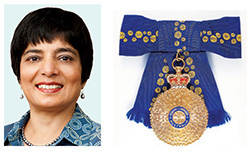
Marlene Kanga with Officer of the Order insignia
Acclaimed for authoring 16 books on cricket, Kersi’s latest work is From Bradman to Kohli – The Best of India-Australia Test Cricket. With his extensive research and records he has been able to document Cricket’s Great Families, Cricket’s Great All-rounders, Cricket’s Great Controversies and also pen quirky books like Out for a Duck, Nervous Nineties, Six Appeal, Cricket, Quirky Cricket.
"I enjoy gathering and sharing interesting cricket information… I have written in cricket magazines in India, Australia and England, giving my opinions without favor or prejudice,” Kersi was quoted in an interview carried in Indian Link. Over the years he has written sports and other features for The Times of India, The Illustrated Weekly of India, Sportsweek, Sportsworld and mid-day in India; The Cricketer and The Wisden Cricket Monthly in the UK; The Sydney Morning Herald, The Australian, The Sun-Herald, Australian Cricket, Cricketer and The Indian Down Under in Australia.
Parsiana too can vouch for his interest in penning articles, relentlessly contributing write-ups on Parsis in cricket, and Zoroastrian achievers in Australia, following up with the editors if there is a delay in publication, complimenting the team once his byline appears in the magazine. Like a seasoned bowler, his deliveries never fail to elicit interest for his articles are replete with facts and laced with frills, having interacted with cricket legends over the last several decades. He has also contributed feature articles that reflect his involvement with community affairs. A founder member of the AZA that was established in 1972, he edited 97 issues of its newsletter Manashni until 2000.
A virologist by profession, Kersi did extensive research on poliomyelitis and related viruses at the Grant Medical College in Bombay, on the pox group of viruses at Sydney University and on HIV, hepatitis and herpes viruses at the New South Wales Blood Bank. His research papers on these diseases have been published in reputed scientific journals. "I was the quality control officer at the NSW Blood Bank to assess the performance of laboratories all over Australia and New Zealand,” he informed Parsiana. He migrated to Sydney in 1970 with $ 50 and a pregnant wife Villie by his side. His first job was as a schoolteacher in Blacktown. Within three weeks, he found employment as a virologist in Sydney University before he joined the Australian Red Cross Blood Transfusion Service. Proud to be an Indian-Australian he advises new migrants to be proud of their identity, assuring them that in Australia "your hard work will be rewarded if you do your best.”