Exploring the enigma that is Eastern Europe
Dilnavaz Bhagwagar
Europe is a continent that unravels itself layer by mysterious layer. First time tourists invariably end up visiting London, Paris and Rome. A subsequent foray might take them to Athens, Amsterdam and Berlin. But the old world charm and beauty of Hungary, the Czech, Austria and Estonia Republics often remain unexplored.
I am so glad we were able to avoid that pitfall. Nearing the end of June 2015 we joined a coach tour starting in Budapest. We did not know too much about the capital of Hungary before we got there. The first bit of information everyone is keen to convey is that Buda and Pesht are two separate towns on either side of the Danube river. Buda on the hill was home to the monarchy and the aristocracy. Pesht on the plains across the river, was where the commoners and working people lived. It was only in 1873 that the towns of Buda and Pesht were merged into Budapest as we know it today.
Big and bustling, yet friendly, straddling the old while embracing the new, Budapest is proudly referred to as the Pearl of the Danube or The Paris of Eastern Europe.
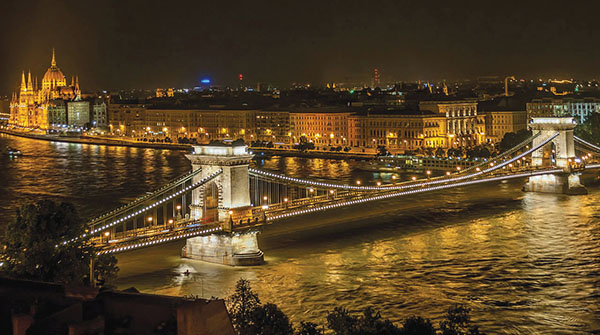
Historic Chain Bridge across the Danube Photo: Wikipedia
To make the most of our visit — and the airfare spent on it — we decided to reach Budapest three days before the coach tour started. This gave us the opportunity to explore the city on our own, at leisure. From the hotel’s reception desk we purchased tickets for the bright red "hop-on-hop-off” buses, with the upper level open for viewing in good weather. June end when we were there was perfect! The buses stop at all the tourist spots. One can cruise along all day, listening to the running commentary on headphones with the option of half a dozen languages, or one can get off at any point of interest and resume the journey on a subsequent bus. We did a little of both.
The history of Hungary is turbulent and some knowledge and information on it made for a greater understanding and appreciation of the people and the culture. Peaceful nomadic tribes inhabited the basin of the Danube, until Attila the Hun conquered the land in the fifth century. Wave upon wave of Mongolian invasions followed. By 1242 the Mongols had left, having looted the land and killing two-thirds of the local population.
After this, Hungary in general, and Buda in particular, underwent slow but steady development. Many churches, palaces and buildings were built in the Baroque style. In 1526 Suleiman, the Ottoman ruler, lured by the increasing wealth and grandeur of the country, invaded Hungary and occupied it for 150 years. The only things they left behind and which exist today are the famed
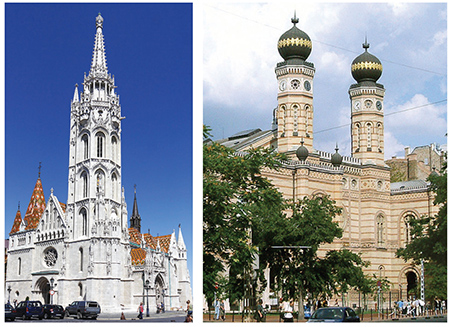
Matthias Church (left); Dohany Street Synagogue built in Moorish style Photo: Wikipedia
Heroes Square in Budapest is often used as a movie locale
Street sculpture in Budapest
Turkish steam baths.
The peace and prosperity of the 18th and 19th centuries was followed by the devastation wrought by World Wars (WW) I and II. All the beautiful bridges and sculpted buildings were destroyed and many people were killed. This was followed by the German and then Russian occupation of Hungary. Political repression, revolts and uprisings were the order of the day. Both the economy and the morale of the people lay shattered. It was only in 1991 that Soviet troops that had occupied Hungary for 43 years, were withdrawn and a democratic government was formed.
The wounds have slowly healed, buildings have been rebuilt, the economy has regained its strength and the bitterness of subjugation has given way to the sweetness of self-determination. In 2004 Hungary joined the European Union.
There is a lot to see and do: river cruises, palaces and churches, museums and memorials in particular. A unique Budapest attraction is to visit the Ruin Pubs, something we heard of but chose not to do. These are pubs in the heart of the city, in derelict, bombed-out buildings that have been transformed into kitschy, chaotic, graffiti covered friendly bars, frequented mostly by youngsters and artists.
The bridges over the Danube are a "must see.” Each one is different and they are beautiful. We walked across the historic Chain Bridge, the first to connect Buda with Pesht. It is one of Budapest’s most famous landmarks. When it was constructed in 1840, it was the longest suspension bridge in Europe and a marvel of engineering, having only two towers supporting the span across the wide river. The towers are decorated with the Hungarian coat of arms and there are imposing stone lions guarding the bridge. The story goes that after the sculpture was completed someone pointed out that the lions with their mouths wide open lacked tongues! Marschelko, the sculptor, was so humiliated by the lapse in his design, that he committed suicide by throwing himself into the river.
In 1945, nearing the end of WW II the bridge was blown up by the Germans to halt the Russian army. It was one of the first structures to be rebuilt post-war and is an exact replica of the original. Being photographed on the Chain Bridge is a must for tourists!
A cruise on the Danube river is another beautiful experience, more spectacular by night. There are cruises with decktop wine and dinner included, but one pays more for that pleasure. Hungarian vineyards and wines are coming into their own. On the whole though, Hungary and most of Eastern Europe are much more pocket friendly than the Scandinavian countries.
Each turn and corner of Budapest has something of interest. Every building and archway is sculpted. Each of the dozen or more bridges over the Danube is a marvel of engineering. It is a country that has suffered much but from that suffering has emerged interesting history, much beauty and character.
An amazing place to visit is the Dohany Jewish Synagogue. Like Germany, Russia and Poland, Hungary also had its share of Jews, many of them rich and successful. The Dohany Street Synagogue is the largest Jewish place of worship in Europe and the second largest in the world, after the Emanuel Temple in New York. Located in the Jewish Quarter, it was built in Moorish style and looks a hybrid of mosque, church and synagogue.
WW II took its toll of this beautiful edifice and of thousands of Jews. The Germans destroyed and desecrated the temple of God, turning it into a horse stable and war communication center. During the course of the tour we came to know that while thousands of Jews were killed, thousands more were saved by Hungary’s Oskar Schindler and Carl Lutz. A deputy consul at the Swiss embassy in Budapest between 1942-45, Lutz saved the lives of Hungarian Jews by hiding them or providing them with false papers to enable them to escape. Though less known, it is considered today the greatest rescue operation of Jews.
During our tour of the Synagogue, listening, learning and being moved, we met a gentleman who is today the last survivor of that time in history. My husband felt both humbled and honored to shake hands with him.
The Synagogue has an organ of 5,000 pipes. Franz Liszt was one of many organists to have played here. Today the organ has become a bone of contention, with purists saying an organ has no place in a synagogue.
In the courtyard of the Jewish Quarter stands a memorial to those who perished for the crime of being Jews. The memorial is shaped like a tree made in silver alloy, with each leaf bearing the name of a martyred Jew.
Matthias Church in the castle district, constructed in ornate Gothic style of the 14th century, has followed the same sad pattern of destruction and restoration. Matthias Church is where coronations, weddings and some of the most momentous events in Hungarian history have taken place. The soaring landmark is named after King Matthias, the medieval King who was twice married in the Church. His reign is considered the golden age of Hungarian history. As the high ceiling and arches make for excellent acoustics the church has become a venue for classical concerts and other cultural performances in the present day.
A ride on the funicular railway took us from Clark Adam Square by the river, up to the castle district of Buda which has several famous buildings such as the Royal Palace, Sandor Palace, Fisherman’s Bastion and Matthias Church. One can spend hours here before taking the funicular back. The rail system operates daily from 8 a.m. to 10 p.m. at intervals of 10 minutes. Tickets can be bought at the stations.
Heroes Square, a big, paved area, with statues of Hungarian chiefs and kings, is often used as a movie set. The film Inferno was shot here, in part. The movie industry is big business in Hungary. During the communist occupation, Russian marches and demonstrations of military strength were held here. During a student revolt in 1956 Stalin’s statue was knocked down in an act of defiance.
Another interesting vignette of Hungarian intelligence and innovation was revealed to us in Budapest! Erno Rubik, a professor of architecture at the university in the early 70s invented the best selling toy of all time. The multi-colored twistable puzzle, originally called the Magic Cube became so popular that Prof Rubik took the idea to America. Overnight, the rebranded Rubik Cube became a worldwide hit! And earned millions for its inventor.
Some local Hungarian specialties that are worth buying are handmade lace, embroidered tablecloths and blouses, porcelain and paprika. Hungarians use two to three pounds of this spice annually.
Of all the places — including Prague, Vienna, Berlin — that we visited on our coach tour, Budapest was definitely my favorite. A manageable group of 31 persons, an excellent guide and staying at the Marriott overlooking the Danube, added to its appeal.