A team of Bombay Municipal Corporation (BMC) engineers and conservation architects has solved a British era plumbing riddle to revive the 38 ft high iconic Flora Fountain structure in South Bombay. "As a conservation architect in practice for the past 26 years I am quite adequately experienced to handle buildings and structures, but dealing with a water fountain is a completely different ball game as it has several complexities…water engineering, the restoration of the troughs, pointing and missing details of sculpture and its cleaning with help of conservators,” conservation architect Vikas Dilawari shared in an email with Parsiana. He told Mid Day (MD) of December 4, 2016, "We had to figure the entire plumbing network out. It was all trial and error since we had to locate the leakages first, and many parts were missing as well. We scanned through old pictures and even wrote to British era plumbing experts in Scotland to see if they could help us. We even tried thermography (a technology that uses infrared images). Finally, we reached out to plumbers from the old days in Bombay and sought their help. The water works are back in shape now.”
During the restoration work in September 2016, when the valves were turned on, water literally started flowing from everywhere, noted MD. "After two months of identifying leaks, repairing rusted pipes, replacing hidden valves, sealing punctures, joining broken fittings — and possibly embarking on the city’s toughest plumbing job — it has finally managed to solve a British era jigsaw puzzle,” the newspaper stated.
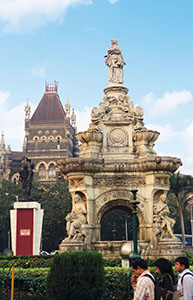
Bombay’s iconic Flora Fountain
Dilawari, who has won recognition from UNESCO for restoring several Parsi structures in the city, is hopeful that after "specialized civil repairs like marble flooring of the trough and waterproofing of the fountain troughs and its pointing, the conservators would be in by mid-January to start cleaning and hopefully by March/April end the restored fountain would be handed back to the municipal authorities,” he shared with Parsiana. People will soon be able to see water spouting there as in the days of yore. The work is being executed by the Bombay Chapter of the Indian National Trust for Art and Cultural Heritage (INTACH), he writes.
According to Wikipedia, "The Flora Fountain was erected at the exact place where the Church gate (named after St. Thomas Cathedral, Bombay) stood before its demolition along with the Bombay Fort. It was constructed by the Agri-Horticultural Society of Western India, out of a donation of Rs 20,000 by Cursetjee Fardoonjee Parekh. Designed by Richard Norman Shaw, it was sculpted in imported Portland stone by James Forsythe.”
Parekh, a wealthy philanthropist who founded many institutions which have survived to this day, including the Fardunji Sorabjee Parekh Dharamshala located in Bombay’s Khareghat Colony, "is said to have been the first person to contribute towards (Flora Fountain’s) cost. His donation of Rs 20,500 in 1864 tantamounted to almost 50% of the total expenses incurred on its installation (see "Alms and the man,” Parsiana, September 1997).”