Steamship travel features in my family history for over 150 years. In the late 1800s, my grandmother’s grandfather Bejon Ferdon Jhansiwala wrote an eye-witness account of the 1857 Sepoy Mutiny, viewed as India’s first struggle for independence. He starts by describing his traumatic travels by ship to Karachi in the 1840s. His sea-sickness, the storms at sea, damage to his ship and his choking fear of those enormous swells came across with terrifying effect well after a century and translation from an archaic style of Gujarati.
While most readers are aware that the Parsis of India are descendants of medieval emigrants from Persia, some may not know they were intrepid travelers as well. As I researched steamship travel for the sequel to my upcoming historical mystery Murder in Old Bombay, I came across a mention of Parsi steamship travelers in 1913. The book, A Century of Sea Travel: Personal Accounts from the Steamship Era by Christopher Deakes and Tom Stanley, mentions Parsi travelers on the SS Arabia — a group of Parsi ladies and at least one Parsi gentleman. This is narrated by Lewis Upcott, who sailed on British India Steam Navigation Company’s SS Arabia on his way to India, and made friends with "a Parsi gentleman, most pleasant...” He noted that, "As far as dress goes, the Parsi ladies are beautifully dressed and leave the English far behind in the matter of art.” The book’s authors commented that this is because the Parsi ladies "were used to the heat and knew exactly what to wear.”
So how far back were Parsis sailing to the UK and America? Who were these daring souls?
Parsi merchant ships had travelled to China in the 1800s to bring back embroidered fabrics which became Parsi gara saris and are now treasured heirlooms (usually white embroidery on brilliantly colored silk fabric). Parsis were also part of the opium trade (which was legal till China banned the trade and rescinded only after the British launched the Opium Wars). A steamer called The Parsi, belonging to Messrs Jeejeebhoy Dadabhoy, Sons and Company which sank in 1879, is said to have had 525 opium chests and a fortune in gold specie (metallic money, such as coins) aboard. So while trade brought Parsis opportunity, they had to contend with the risk of storms, shipwrecks and disasters.
Parsis were also innovative ship builders. In 1814, Francis Scott Key is said to have written the words to The Star Spangled Banner on the deck of a Wadia built ship HMS Minden. It was the first royal navy ship built by Jamsetjee Bomanjee Wadia at the Duncan Dock in British Bombay. In 2016, a scale model of it was replicated by Mazagon dockyard workers after their research team stumbled upon the actual drawings of the ship at the National Maritime Museum in UK. (Another personal connection, since I lived at Dockyard Road, Mazagon, as a child.) The Wadia shipyard at Bombay churned out over 400 British ships. It is said, each ship built in Bombay "had a silver nail hammered into the ship’s body for good luck — a Parsi tradition!” The webpage victorianweb.org states that way back in 1820, when the SS Snake was launched in Bombay, "her engines were designed and built by a Parsi, and were the first ever manufactured in India. How well they were constructed is evidenced by their lasting power. After a notable career of 60 years, she was broken up in 1880.”
Early Parsi travelers are mentioned in Dosabhai Framji Karaka’s History of the Parsis. He describes the East India Company’s (EIC) difficulties when they first attempted to trade with the Mogul empire. The EIC then approached a respected Parsi, Rastam Manak of Surat, who introduced them to the Mogul emperor in 1660 and thus helped them begin trading. However, by 1723, officers of the EIC refused to pay what they owed the Manak family, placed him and his eldest son in prison, and fined the family Rs 50,000 (USD 665)! His younger son, a persuasive young man called Naoroji Rustamji traveled to London on the man-of-war
Salisbury in 1723 to plead his father’s case with the EIC directors. When that was unsuccessful, he sued the EIC, won the trial and was awarded the princely sum of Rs 500,000 (USD 6,653)! He was the first Parsi and the first native of India to visit England. After this, other Parsis traveled to the UK for political, trade or legal reasons.
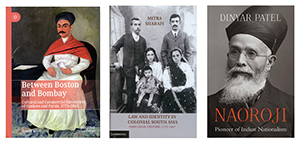
To find Parsis traveling to America I consulted Dr Jenny Rose, author of Between Boston and Bombay: Cultural and Commercial Encounters of Yankees and Parsis, 1771-1865. Her book describes two Parsi men traveling from Bombay to Boston. First, in 1851, Ardashir Cursetji Wadia visited Boston, then in 1860, his nephew Rustomji Hirjibhoy Wadia visited the Essex Institute in Salem and was initiated as a Freemason. Generations of Wadias were agents of Boston merchants who needed a stable source of cotton for their factories, after the destruction of the Civil War. They found it in Indian cotton, dispatched by ship through Parsi agents. Another Parsi, Pherozshaw Pestonji Meherhomji arrived in New York in 1862 with Dossabhoy Framji Muncherji Cama. In her book Rose describes their travels and dealings with American business families, as well as the exchange of ideas. These were not merely pleasure trips — Rustomji became the sole agent for Wheeler and Wilson sewing machines in India, which brought India that much closer to building its own clothing industry.
Some travelers ran into trouble. Mitra Sharafi’s Law and Identity in Colonial South Asia contains the legal case of B. B. Colah, a wealthy Parsi traveler to the States in 1870, perhaps suffering from mania, who was duped by unscrupulous individuals, losing almost all of his USD 100,000 (Rs 75,14,749) fortune, which today would be worth USD 2.5 million (Rs 18,78,68,735).
On the other hand, many voyages were joyful. Dinyar Patel’s recent biography, Naoroji, Pioneer of Indian Nationalism states that in 1893, when Dadabhai Naoroji travelled from London to Bombay after assuming his elected position in British Parliament, he arrived to the welcome of about half a million people. The voyage from Bombay to London through the Suez Canal then took 27 days — the narrow Suez Canal was often blocked with traffic and sometimes because of accidents. However, from Liverpool one could reach New York in just six or seven days on the great trans-Atlantic steamships of the time.
Exploring Ellis Island (in New York harbor) passenger lists, I found a Parsi, Ralanghan Dadabhoy who travelled to New York from Bombay on the SS Majestic in 1893. A brand new ship at the time, on her maiden journey in 1890, the Majestic achieved the astonishing speed of 20 knots per day to arrive at New York in six days. It is likely that Dadabhoy was drawn by the magnificent spectacle of the 1893 World’s Fair, the Columbian Exposition in Chicago.
Another visitor to the World’s Fair, the industrialist Jamsetji N. Tata, met the Hindu sage Swami Vivekananda on the SS Empress of India as he sailed through the Pacific. Vivekananda was to attend the first Parliament of World Religions, held at the Columbian Exposition as well. Ellis Island records show that Tata returned to the USA in 1895, this time sailing on SS Britannic to New York — it may have been his last trip, as he died in 1902.
Returning to my ancestor’s book, I found a curious note from my grand-aunt, Nergesh Byramji about another ancestor, Hormusjee Contractor, who was sent to England during the time of the Burmese king, Thibaw Min. Since Thibaw was exiled from Burma in 1885, this voyage must have happened prior to that. A clever carpenter (or contractor, as they were referred to), Hormusjee had made an ingenious model of a pagoda that could be taken apart and re-assembled. Burmese officials decided to send it as a gift to Queen Victoria, accompanied by its inventor. Then, something unexpected happened. My grand-aunt wrote, "While making a gracious bow to the Queen for her kind appreciation, he stepped backwards, and while doing so, tripped because of his long over-all jaama (coat). The gracious Queen stepped down from the throne and helped him to his feet. He was all along treated with great esteem and as a royal guest.” Although I have found no evidence to corroborate this charming family folklore, the next sentence feels strangely prophetic. "He even went to America as such. Very few Indians could go abroad those days, but to go to the other two continents and be a royal guest was almost a unique opportunity and honor.”
If he visited America in the 1880s, then 110 years later in 1990 I followed in his footsteps to eventually make the United States my home.