The dwindling Neemuch Parsi Anjuman hands over its reins to the
Federation while some other anjumans are considering the assistance
of the all-India body to protect their assets
Parinaz Gandhi
"For the first time in the history of the Federation of the Parsi Zoroastrian Anjumans of India (FPZAI), an anjuman has given total control and management of its affairs to the FPZAI,” reported Federation president and chairman of the Bombay Parsi Punchayet (BPP) Yazdi Desai at the executive council meeting of the Federation held after a year at the Annexe Hall in the Banaji Atash Behram compound on April 29 and 30, 2017. He was referring to the Neemuch Parsi Anjuman which at its annual general meeting attended by eight members on April 1, 2017 elected seven representatives of the Federation as its trustees. The Neemuch anjuman in Madhya Pradesh that is left with a Parsi population of 13 has several properties including the Agiary Mohalla with open land admeasuring nearly 41,000 sq ft, Cawas Mansion (4,000 sq ft), Tower of Silence (15,000 sq ft) plus plots of agricultural land (21 bhiga).
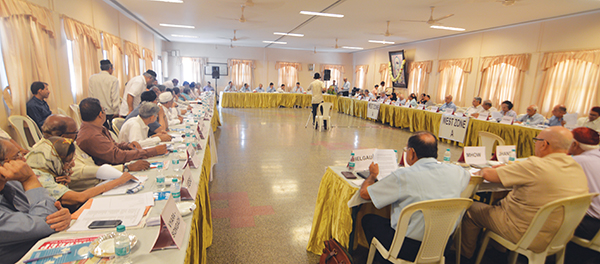
Federation meeting in progress
(From left): Mancher Mubarakai, Tehmton Anklesaria, Farrokh Rustomji, Yazdi Desai, Sam Chothia, Noshir Dadrawala
The anjuman in Gandevi too where stands an agiary, mobed quarters, a dharamshala and 14 acres of Doongerwadi land want to hand over charge to the Federation, conveyed Gandevi representative Farokh Shaher. As per a detailed report submitted by the chief executive officer (CEO) of the Defunct Anjumans Committee (DAC), Sam Chothia, he has managed to convince some other anjumans to also involve the Federation in their affairs. According to Desai, this "is a testimony of the faith in the integrity of the present FPZAI leadership team.” The following day however Desai had to endeavor to reassure Pervin Jehangir who was representing Ilav. Some amount from Ilav has been reposed with the BPP "but we are not getting an account of that fund for some years,” mentioned Jehangir. "How do we convince you about our integrity?” asked Desai. "You need committees and experts in place,” responded Jehangir whilst conceding that "the Federation is a very necessary body.” She opted to consult Chothia, head of the DAC and vice president of West Zone B in connection with Ilav. Reluctantly, she agreed to meet the other Federation office bearers in connection with the impasse in Mhow. The Mhow anjuman matters are currently sub judice but since the court has recommended mediation, the Federation wants to broker peace, especially since Mhow was the first anjuman to sign the custodianship agreement with the Federation, with the FPZAI North Zone vice president Tehmton Anklesaria sitting on the Mhow anjuman committee.
The Tithal Sanatorium property continues to be under litigation with "two Parsi ladies foisted as trustees… and the change report being allegedly accepted by the Charity Commissioner,” reported Manek Kalyaniwalla of Mulla and Mulla and Cragie Blunt and Caroe who at the behest of Chothia has filed an appeal in the Charity Commissioner’s office against the alleged fraud and hopes the matter will be put to rest when the case comes up for final hearing on June 23, 2017. Fearing that what Mehrwan Irani, former president of the Iranian Zoroastrian Anjuman (IZA), had fought so diligently to retain for the community "can go out of our hands,” Kalyaniwalla beseeched those present: "Please be vigilant when entries are passed in your mamlatdar’s office. To subsequently set the cart back on track is a herculean effort.” If he succeeds in procuring a favorable order, he would like "to go after the perpetrators.” Irani had entrusted the matter to the neighboring Valsad anjuman now headed by Chothia.
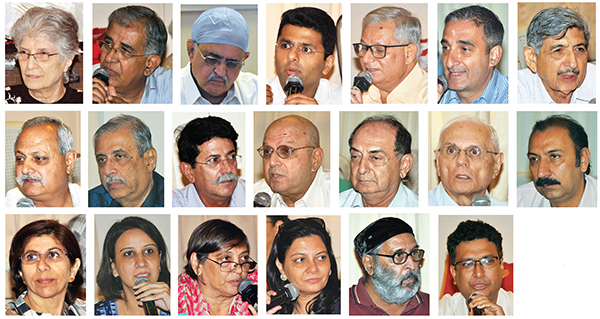
From left (top row): Armaity Tirandaz, Kersi Randeria, Zarir Bhathena, Viraf Mehta, Cawas Panthaki, Adil Nargolwala,
Baman Cama; 2nd row: Brig Jahangir Anklesaria (Retd), Dara Deboo, Pervez Irani, Cyrus Mancherji,
Cmde Medioma Bhada (Retd), Khurshed Pastakia, Porus Debara; 3rd row: Yasmine Sanjana, Pareecheher Daviervala,
Pervin Jehangir, Anahita Desai, Farokh Shaher, Manek Kalyaniwalla
Code and Commission
The proposal to adopt a Uniform Civil Code (UCC) in India is vexing Federation members who are keen that the Parsi community retain its exclusive practices and laws. (The Federation deliberations were preceded by a jashan at the Banaji Atash Behram.) After ascertaining the sentiments of the members present, it was decided that the Federation, as the all-India body, would convey to the Government that they wished to retain status quo. Advised Kalyaniwalla, "If you wish to maintain status quo, you have to specify the duration.” Otherwise, you have to unequivocally state whether you are or are not in favor of the UCC. Considering that Justice Dr B. S. Chauhan, chairman of the Law Commission of India, had posted a circular on the website last October inviting public response to the proposed UCC (see "One for all?” Parsiana, November 7, 2016), vice president of the South Zone, Cmde Medioma Bhada (Retd), representing Belgaum, was concerned that the reformists may have spoken up within the stipulated 45 days and the orthodox voice may go unheeded.
Citing the initiation last year of Chaitanya Kersi Jaikaria who is the grandson of Dadi Mistry, the then Zoroastrian representative on the National Commission for Minorities (NCM), Bhada continued, "The ramification of this navjote is manifold… What is the future of these children? Are they allowed into agiaries by priests or is it clandestine?” "In this day of parity, Zoroastrian women should have equal rights,” Baman Cama of Vadodara voiced his personal views, recalling that Justice Sam Bharucha had opined that if a Zoroastrian lady goes to court today, she might get a judgment in her favor.
BPP trustee Armaity Tirandaz enquired, "Does it mean that the person whom we choose on the Minorities Commission should have ideas that coincide with the general community opinion?” Asked Bhada, "How is the Minorities Commission representative chosen?” According to Yasmine Sanjana of Bardoli, one has to make an application to Mukhtar Abbas Naqvi of the Minorities Commission and cite community support. Pareecheher Daviervala of Davier who has recently joined the Bharatiya Janata Party revealed that "your political contacts matter.” Last time, when Mistry and former BPP trustee Homi Ranina’s names were being considered, "Mistry’s contacts with Delhi chief minister Sheila Dikshit helped.”
In the subsequent discussions it emerged that former BPP trustee Dinshaw Tamboly is expected to be named as the next Zoroastrian representative on the NCM. "That will be a nail in our coffin,” opined Bhada who felt the Federation should object "before somebody appoints somebody.” Despite their opposing religious views, Desai acknowledged, "No one can deny the extensive socioeconomic work he (Tamboly) has done.” He further revealed that when Dr Shernaz Cama of Parzor sent the BPP an urgent message stating that someone was being considered who is "not in the best interest of the community,” the trustees recommended Tamboly. When co-trustee Viraf Mehta stated that he was not informed of this and was hearing of this for the first time in an open forum, Desai said, "We stand admonished. We did what we thought was in the best interest. It was done under peculiar circumstances… He has given us an undertaking that in religious and ethnic matters he will not influence any decision.” "Is he going to make that public?” asked Tirandaz. "I can ask him,” said Desai. "If Tamboly doesn’t get involved in this controversy, he’s by far one of the best candidates,” declared Daviervala.
Revision of constitution
Nearly 36 clauses/sub-clauses of the Memorandum and Rules and Regulations of the Federation were revised to bring them on par with the laws of the land and the mood of those attending the executive council meetings in recent times. A three-member subcommittee chaired by Bomi Hirjee of Indore with Khurshed Pastakia of the Borivli and Suburban Zoroastrian Association and Federation honorary secretary Farrokh Rustomji had readied a 31-page document. The trio had provided the original clause, the revised wording and the rationale for the amendment, incorporating recommendations by anjumans who had reverted with their feedback earlier. "It is before you for final approval,” said Rustomji at the start of the nearly two-hour discussion, urging the representatives present at the annual general meeting "to approve it at this meeting and not let it linger to the next meeting.”
Two new clauses, 35A and 35B have been included to safeguard the interests of dwindling/defunct anjumans. Clause 35A specifies in detail how the executive council should respond to an application from a dwindling or defunct anjuman or trust, whether it is a Federation member or not, "seeking its assistance in either managing its affairs and/or protecting its funds and properties.” Clause 35B stipulates when the Federation "shall be empowered to take such immediate suo moto action as may be necessary” when a defunct anjuman’s "property and/or funds are threatened with encroachment or alienation by unauthorized persons” or there is fear of misappropriation of property and funds by unscrupulous individuals. When winding up the affairs of a defunct anjuman, the assets should be divided between the Federation and the neighboring anjuman, recommended Brig Jahangir Anklesaria (Retd), president of the Ahmedabad Parsi Panchayat. "When something has to be taken care of in Jamnagar or Rajkot, Ahmedabad will have to send someone, not the Federation. The burden of functioning falls on the neighboring anjuman.” According to BPP trustee Kersi Randeria, "The purpose of the Federation is to work together in the interest of all of us. The Federation is you, me, all of us.”
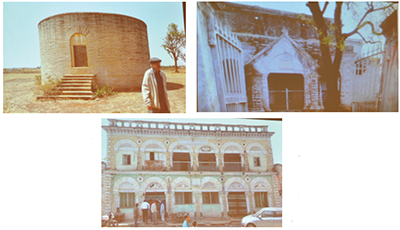
Clockwise from above left: dakhma, agiary and Cawas Mansion in Neemuch
Another clause, 6, has been substantially altered as "it was felt that there is a need to install certain safeguard to prevent misuse of ‘proxy’ representatives (at the FPZAI meetings) by certain inactive anjumans.” As per the amended clause: "Such member-representative must necessarily be a member of the anjuman, although such person need not be actually a resident of a place within the geographical jurisdiction of the anjuman as defined in its trust deed/constitution.” As commented Desai, the amended clause has been "made so tight that now even Anahita Desai (his wife) cannot represent Badnera-Amravati.”
Clause 5A concerns granting autonomy to anjumans and encouraging the members to seek Federation advice periodically. The original rule stated that the Federation recommendations could be implemented by anjumans "as they may deem fit.” But the revised rule has deleted the last phrase. Questioned Adil Nargolwala of the Delhi Parsi Anjuman Registered Trust (DPART), "Every anjuman has the right to maintain autonomy. What happens if we do not subscribe to all the rules of the Federation?” Clarified Desai, "The anjuman has autonomy in managing its affairs, properties and fees.” But if it does not subscribe to the basic structure of the Federation, it would be asked to leave. Observed Pervez Irani representing the IZA, "Nowhere is it said that if an anjuman changes its rules, it can be expelled.” Clarified Rustomji, "Delhi was a founder member and when they changed their rules, the Delhi Parsi Anjuman was asked to withdraw” and the DPART was granted membership.
Membership to the Federation, in accordance with the new rules will be open to those registered trusts or associations of Parsi/Irani Zoroastrians "having aims and objects generally compatible with those of the Federation” on the proviso that "there shall be only one anjuman representing one geographical location.” Membership applications with the mandatory eight documentary accompaniments will, as per the revised rules, be scrutinized minutely to ensure that only "genuine anjumans” are admitted.
Affiliation with a world body of Parsi Zoroastrians will be pursued only if it is approved by not less than two-thirds of the members present and voting at the extraordinary general meeting after they are given a chance to study the rules of the world body. A Parsi/Irani Zoroastrian, as per the revised rules, shall include a person born of both Parsi/Irani parents or whose father is a Parsi/Irani and "who has been duly admitted into the Zoroastrian religion by having undergone a navjote ceremony as a child and who continues to profess the Zoroastrian religion…” "Is it necessary to state ‘undergone navjote as a child?’” asked Randeria.
One more member
The membership application from the anjuman in Dahod, on the border of Gujarat and Madhya Pradesh, was accepted, making it the newest entrant to the Federation family. It is estimated that in Dahod are five to 10 Zoroastrians residing there, with the politically well connected Contractor family running a school there. At one time, the railway colony in Dahod was known as the Parsi Colony because of the large number of Parsi railway officers, stated Dara Deboo of Navsari.
Little room for change
Since Khodadad Irani had withdrawn his nomination from the vice presidentship of West Zone A, current incumbent Mancher Mubarakai continues. For West Zone B, Chothia came in unopposed as did Russi Jeejeebhoy of Calcutta for the East Zone. There was no representative present from the East Zone. For the South Zone, Mani Clubwala of Madras chose to step down and nominated Bhada. Barring Belgaum, no other South Zone anjuman was represented. For the North Zone, Tehmton Anklesaria volunteered to withdraw his nomination in favor of someone younger with more energy. When Nargolwala offered to give it "a try for one year,” Desai maintained, "The nomination time has expired.”
BPP trustee Noshir Dadrawala and coopted member Rustomji were reappointed as honorary secretaries while BPP trustee Zarir Bhathena and Brig Anklesaria were reappointed as honorary treasurers. BPP CEO and secretary of the DAC Cawas Panthaki was appointed as the executive secretary of the Federation. In addition to Rustomji, the four others coopted on the executive council once again were Minoo Khan of Borivli, Persi Buhariwala of Vyara, Farroakh Govadia of Nargol and Yazdi Karanjia of Surat.
Zonal representatives on the executive council will continue as before for West Zone A: Nagpur and Thana; West Zone B: Bilimora and Nargol; South Zone: Belgaum; East Zone: Calcutta. There being six nominations from the North Zone and five seats, Ratlam withdrew in favor of Agra, with the other four being Jabalpur, Mhow, Jhansi and Kanpur. When Nargolwala sought to ascertain why Delhi, as the largest North Zone anjuman was not included in the five, Desai explained that Delhi has a permanent seat as does Udvada. Brig Anklesaria pointed out, "West Zone B has two representatives and North Zone has five. I fail to see the logic… Are we going by the area or population? Look at the line of people representing West Zone B.” There were nearly 20 anjumans attending from West Zone B as against five from the North Zone. He was told by Rustomji that the proposed amendments in the Federation constitution has reduced the North Zone representatives to three. Added Tehmton Anklesaria, "The North Zone has 17 anjumans covering a distance of 5,000 km. The Federation is not needed for bigger areas like Bombay, Poona or Surat but for the anjumans in the mofussil areas.” Since the clauses in the Federation constitution were not explicit in the context of reelection/reappointment of office bearers/zonal representatives in the absence of any new nominations, it was decided to amend the wordings.
The next executive council meeting of the Federation will be held in Ahmedabad on September 23 and 24, 2017.
The next report on the Federation meeting will appear in the May 21, 2017 issue.