The recent and long-term affinity for Zoroastrianism expressed by Kurds
was explored at two sessions at the 12th World Zoroastrian Congress
Parinaz M. Gandhi
"In Kurdistan, it is fine” for people to leave Islam and profess Zoroastrianism, stated Faiza Foad from Kirkuk, Iraq. Under Law (number 5), the rights of minorities in the Kurdistan region of Iraq have been protected since 2015, stated the Kurdish Zoroastrian activist. She was responding to a query from moderator Matthew Barber, a doctoral candidate at the University of Chicago, familiar with Islamic thought and modern Middle Eastern history. The two were participating in an interactive session on "One Zarathushtra, Many Zoroastrians: Iraqi Kurds Reclaim their Heritage” on the third day of 12th World Zoroastrian Congress (WZC) in New York on July 3, 2022. While there have been instances of mullahs being fired from a mosque for insulting Zoroastrians, she cautioned, "People have to be very careful” in Kurdistan which, according to Wikipedia, is "a roughly defined geo-cultural territory in Western Asia wherein the Kurds form a prominent majority population.”
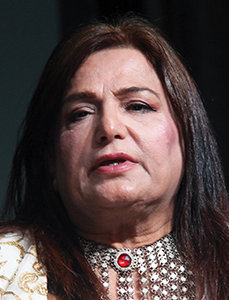
A board member of the Alliance of Iraqi Minorities, Foad is considered one of the leading voices among Zoroastrian activists in Iraq and the Kurdistan region having founded an organization in 2006 to raise awareness about Zoroastrianism. Over several decades she has been espousing the cause of religious minorities, women and children and documenting atrocities in the Anfal genocide. She has worked with several United Nations agencies, foreign consulates and local and international nongovernmental organizations.
When asked to estimate the strength of the Zoroastrian population in the region, Foad said "more than 100,000.” Barber though clarified, "No one has been keeping track although 55,000 is given as the official number.” The Kurdish Regional Government though is permitting its religious minorities to freely declare their religious affiliations, and Zarathushtra’s message seems to be resonating with the Kurds.
Foad was in her early 20s during the Kurdish uprising against the government in 1991 when "a neighbor’s son who participated in the demonstration was never seen again… People would mysteriously disappear.” In their local language, the demise of someone valuable is expressed as "losing your kusti,” she said.
Leaving her home, she had walked for around 15 days to resettle in Sulaymaniyah on the Iran-Iraq border. "Helping others who are suffering more than you” was therapeutic for her. "We cannot be God, but we can be a friend to God, to assist God. I want to be a saoshyant to bring happiness to others,” she asserted.
Although her grandmother had a Zoroastrian background, Foad regretted she never got a chance to know her. Her first acquaintance with Zoroastrianism was as a teenager when she heard a Lebanese speak about the religion. Later in the course of her work when required to translate an article in Kurdish she read about the Gathas. Ahura Mazda’s message of choosing wisely and using Vohu Mano, the good mind, for betterment of humanity appealed to her. "Amesha Spentas became the most powerful road map in my life,” she shared her experiences and reasons for being drawn to Zoroastrianism.
Her sudreh pooshi was done in 2016, she stated. At that time there used to be five persons who performed the ceremony but since then one has passed away. Besides hosting events, giving lectures, translating and publishing articles on the faith in Kurdish and Arabic, she has published a Kurdish translation of the Gathas. When asked what Kurdish Zoroastrians need, she responded, "We need books, a central organization to work together, proper religious education, a need for a temple to be built.”
Recently the Ministry of Endowment has adopted a Curriculum Reform Project and celebrating these changes were members of eight minorities. The Ministry of Culture promotes 17 religious organizations. "There is competition among Zoroastrians working on the same road in the same direction,” she noted. This was reiterated by a member of the audience who referred to "the conflict between groups and fabrication of history for political gains.” Since Kurds originate from four different countries — southeastern Turkey, northwestern Iran, northern Iraq and northern Syria — it was observed that disagreements arise when each one tries to represent the entire Kurdish region.
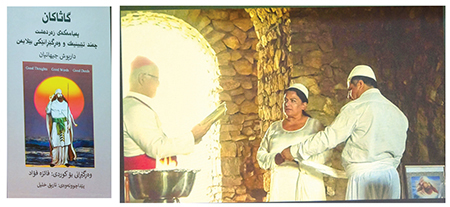
Top: Faiza Foad Photo: Jasmine D. Driver; above l: Kurdish translation of the Gathas; above r: at her initiation
Active affiliation
In a separate breakaway session later on the same day Barber provided "An Overview of the Kurdish Zoroastrian Movement,” going back a century. For the last eight years he has been following the Kurdish Zoroastrian movement and is completing a book that explores the history, literature and the personal journeys of its members. His research and publications have dealt with political and human rights issues facing Middle Eastern minorities. Following the Yazidi genocide by the so-called Islamic State of Iraq and Syria (ISIS) in 2014, he served as director of a humanitarian organization that developed aid and advocacy programs to assist Yazidis.
Matthew Barber Photo: Jasmine D. Driver
In his presentation at the Congress, the researcher explored the long-term affinity for Zoroastrianism on the part of the Kurds and described how it eventually evolved into a movement involving active association with and practice of Zoroastrianism. Since Parsiana could not attend this concurrent session, on our request Barber shared with us the salient features of his presentation:
"I explained that though we have few historical sources that can confirm whether any pre-modern Kurds were adherents of Zoroastrianism, there are examples suggesting that at least some Kurds retained the belief that their ancestors had been Zoroastrians, and that this assumption existed among Kurds prior to the advent of the modern Kurdish nationalist writings that emphasized a Zoroastrian past for the Kurdish people.”
Barber demonstrated an interesting Parsi connection with the first Kurdish writers who began to discuss a Kurdish Zoroastrian past. "Parsi intellectuals published the writings of Kurdish nationalists in a journal in India. They also maintained correspondence with Kurds in Iraq and sent books to them on the Avesta. Parsi intellectuals even made statements about the Kurdish past that sounded as if Kurdish nationalists had written them. From the sources I have found, it appears quite clear that Parsi intellectuals in the 1930s were encouraging the Kurds to explore the possibility of Zoroastrian roots.
"Even though Kurds may have first encountered Zoroastrianism through nationalist writings, many go on to develop genuine commitment to the faith. And while nationalism can certainly be dangerous or even harmful, one’s personal adherence to a religious tradition cannot be invalidated because of the presence of a nationalist element… No matter how the global Zoroastrian community today feels about the growth of the contemporary Zoroastrian movement in Kurdistan, it is definite that Zoroastrians themselves played a role in supporting the foundations for this movement, foundations that were laid in the early years of the modern Iraqi state.”
His lecture proceeded to cover the intellectual legacy of Kurdish writings on Zoroastrianism through the 20th century and alluded to some historical-political factors and pioneers who impacted the trajectory of the movement and its contemporary public expression in the last decade.
Reprimand for representation
Divisiveness among the Zoroastrian Kurds became apparent at the Congress and the days following the Congress as witnessed firsthand by some and glimpsed from the heated email exchanges by others. While the organizers of the 12WZC chose to give a platform to Foad, another Kurd, Awat Darya who was present at the 11WZC and had registered for the 12WZC, went up uninvited on stage on two occasions.
In a press release issued by the Congress organizers on July 6, they wrote, "The Congress seeks to feature a diverse range of active individuals. Four years ago, in June 2018, Awat Darya (who has also used the names and spellings Awat Husammaddin/ Husamuldeen/ Taieb/ Tayeb/ Derya) was an invited speaker at the 11WZC held in Perth, Australia. In order to provide the Congress attendees with exposure to a greater variety of voices, it was decided to feature another Kurdish Zoroastrian at this year’s Congress. (And in the future, still other voices will be heard.) Therefore, the selected speaker for this year was Foad who was featured in the book A Kurdistan for All: Embracing Faith and Diversity, an official publication issued by the Kurdistan Regional Government in September 2021.”
The press release titled "False Claims Mislead Kurdish Zoroastrians,” explained, "When Foad’s invitation became public in early 2022, Awat began a campaign of letter writing to the Congress directors and to a number of American Zoroastrian individuals expressing her objections to the selection of Faiza and asserting that she (Darya) was the sole representative of Kurdish Zoroastrians.” The Congress co-chairs responded to her correspondence with a letter last March.
Darya paid to register and attend the Congress. "She was welcome as an attendee but was not invited as an official guest to speak or to participate in any event or ceremony,” noted the press release, adding, "Awat brazenly entered the procession, without invitation and without the permission of the organizers, and walked onto the stage with the mobeds. This was insulting and extremely disrespectful to the trained mobeds from around the world. During the prayers, Awat stood embarrassingly silent because she was unfamiliar with the prayers and could not recite them.”
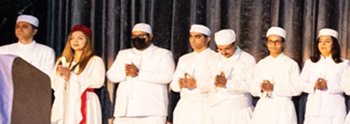
Above(2nd from l) Awat Darya with priests at the Congress inauguration Photo: 12WZC 2022
Foad (l) and Darya carrying flags Photos: 12WZC 2022
The Congress organizers quoted a report from Rudaw Media Network stating "Awat was holding the rank of asrawan before, but in this conference, she has been promoted to two ranks above that, to the rank of mobed. According to Awat herself, this is the first time a Kurd has been awarded this rank.” Rebutting this statement the organizers clarified her statement was "a blatant lie. Nothing like this ever happened and could never have happened since the Congress has no authority to proclaim any one a mobed or any other priestly title.”
The organizers were further annoyed that although predetermined delegates from different countries had been asked to walk up to the dais with their respective flags, "Awat walked onto the stage from the left side, carrying a flag she had brought herself, and positioned herself behind the announcer for a photo op… So as not to disrupt the proceedings, the organizers let her remain there… These actions show complete disrespect to the Congress and to the individual whom the Congress had selected” to represent Iraq and Kurdistan. "These actions also constitute the exploitation of the Congress for misleading photo opportunities.”
The Congress organizers confronted Darya the same morning and asked her "to refrain from any further disruptions during the Congress.” They were further surprised to see the Kurdish Yasna organization in Victoria carrying posts that wrongly conveyed Awat was a Congress invitee. "We believe that we have a responsibility to lay out the facts as they happened and to stop the spread of intentional misinformation and self-serving statements… It is extremely disheartening to see that Awat…has blatantly lied and acted completely contrary to the Zoroastrian principle of Asha — The Truth,” stated the press release.
In her rejoinder of July 24, Darya introduced herself as "a volunteer official representative of Kurdistan Zoroastrians in the Ministry of Endowments and Religious Affairs of the Kurdistan Regional Government, a founder committee member of the Yasna Organization for the Development of Kurdistan Zoroastrian Philosophy, a member of the Kurdistan National Religious Minorities Network founding committee and founder of the Ashavan Institute for Culture and Music.” She wrote, "In 2016, I was awarded the rank of Asrawan, a Zoroastrian religious rank in Kurdistan, by Asrawan Andaz Hawezi, the head of the Kurdistan Zoroastrian Fire Temple in Stockholm.” She maintained the Congress press release was "only to tarnish my personality… (and) an insult to Yasna and to the Kurdistan Zoroastrian Supreme Council and the Saray Kurdistani Zoroastrian which includes several Zoroastrian civil society organizations in Kurdistan” for which she was awaiting an apology.
She further declared that the press release was "publicly distorting the facts, under pressure and influence of a particular group…led and advocated by several nationalist extremists…spreading hate speech against Islam in the name of Zoroastrianism.” She insinuated that Foad was working "against the unity of Zoroastrians” for which reason "The Supreme Council of Yasna Organization had expelled her (Foad) from the ranks of Kurdistan Zoroastrians.” Awat queried, "Why did the Congress not heed the official letter of the Supreme Council of Kurdistan Zoroastrians that the speaker chosen does not in any way or form represent Kurdish Zoroastrians?... When they had so many Parsi and other Zoroastrian speakers on stage, what would it matter to have more than one Kurdish speaker?”
She insisted she went on the dais along with the other mobeds after Dr Ali Makki sought permission from one of the senior mobeds. In her interview with Rudaw TV she claimed that she was honored to be on stage among respected mobeds. She stated she went on stage with the national flag when she saw "more than one representative of each country going on stage… Since there was no one representing the Kurdish flag, I went on stage with a big Kurdistan flag, just like at the 11th WZC in Australia.”
According to her, she "consolidated the Zoroastrian revival process in Kurdistan at a time when few people were brave enough and dared to openly say that they followed the Zoroastrian religion.” She felt it would have been better for a press release from the Congress "to talk about the teachings of Asho Zoroaster... to participate in the process of coexistence and spreading love, peace and environmental protection… and to... invent solutions to humanity’s spiritual and material problems.”
Insights from Iran
Asked to condense her 45-minute presentation on "Zoroastrian Voices from Iran” to less than half its time was a challenge for Dr Sarah Stewart, the last speaker on the third day of the Congress, as the Ballroom had to be vacated to prepare for the Gala Banquet that night. Co-chair of the SOAS (School of Oriental and African Studies) Shapoorji Pallonji Institute of Zoroastrian Studies, Stewart had planned to start her talk by looking at the textual basis for the beliefs and practices associated with death in the Iranian context and the major changes in the mid-20th century that resulted in dakhmas being replaced with cemeteries.
Her principal area of research is the Zoroastrian living traditions and her considerable fieldwork in Iran is published in her two-volume publication Voices from Zoroastrian Iran co-authored with Mandana Moavenat. Sixteen letters had to be exchanged with Iranian government officials before she was permitted to do her research in Iran. The personal views and anecdotal evidence drawn from these interviews had unfortunately to be cut short at the Congress.
Modifications in religious rituals and traditional customs in Iran and elsewhere reflect contemporary constraints, a diminished priesthood and migration away from major Zoroastrian centers, she pointed out. One of the main changes in religious practice concerns customs and ceremonies surrounding death. "The last time a dakhma was used in Iran was in 1974... Nirang is no longer used in Iran. However it would appear that the priests continue in their efforts to continue with the traditions even though all mobeds and mobedyars are part-time. The time spent in learning rituals comes at some cost… It reflects dedication to the faith,” said Stewart.
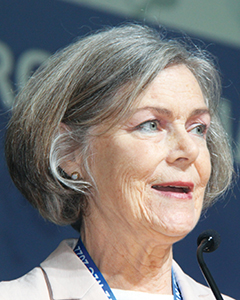
Dr Sarah Stewart Photo: Jasmine D. Driver
At Jadid cemetery: old (l) and new graves with niche for divo
Even as some felt exposure of dead bodies in a dakhma was not conducive to health, others believed neither is a cemetery scientific since it allows microbes and viruses to survive. As compared to a cemetery where tombs reflect the status of the deceased, a dakhma where corpses are laid on pavis in an open well proved death as "a great leveler; personal identity was dispelled.” When there were reports of "Muslim medics using bodies from the dakhma for their experiments,” it was decided to discontinue the system to prevent desecration by vandals.
After digging the ground for a grave, stone and pebbles were laid so as not to contaminate the soil. A corpse was clothed in a sudreh-kusti. Based on interviews it would appear that the transition from a dakhma to a cemetery was not easy. She showed images of the Jadid Cemetery, near Yazd, where old Zoroastrian graves were identified by the aperture for divo.
Zoroastrian sacred texts reflect the prevailing customs and traditions. "Prescribed in the 22 chapters of the Vendidad are laws against demons” through queries supposedly raised by Zarathushtra and answered by Ahura Mazda. "The laws on purity are harsh on women… Dead matter is considered an impurity. To limit the power of evil, a dog’s gaze was considered necessary” as also prayers, stated Stewart. She shared a comment by one of the interviewees: "Recitation of the Avesta is calming and these ceremonies make the family think less of the body of the deceased and (more) aware that his soul (ravan) is present. All these ceremonies as well as their timing keep the family busy and cause them to think less about the body… The smell of fruit emits energy. It is the same with the smell of the bread and lork (dry fruits) and the light of the fire. They all give out positive energy.
"Many Zoroastrians have left Iran, never to return. The situation is not good. The war with Iraq has resulted in considerable displacement,” observed Stewart. Should Zoroastrians feel obliged to serve their country during war times although they consider themselves Iranian first and foremost? "Martyrdom is quite complex. While dying for a just cause would be rewarded, you can’t buy a place in heaven,” felt one of the interviewees.
Reports on other sessions at the 12WZC will appear in forthcoming issues of Parsiana.