Dr Zareer Masani paints a human portrait of
Robert Clive, the controversial governor-general of Bengal
Firdaus Gandavia
Was British East India Company (EIC) representative Robert Clive "an obscure urchin, picked up, fostered and very unmeritedly raised to the highest pinnacle of affluence and pageantry by that deluded Company” or was he the "Flower of the empire, Defender of the country, the brave, the firm in War,” the man who won Britain an empire?
These were the questions raised by Dr Zareer Masani on the controversial career of Clive at a lecture "Robert Clive: The Man Who Would Be King” organized by the Chhatrapati Shivaji Maharaj Vastu Sangrahalaya, Bombay and the Museum Society of Bombay at the Max Mueller Bhavan on December 4, 2019.
Masani has an Oxford DPhil in Modern History and, in addition to a compelling family read And All Is Said: Memoir of a Home Divided, has written several books on history, including biographies of erstwhile Indian Prime Minister Indira Gandhi and British liberal imperialist Lord Thomas Macaulay.
Masani presented a cogent and well-balanced study of a very complex character and successfully rescued him from the adverse criticism meted out to him by the anti-colonial Left as well as Scottish historian and writer William Dalrymple in his recent book The Anarchy: The Relentless Rise of the East India Company.
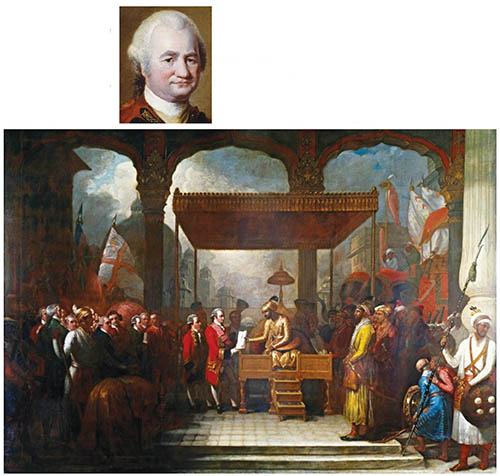
Top: Robert Clive painted by Nathaniel Dance; above: Clive meeting Emperor Shah Alam II
painted by Benjamin West Photos: Wikipedia
Clockwise from top l: Clive at Battle of Plassey Photo: collection.nam.ac.uk;
Shah Alam II Photo: Wikimedia Commons; Nawab Siraj ud-Daulah Photo: steemit.com
The Clive family with an Indian maid painted by Joshua Reynolds Photo: Wikipedia
Clive, an orphan who was brought up by a doting aunt and uncle, was supposed to have been a very bad-tempered child. Macaulay mentions that he held shopkeepers in his village to ransom and threatened to break their windows — a fact disputed by Clive’s leading biographer Mark Bence-Jones. He started his career with the EIC on the wrong footing. There are stories of an unsuccessful suicide attempt, rebellious behavior with his superiors and a fight with the chaplain. Masani informs us that he adopted local customs and frequently visited local brothels, acquiring several doses of the clap (gonorrhea). As a young captain, he acquitted himself admirably in the war between Muhammad Ali, Nawab of the Carnatic, and Chanda Sahib, who was being assisted by the French EIC. Clive laid siege to and even finally captured Chanda Sahib’s capital of Arcot.
Ill-health dogged Clive throughout his life. When he was 27, he suffered from what we today consider a bipolar disorder coupled with severe stomach cramps, a condition, Masani informs us, "for which there would have been little sympathy or remedy back in the 18th century.” He returned to England for three years, failed to get a place at the House of Commons and returned to India in 1755 with the rank of colonel and deputy-governor of Madras, but soon found himself deputed to Bengal.
Masani explained Clive’s role in the web of intrigue to replace Nawab Siraj ud-Daulah with a ruler who would have had a more friendly attitude to the British. Siraj had crossed swords with the Company and played a prominent part in the Black Hole of Calcutta where over 100 British were allegedly suffocated. The Nawab’s court was a nest of vipers and Clive outwitted the crooked courtiers and managed to extract large payments to the Company and to himself as well. The Battle of Plassey in 1757 was a feather in Clive’s cap as it resulted in the defeat of Siraj and established British rule in India.
Clive had the backing of Bengal’s Hindu merchant class and during his first term as governor of Bengal he protected them from the aristocracy of the Nawabs. However, after his return to England, they found themselves being supplanted increasingly by the gomustas (Indian agents) of English traders. Macaulay was very critical of the role of the Company which acquired a "monopoly of almost the whole internal trade.” Macaulay expressed his dismay that "they forced the natives to buy dear and sell cheap.” The Company seemed to be changing its avatar from a trading company to a powerful political animal.
However, the situation in Bengal deteriorated substantially in the five years that Clive was away in England, and it was thought that he was the only person who could stem the rot. Clive returned to Bengal as governor for a second term and fought valiantly to root out corruption, a war which he mentioned was "a battle harder than Plassey.” Power sharing with the ineffectual Nawabs came to an end and the Company was established as the ruler of Bengal.
Clive returned to England for good in 1767 and faced much criticism and lampooning by the British Press. He was blamed for all the disasters and became, as Masani mentioned, "a convenient scapegoat” for the unpopularity of the EIC. In spite of his services to the Company, he never received an English peerage, only an Irish one. However, he was elected to the House of Commons and to the newly appointed Select Committee to enquire into Indian affairs. He was cross-examined by his colleagues and complained that he was treated "like a sheep stealer.” However, it was thanks to his efforts that the new Regulating Act of 1773 turned the governorship of Bengal into the post of governor-general with supreme authority over the presidencies of Madras and Bombay.
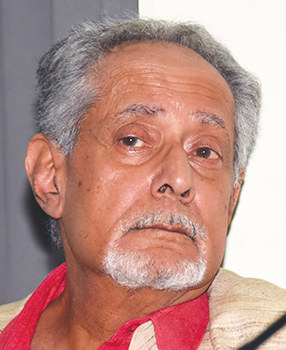
In 1773, he suffered another bout of intense depression along with the stomach cramps which caused him to stab himself in the jugular with a penknife. He was only 49 years old. Masani (pictured), who painted a wonderfully human portrait of his protagonist, ended his lecture by comparing Clive with British Prime Minister Sir Winston Churchill. Both had "enormous intelligence, an ability to get things done and inspire others, a capacity for both hard work and petty quarrels.” And, of course, both suffered from depression.