An eviction notice served on the N. P. Vakil Trust by the Government of India under the draconian Public Premises Eviction of Unauthorised Occupants (PPE) Act to recover the Trust’s salt lands has been quashed by the Bombay High Court. In their order of July 14, 2016, Justices S. C. Dharmadhikari and Shalini Phansalkar-Joshi were unequivocal in stating: "The impugned action is clearly arbitrary and violative of the mandate of Article 14 of the Constitution of India. The principle of equality before law and equal protection of law in this case implies that whether it is the Union of India or a private party, the moment there is a dispute about title, then, the remedy of a regular civil suit in a competent Civil Court must be resorted to. Any departure from the same or bypassing it would violate the mandate of Article 14 of the Constitution of India and make a mockery of the principle enshrined therein of equality before law. Looked at from this angle and in the light of the peculiar facts and circumstances of this case, it will have to be held that the impugned eviction notices and the proceedings in pursuance thereof are ex-facie without jurisdiction. The eviction officer under the PPE Act has usurped the jurisdiction without any legal foundation. Once this conclusion is reached, the petitioners cannot be compelled to appear before him and defend the notices or submit to his power and authority under the Act. The Act itself is incapable of being invoked and applied to the petitioners herein.”
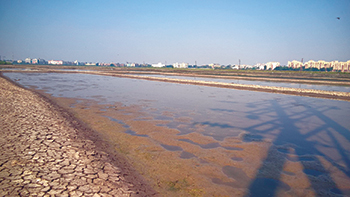
Salt pans in Naigaon, near Vasai
The Trust has been in "uninterrupted possession” of 432 acres of salt pan land in Naigaon near Vasai since 1887. Since the Government is claiming ownership of all salt pans in the country, the Bombay High Court decision has come "as a shot in the arm for private salt manufacturers, who have controlled large swathes in and around the city since the late 19th century,” reported The Times of India (TOI) on October 27, 2016. Many other owners have also received eviction notices from the Government.
The state government in Maharashtra had been eyeing these lands for creating low cost housing and many builders are interested in developing them, reported TOI.
According to the trustees, in 1887 Sir Navroji Pestonji Vakil held a government agency for salt distribution in central and north India. When this agency was about to be acquired by the government, Vakil wrote to the British authorities of that time asking for compensation to be given to him in the form of land so that he could commence manufacture of salt. On May 30, 1887, the Land Revenue Department granted him lands with occupancy rights in the villages of Umela, Sandore and Kiravli at Naigaon and Bassein Taluka in Thane district. These lands were granted with occupancy rights without being put up for public auction as a special case on the ground of the "good services”’ he had rendered as government agent for the sale of salt.
The Trust avers that occupancy rights were granted under the Bombay Land Revenue Code of 1879, which confers on the lands inheritable, transferable right and the salt department was merely the licensing authority for the salt manufacturing licence and is in no way concerned with ownership of said lands. The trustees also submitted to the court a letter dated October 20, 1887, issued by Commissioner Northern Division to the Collector of Thanna, confirming the grant of land to Vakil.
In January 1892 Vakil executed an officially registered Indenture of Trust by paying the then stamp duty and passed on the ownership lands along with the salt works which he had constructed on them to a family trust whose beneficiaries were his five daughters, whose descendants are trustees today.
A letter from the salt department dated August 31, 1957 stating that the land of these three salt works of the Vakil Trust "does not belong to the central government ...” was taken on record by the judges. In 1971, a small portion of the salt land was acquired by the government for a public amenity for which the trust received monetary compensation of Rs 11,021. "It is thus clear that respondent No 1 (Union government) has at the relevant time proceeded on the basis that the subject land was owned by the petitioner (Sir N P Vakil Trust),” reads the court’s order. "This among other things, amounts to an unequivocal acceptance of the petitioner’s ownership.”
However, since a Writ petition cannot determine title, while rejecting the salt department’s justification to invoke the PPE Act and quashing the notice, the court said: "The issue of title shall be decided uninfluenced by the outcome of the present petition...”