The 100th anniversary of the founding
of the Dadar Athornan Institute stands
testament to the school’s lasting legacy
Farrokh Jijina
It has been a very satisfying centenary,” principal Ervad (Dr) Ramiyar Karanjia stated to those gathered at a function to mark completion of 100 years of the establishment of the Dadar Athornan Institute (DAI) held at the Sophia Bhabha Hall on December 13, 2019. The priest noted: "Life in the Madressa is a bitter-sweet thing… When one has been a student, it is difficult to stay away… All students have a love-hate relationship with their teachers.” His remarks elicited loud applause from the ex-students in the balcony of the Hall. Urging students and ex-students to be ambassadors for DAI, he hoped that it may "always continue to
serve the community.” Mobeds and the laity need to walk hand in hand, he stated.
Inaugurated on November 9, 1919 as Athornan Boarding Madressa by the Athornan Mandal, and renamed DAI in March 2009, the Institute is the only functioning Zoroastrian seminary in the country.
Trustee and president of the Mandal and Udvada High Priest Dastur Khurshed Dastoor, who Karanjia introduced as "not just a president but a friend of the DAI students,” emphasized that there should be no attitude in the behdins of "hu aapuch (I give) and the clergy takes… Look at other communities…See how they respect their priests… Let us change our mindset.” Ruing that "mobeds were never looked after by the community,” Dastoor stated that "at least 30 schemes” must have been announced for the welfare of priests in the recent past. "None took off…I do not understand why (wealthy business houses) have not taken the lead.”
Associated with the DAI since 1971, Dastoor recalled the efforts of previous principal the late Ervad Rustomji Panthaki who "begged from the community” to sustain the Institute. His wife Jalamai was a "mother figure to all the students,” he said. "It is for the community to decide whether this Institute should go on for another 100 years,” Dastoor commented. In his message printed in the centenary souvenir, the High Priest noted: "I yearn to bring about a fundamental change in the formative years (of a young priest)… so as to bring about a complete transformation in the life of future mobeds.” Student-compere Ervad Zahan Turel described him as aapra baddha na pyaara [beloved of us all (students)].
Writing in the centenary souvenir Dastur (Dr) Jamasp JamaspAsa expressed his wishes for DAI’s growth, but also reiterated that respect for priests has "slowly but surely been eroded.” Dastur Keki Ravji Meherjirana stated he owed his position to the knowledge he gained at DAI while Dastur Cyrus Dastur recalled the efforts of visionaries in establishing it.
Referring to the DAI as Herbadestan (religious seminary), chief guest Dastur (Dr) Firoze Kotwal stated that in 1917 when the DAI was sought to be formed, priests were divided on whether a school was needed or informal training was adequate. "Five to seven years (duration of priestly training) is not a long time in the life of a student…The learning lasts a lifetime… Mobeds should have unflinching faith in religion…(and) sterling virtues,” Kotwal emphasized. Insisting on compassion from the DAI teachers, Kotwal’s advice to the assembled priests and students was "jé bhi bhano aastha thi bhano (whatever you pray, pray with faith).” This, he noted, was listed as the last of the 14 attributes of a priest in the Dadestan.
Chairman of the Mandal’s board of trustees Ervad Nadir Modi felicitated Kotwal with a scroll that acknowledged his "immense contribution to guiding Zoroastrians worldwide.” In his introduction of Kotwal, Mandal trustee Ervad Vispi Dastur referred to 26 entries in Encylopedia Iranica for the High Priest’s work. The Athornan Mandal "acknowledges, appreciates and applauds” Kotwal, he stated.
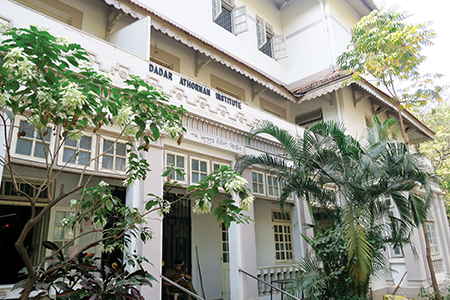
Dadar Athornan Institute Photo: Farrokh Jijina
From right Ervads Vispi Dastur, Asphandiar Dadachanji, Nadir Modi, Dasturs Khurshed Dastoor and (Dr) Firoze Kotwal,
Ervads Parvez Bajan and (Dr) Ramiyar Karanjia
Welcome by students at their 100th anniversary function
From right: Student comperes Yazad Broacha and Ervad Zahan Turel;
felicitating Dastur Keki Ravji Meherjirana (in shawl)
To trustee Ervad (Dr) Parvez Bajan, the DAI and the other seminary (M. F. Cama Athornan Institute in Andheri, reportedly with no students for the last two years) are the Oxford and Cambridge for priestly training. "Cama started with a fund of Rs 25 lakhs…the DAI started with a begging bowl… DAI is for, and by, athornans… We will see to it that DAI goes on and on and on,” he prophesied. His advice to the assembled priests: "Deserve, and then desire.”
Homi Ranina, Hoshang Sinor, Ervads Cyrus Unwalla and Asphandiar Dadachanji also serve as trustees of the Mandal.
The evening had begun with student-comperes Turel and Yazad Broacha welcoming the audience, a humbandagi and two monajats rendered by the students. The boys’ benediction for the audience was long lives, prosperity and the ability to do good, useful deeds ("bhala, upyogi kaam”). A film on the Institute Keeping the flame burning bright, scripted by Karanjia and executed by Aarish Daruwalla of Mazda Studios took the audience through its history, before explaining a typical day in the life of a priest in training. The event saw the release of a commemorative medal and also two books written by Karanjia: A History of the Dadar Athornan Institute (erstwhile "Athornan Boarding Madressa”): A Hundred Years of Educating Priests and A Comprehensive History of The Athornan Mandal of Mumbai: A Glimpse into the Priestly Class of the 20th Century.
Prizes were awarded for prayers and academic excellence, all watched over by the beaming principal. The docudrama Amar Jyoti Zarathushtra conceived by Dadar matriarch and social worker Mithoo Jesia was staged. Joint honorary secretary of the Mandal Ervad Cyrus Darbari offered a comprehensive vote of thanks.
Community catalyst
"I am hoping to be a catalyst in providing yozdathregar mobeds to the community… mobeds who are on the right side of the religion,” Karanjia said, while talking to Parsiana in his office late morning on January 8, 2020. He explained that yozdathregar priests are those who can perform higher liturgical ceremonies like the ijashne, vendidad and niragdin. "About 40 yozdathregar mobeds who serve our atash behrams are from DAI,” as are an equal number of priests who serve other fire temples, Karanjia said.
The patter of feet outside his office told us that the students were off to the neighboring Dadar Parsi Youths Assembly (DPYA) High School for their non-religious studies. "Afternoon session,” explained Karanjia, bestowing an indulgent smile on a student who wanted a note from him to take to School. Karanjia has been principal for the last quarter century of the Institute, and associated with it for 45 years of his life as student and teacher.
Earlier, the young trainee priests were reciting their prayers before lunch under the watchful eye of a young monitor in the presence of resident teachers, Ervads Sarosh Behramkamdin and Kersi Karanjia. In a double line, the 20+ students, ages ranging from seven to about 15, then filed into the adjoining dining hall. Their plates laden with food, they sat down on preassigned seats to eat, expressing only mild curiosity at being photographed.
A plaque outside the principal’s office lists nine mobeds who have performed 320 nirangdins between them, since records started to be kept in 1966. In its century of existence, the Institute has trained over 500 mobeds for higher liturgical work, Ramiyar stated. There are an adequate number of ordained mobeds for the community, but all of them do not practice as priests.
Of the students who have passed out from DAI in the recent past, "all of them were doing part-time mobedi while in college,” Ramiyar asserted. "It may perhaps be better if they completed college, even took up a job, and then became full-time priests… Then it would be a matter of choice, not compulsion,” opined the principal.
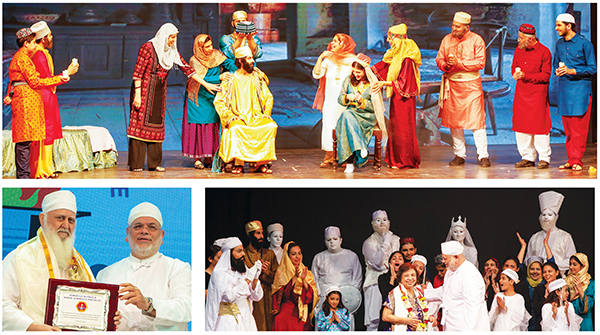
Top: Scene from docudrama Amar Jyoti Zarathushtra; above, from l: Kotwal felicitated by Dastoor;
cast of docudrama with Mithoo Jesia (center), felicitated by Dastoor
Top: Student priests at prayer; above, from l: plaque on Institute building, Tehmton and Hoshedar Dotiwala
in the DAI office; playground Photos Farrokh Jijina; above from far l: Homi Ranina, Hoshang Sinor,
Ervad Cyrus Unwalla, resident teachers Ervads Kersi Karanjia, Sarosh Behramkamdin, Cyrus Sidhva,
resident matron Kamal Karanjia
Audience Photos: Mazda Studios
Ramiyar foresees that only six or seven from the current batch of 24 students will be full-time priests. As the principal notes in his 213-page meticulous compilation of the history of DAI, "The scarcity of good priests for performing higher rituals was felt as early as in the 1900s… as parents discouraged their brilliant sons to take up priesthood as a vocation.” Ramiyar noted that eminent people of the time like Bomanji Dinshaw Petit bemoaned that due to the depleting number of priests, a "time will come when there will be nobody to look after Zoroastrian religious institutions or perform rituals for departed ones.” Such concerns and those voiced in the media prompted the Athornan Mandal, "which was still a nascent trust for the amelioration of priests,” to set up a religious training school for priests with boarding and lodging facilities.
"The Madressa’s fall started around 1962,” said then Udvada High Priest Dastur (Dr) Hormazdyar Mirza, when presiding over Rustomji’s retirement function on April 22, 1995 (see "Mentors at the Madressa,” Parsiana, February-March 1996). "The breakup of the joint family system and the emergence of two working parents has caused children to be deprived of moral education… They are more prone to accept superficial cultural norms,” Rustomji had told Parsiana (see "The priest as a pillar,” Parsiana, February-March 1996). He called for "mutual love” and "understanding.” His advice: "The priestly class should become one, rather than belong to different tolas (groups).”
Credited by many as almost singlehandedly reviving and strengthening the Madressa, Rustomji’s appointment had come in June 1966 after the Madressa remained closed for a year "due to lack of students.” His quiet insistence that the Madressa students should be educated up to the SSC (Secondary School Certificate) in addition to religious education "paid off.” His portrait hangs in the bhanter (prayer) room at the DAI. An annual award has been instituted in his memory for students who have studied under his guidance "and later excelled in priesthood, community welfare or other religious and academic activities.” Resident teacher and editor of DAI’s journal Knowledgiate Ervad Cyrus Sidhwa noted in the centenary souvenir that the publication was first published "exactly 35 years ago… with the blessings of Rustomji.”
Principals of the Institute were earlier designated "Head Teacher,” Ramiyar noted. "The Mandal’s managing committee was of the firm view that the head teacher may not necessarily be a graduate, but should be a yozdathregar priest.” All but one of the eight principals who preceded Ramiyar and Rustomji belonged to priestly families. Hirji Driver who served from 1957 to 1961 was the only behdin (lay) principal.
At the core
Besides being knowledgeable, "priests of today have to be givers of succor to the laity… The community needs articulate priests,” stated Ramiyar, appreciative of the efforts of the World Zoroastrian Organisation Trusts and the Mandal to enhance soft skills of Bombay-based priests. A program for select mobeds and some students of DAI was held in February at Sanjan, he told Parsiana.
Peripheral changes have been made in minor religious practices and rituals over the centuries after the arrival of the Zoroastrians in India, Ramiyar explained. "For instance a lot of mobeds wear colored clothes and may even be seen without their heads covered…even in shorts.” The faith will be "totally lost if changes are made to its basic fabric.” Every departure from the prescribed rituals will take us one step away from the religion, "until nothing is left…This may not be perceptible now, but will make a big impact,” he noted. Already, the "25,000 strong community” in the US diaspora are asking "why should we look to India” for answers about the religion, shared the principal. "I tell them to be diligent in their beliefs and practices.”
Small adjustments in religious practices are necessary where required, he said, but "if you once open the floodgates, the religion will be diluted… the core of the religion should never change.”