Unity and charity guide the activities of the
Zoroastrian Charity Funds of Hong Kong, Canton and Macao
Text: Parinaz M. Gandhi Photos: Jasmine D. Driver
"Ours is a very harmonious community for sure. Very understanding and supportive. Perhaps the Bombay Parsis could learn from us,” declared Neville Shroff, president of the Zoroastrian Charity Funds of Hongkong, Canton and Macao (ZCFHCM). His team of five trustees — including Viraf Parekh, Rustom Jokhi, Dilnavaz Daver and Homiar Poonawala — steers the affairs of the Parsi community in Hong Kong that numbers around 250 and is steadily increasing like in the US, Canada and Australia thanks to the inflow of migrants.
During the brief interaction that the trustees had with Parsiana on December 17, 2016 it emerged that they are "passionate about charity” with their annual donations to around 35 organizations approximating nearly two million USD (Rs 13,64,11,000). As specified in the Directory of Hong Kong Zoroastrians, "The trust’s donations of crores of rupees to institutions such as the Parsee General Hospital, Godrej Baug, Malcolm Baug, homes for senior citizens and the poor and needy in Navsari and other such large projects are well publicized, but what is little known is that the main thrust of the trust’s donations are actually done quietly and directly to the sick, the poor, the infirm and the needy, and to small institutions and anjumans mainly in India for repairs etc to agiaries, dakhmas, dharamshalas, libraries, etc and for distribution of medical, food and educational aid to these anjumans’ members.”
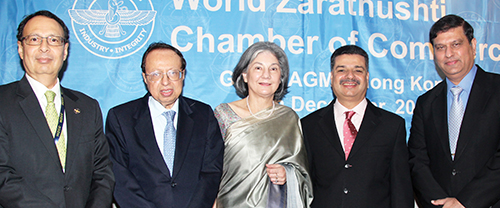
From left: Neville Shroff, Viraf Parekh, Dilnavaz Daver, Rustom Jokhi and Homiar Poonawala
Zoroastrian Building
(From left) Neville Shroff, Thrity Mukadam Kenny, Rasheed Shroff, Jehaan Kotwal,
Arzan Wadia, Siavosh Kaviani, Danny Khursigara
A section of the audience with the panel
They give regularly to the WZO Trust in India managed by Dinshaw Tamboly "to support all his major programs,” said Shroff. Within Hong Kong, they are "sympathetic to children in particular, assisting orphanages, as also the visually impaired and the mentally challenged,” added Parekh. In times of natural calamities too they extend help, choosing "not to discriminate as far as possible.”
Besides listing the contacts of the 66 resident families in Hong Kong, their Directory, which is updated every year thanks to the efforts of the Parekh family, includes details on overseas relatives and friends, "A Historical Outline of our Trust, its Activities and its People,” the events calendar listing the score plus get-togethers organized by the association, useful utility, social and entertainment contacts, IDD country/city codes, world time, measures and conversions.
The Social Hall Committee, comprising Parvez Jokhi, Farida Shroff, Roxy Jokhi and Chermeen Parekh functions independently and organizes dinners and events in the Zoroastrian Building as also outdoor activities like picnics. With the youths — under age 30 — constituting 25% of their total strength, special programs are geared to interest them. The Christmas party is a favorite event when the association sponsors gifts for all children under 11, reported Jokhi. The periodic religion classes are also enjoyed by the little ones where they get to learn about their religion and culture.
"To encourage the young to come to the Parsi Club (as they refer to their network of Zoroastrian members) we don’t charge anything for those under 11 years of age and half the price for those under 18,” stated Shroff. To promote fraternization among the young adults of the community, three to four times a year, during vacations, they are encouraged to undertake social outings like boat trips or drinks and dinner with all expenses paid by the anjuman.
Noticing that interfaith marriages "are increasing,” the association chooses to be "flexible” and welcomes non-Parsi spouses at most of their social functions. There are 21dinners in a year organized for the members from funds specially bequeathed to ZCFHCM. Barring the six gahanbars, interfaith spouses can join in all the other memorial dinners. On their payroll are the resident priest, Homyar Nasirabadwala and the two chefs, one of whom is a Parsi, who facilitate the organization of jashans and community meals.
Seniors constitute 40% of the Hong Kong Zoroastrian community. "The majority are well looked after by their own families.” But if the trustees realize any elderly person needs assistance, "we are the first to help… After all charity begins at home,” declared Neville.
In the 23-storey centrally air conditioned concrete and glass Zoroastrian Building, ZCFHCM occupies four floors and rents out the remaining space as shops and offices to derive a steady source of income. Besides maintaining this tower, the cost of preserving the Zoroastrian cemeteries in Hong Kong and Macao is also borne by the ZCFHCM. While the cemetery in Macao classifies as "a heritage structure, it is under our active management,” stated Neville.
As mentioned in the Directory, Parsis had begun to settle in Macao in the 1820s, in Hong Kong in the 1840s after the establishment of the British administration, and in Shanghai in the 1850s after it was opened up to foreigners. The trust in Hong Kong has its origins in 1822 when a plot of land was purchased in Macao for the establishment of a Parsi cemetery. However since the hub of China trade was in Canton, the first Parsi association, the China Canton Anjuman was established in 1834. Eleven years later a wider anjuman body was created to cover Hong Kong, Canton and Macao but the trust was registered under its present name only in 1874. Having gained a reputation of being among the most philanthropic community organizations, the trust is known to have made its first remittance to India in 1848 and contributed for the relief of local destitute Chinese beginning 1854.
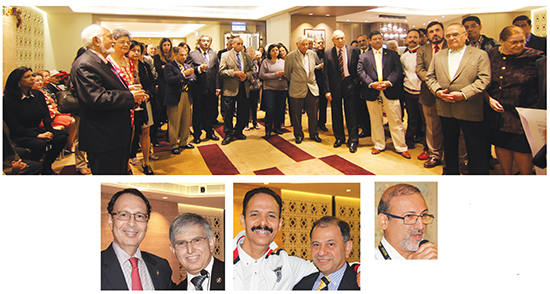
Top: Hong Kong residents and WZCC members at Zoroastrian Building;
Above (from left) Neville Shroff, Sam Balsara, Mickey Mehta, Edul Daver, Firoz Pestonji
From left: Dr Sharmeen Shroff Sidhar, Natasha and Alisha Shroff,
Nekzad Irani, Nigel Shroff, Tania Shroff
Nariman Dandiwala (top); bonding opportunities for seniors (left) and the youth (above)
To the president, "it is important to highlight the positive features concerning the community rather than dwell on the declining numbers.” Ever an optimist, he is keen that the youth take pride in their roots and retain their affiliations.
Shaping business success
"Technology is advancing at an unprecedented pace. What worked five years ago is now largely obsolete… In this game changing business world…how innovative do we need to be?” enquired Neville Shroff when moderating the panel discussion on "The Impact of doing Business in a Globally Volatile and Political Environment – The Challenges and Opportunities in Shaping Business Success” on the morning of December 17 at the Zoroastrian Building in Hong Kong.
In keeping with his objective of involving the youngsters in community activities, the discussion following the annual general meeting of the World Zarathushti Chamber of Commerce (WZCC) had six youthful panelists. From Hong Kong were: Thrity Mukadam Kenny who has worked in the field of commercial law in a private firm, and later shifted to the securities market regulator where her duties involve overseeing the exchanges and clearing houses as well as developing policies and legislation relating to market infrastructure; Rasheed Shroff, vice president, Fossil Brand, Asia Pacific Region, managing sales and marketing activities in retail, wholesale and ecommerce channels, and also a board member of the Fossil Foundation that partners with nonprofit organizations to unleash the potential of youth; Danny Khursigara, certified life and executive coach, speaker and trainer who has co-authored the bestselling work The Road to Success, and career banker who has also served as chief operating officer and chief financial officer for Fortune 500 corporations. With them were India’s Jehaan Kotwal, chief executive officer of the family firm JFK Transporters that provides end to end logistics support to all types of multinational companies in India and recently won the Castrol best transporter award; New York based Arzan Wadia, architect and urban designer who also runs a technology consultancy firm providing system and network management and web design for small and medium firms, and is additionally vice president of the Federation of Zoroastrian Associations of North America; and Iran’s Siavosh Kaviani, a mechanical engineer who is in the business of his father’s firm Iran Spare Company dealing in automotive parts that he diversified to include groceries, super markets and hyper markets, and additionally sources financiers for commercial construction projects in Tehran.
With Hong Kong presently under China, "There are a lot more opportunities. However, the approach to government is different, with a very different language and culture. We have to understand where they are coming from and maintain our individuality within that environment,” said Kenny. Her workplace now has 50% women but the board of directors has 70% men, "not because women are not getting enough opportunities but because a lot of women don’t want to take on that role. They are valuing something else,” Kenny referred to the mothers who give priority to domestic responsibilities. In the 1990s when she started working, Hong Kong was under British rule and she did not have widespread use of the Internet and mobile technology. The scenario now is "completely different with information so widely and easily available that we do not know what is significant from what is noise or false. We don’t know how much information is reliable since there is no accountability, no referencing, no substantiating,” she added.
In the new global scenario where standards are constantly changing, where markets work differently permitting buying of stock anywhere in the world, where investors are not only individuals but also institutional, where it is easy for markets to be dominated by power houses, she felt regulation, and even over-regulation is required. "We don’t do it for fun. We really try to listen to all sectors and hope to get it right most of the time.”
Although there are "opportunities everywhere with access to Uber, and Amazon that did business of USD 13 billion in the last quarter, Shroff described the current consumer environment as "disruptive… When the king died in Thailand, our market dried up. When there was a ferry tragedy in Korea, they (the shoppers) felt they could not shop” because according to the Korean psyche it would be inappropriate to indulge themselves in the face of disaster. Whilst online business has gone up by over 300%, offline business is not up. We have to change our complete approach to products… We have to diversify…stay flexible… We will never succeed if we don’t…The millennial consumer reacts differently. Why would he be interested in buying a watch that only gives the time if he can get a timepiece that also gives information on whether there is traffic along the way?” he expressed his views.
Being a director of Fossil Foundation, he reported that when "the employees know that what they are doing is giving back to society, they become passionate about their work as they want to make an impact.”
Describing logistics as "the sunrise industry in India, thanks to technology, thanks to IOT (Internet of Things that facilitates instant transfer of data with interrelated computing devices),” Kotwal stated, "It was unorganized and unprofessional for a very long time… Our generation wants new ideas, constant upgrading… To be ahead of the curve young entrepreneurs must travel” to open themselves to new experiences.
"Technological advances should translate into products which are useful,” observed Wadia who pointed out that the field of architecture though is "still the slowest moving, using brick and mortar as also concrete that takes 28 days to dry!” In this day of "digital disruption,” two kinds of skills are required to run an architectural firm, believed Wadia. In addition to professional training as an architect, problem solving skills are equally important. He reported that as per university guidelines, "international students are permitted to work for limited hours if they hone their problem solving skills in a computer laboratory.” They thereby learn "to understand the needs of a client, find holistic solutions.” The concept of office parks and the need for physical space is giving way to low budget design firms where individuals operate optimally from the convenience of their residence employing "cutting edge of technology… Uber wouldn’t have happened if cell phones did not exist.”
"People are not investing in production and business in Iran,” regretted Kaviani. "The interest rates are still as high as 24% in the banking sector. There is also the language barrier because of which there is not much improvement… China though had continued to have business ties with Iran even when sanctions were imposed by many other countries. They would buy oil and gas from Iran and repay in Chinese made goods, or via transactions honored by Bank of Kunlun.”
Defining success as "a higher level of perceived life,” Khursigara commented, "This is a time for great opportunity despite the recession…The quality of success is in direct proportion to the purpose and strategy of doing business. Is the purpose (of business) for financial gain and profit or growth and contribution?” Knowing that success or outcome is dependent on the event (beyond one’s control) and one’s response (within control), he felt each of us should take 100% responsibility for one’s life. "The only thing we control is our mindset and how we are going to do business… You are the average of five people you spend time with.”
"Technology is a tool, a catalyst; not an end to business. Business needs governing principles, plans, morality, ethics, standards,” summed up the discussion.
Following the discussion, the WZCC entourage proceeded to the Craigengower Cricket Club for a traditional Chinese lunch. The facility was extended to the guests thanks to the only Zoroastrian member of this Club, nonagenarian Nariman Dandiwala, announced Shroff.
Embrace change
"It is high time we stopped harping on the past. It is lulling us into believing we are great. The point is, are we great?” enquired Sam Balsara, chairman and managing director of Madison World in his opening remarks at the informal get-together at the Zoroastrian Building in Hong Kong, on December 16, 2016. For a community known for its enterprise, honesty, integrity, Balsara regretted "we are going down.” In the prevalent scenario of no marriages, late marriages, dwindling population, cheating by a Parsi priest, the goings-on in the largest industrial empire of Tatas "which make the (Bombay Parsi) Punchayet trustees look like saints,” Balsara advised "do something to impact the future.”
When addressing members of the Hong Kong and international community who had met a day prior to the annual general meeting of the WZCC hosted by the ZCFHCM, Balsara noted, "Religion is the reason why we came together. It should bind us together but is instead becoming the reason for divisiveness.” He advocated the need for a "codified, hierarchical religious order” with the emergence of one religious head who after years of study "can guide you and me... one whom we can respect.”
Another problem plaguing the community is the trusts which are "asset rich, cash poor and management poor.” Since all were created for the betterment of the Parsi community, instead of working as islands they should come together under a senior, well-to-do man of stature whose integrity is beyond doubt. "Someone like Nadir Godrej could supervise, advise and monitor,” Balsara recommended the name of the managing director of Godrej Industries to head a youthful working/managing committee whose term "could be restricted to five years so that they don’t get carried away.”
To address the issue of dwindling numbers, Balsara asked rhetorically, "What are we doing? Not much.” That 100 babies were born under the Jiyo Parsi scheme, he considered, "wonderful,” but he insisted "we should put our money where our mouth is.” Observing that the poorer section are more inclined to have more children, he felt those with an annual income of less than Rs 10 lakhs needed "a solid subsidy of Rs 50,000 a month.” By unlocking the potential of assets lying idle in community trusts, subsidies could be provided to deserving families.
Living in a house that is 85 years old, Balsara stated that he is in favor of appreciating heritage but "Parsis can’t live by heritage alone. The world is changing so fast… (Our) religion is going to recede… (unless) we embrace change and face it with confidence.”
The second speaker for the evening was health guru Mickey Mehta who has launched "Heal the World” initiative and was presented a citation to commend his "35 years of valuable contribution to holistic health science.” He started his talk by asking the gathering to clap as it creates "a condition of happiness.” In response to Balsara’s concern for community numbers declining, Mehta jested that the problem would be resolved if Parsi men were permitted four wives. Countered Balsara, "Allow women four husbands also,” which, Mehta concurred, should also be permissible.
He then dwelt on the five elements of nature that Zoroastrians revere with special emphasis on fire, "the invisible, indestructible energy.” Fire should be "fuelled with wellness,” and religion should be lived "moment to moment.” He referred to the science of epigenetics (developmental processes that lead to the formation of organs) and studies that indicate that nutrition can impact the aging process. He differentiated evolution or progress from entropy or degradation. According to him, every religion advocates "harmony and fructifying of life,” and recommended the community adopt a lifestyle of "wholesome, soulful eating, that is organic friendly and free of animal meat. Vegetarianism is life embracing,” he asserted. Start the day with fruits, herbal tea, hot water, and end with dinner, no later than 7 p.m. he told the assembly who chose to disregard his advice and enjoy the culinary spread organized by the ZCFHCM.
Giving an overview of the nearly 5,000 strong Australian community that is hosting the XI World Zoroastrian Congress in Perth in 2018, principal organizer Firoz Pestonji stated, "Ours is a very, very young diaspora. Religious minded yet tolerant, we live harmoniously with the intermarried.” He was happy to report that within half an hour of the Congress being awarded to Australia at the Global Working Group meeting in Udvada in 2015, they had already launched the Congress website. When they invited community members to express what they were seeking from this Congress, they got responses from all over the globe. "It is a learning curve for us,” he announced.