Delhi Parsi Anjuman bids farewell to its
long-standing manager Dhun Bagli
Text: Ava Khullar • Photos: Navroz Behramfram
We will always remember
in January, June and December
Dhun Bagli, our Dharamshala’s prima don-na!
Who always welcomed us with a ‘jio mara vah-la’!
Proud Chef of Parsi feasts
Mother of our beloved Head Priest
Keeper of the Agiary keys
Conscientious collector of bhona-nee-fees!
Frilled cutlets, drenched in gravy
With fried fish — we’ll miss all this, dearly!
Suggester of dishes to make our menus
When sending large portions to far-away venues
Purveyor of soft drinks and chips
That made a beeline for our hips!
But we can vouch — Maja, Keki and Fali
That there will be no match for your boti-sali!
Your kolmi-no-patia will linger on our lips
As will your samosas — with dips
Of all your services, what can be said?
You looked after our navjotes and weddings
And even solemnly buried our dead
How beautiful the Aramgah looked every muktad
Thanks to dasturji saheb, his consort,
And Dhun-Abad!
We will miss you and shed a tear
Staff, trustees and all
Whenever we have a function in the Hall
Sayonara, Dhun dear,
And for the future — have no fear.
Three stalwarts of the Delhi community — jurist Fali Nariman, poet and novelist Keki Daruwalla and human rights activist Maja Daruwalla — penned this good humored poem in honor of 84-year-old Dhun Bagli, manager for over four decades of the Delhi Parsi Anjuman (DPA)’s Mengusi Dharamshala, at the fond farewell organized for her at the Navroz function on August 17, 2017.
Parsis in Delhi, outside Delhi, and even abroad fondly remember the lady, formally dressed in her crisp, cotton sari, worn Parsi style with a matching high-neck blouse, sitting in her high-backed chair in the Dharamshala office, interacting with guests or visitors coming to the Kaikhushru Pallonji Katrak Dar-e-Meher who would drop in to chat with her after the prayers. She would certainly be a rich repository of all the news and happenings concerning the Parsis of Delhi over the years.
The president of DPA, Yezad Kapadia, wished her a justly deserved, restful, retired life and commended her for operating the Dharamshala with efficiency, maintaining discipline over the staff during her tenure. She literally became the face of the Anjuman’s guest house.
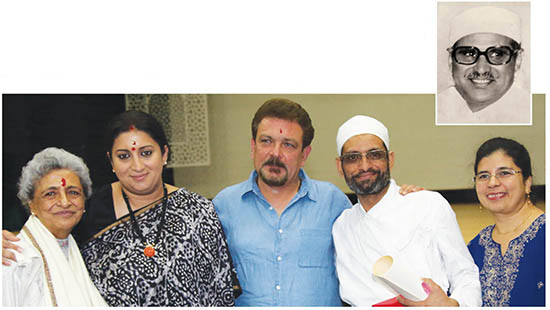
From left: Dhun Bagli, Smriti and Zubin Irani, Ervad Cawas and Benaifer Bagli; inset: Ervad Daraius Bagli
Clockwise from right: audience at the felicitation function; Dr Shernaz Cama,
Adil Nargolwala and Dhun Bagli; Maja Daruwalla Photo: Anay Mann; Keki Daruwalla and
Fali Nariman
Parzor director Dr Shernaz Cama recalled how when she had come to Delhi as a young girl she had heard of "Dancing Daraius Dasturji and his highly talented IBM wife.” Over the years she had developed high regard for "Dhun aunty” for her caring attitude towards the Parsi families of Delhi, most of whom were her friends. She had been involved in their nahns (ritual bath), children’s navjotes and marriages, and had even tenderly bathed them before their last earthly journey. Post retirement, Cama has a job ready for her: To write a book on the history of the Delhi Parsis with support from other old residents who have seen the community grow and thrive in Delhi.
On behalf of the Farohar children’s religious class, Kerman Mehta and Rukshana Shroff presented Dhun with a special "Farohar Mug,” recalling how it was Dhun who had suggested they name the children’s class as Farohar.
Dhun was also presented a shawl, a plaque and a cash gift by the chief guest, union minister of textiles and information and broadcasting Smriti Irani who seemed more Parsi than Parsi, charming, casual and friendly with no airs of a person holding a ministerial post in the central cabinet. Having interacted with Dhun through her husband Zubin, Smriti recounted some anecdotes. An endearing episode mirrored the informality and bonhomie of the evening when the chief guest walked out to get a glass of water for herself and then joined her husband and children sitting in the second row in spite of requests from the organizers to sit in the front row.
Nari Tarapore and Shernaz Italia were among the members present who remembered the good times of yester years and came forward to share their feelings for the retiring manager. Old friends like Rusi Sorabji, settled in California, wrote of their memories of "masti majha (mischief and fun)” with the Baglis during the 1950s and 60s.
In her address, Dhun spoke fondly of her first meeting with Daraius who sternly reprimanded her and her two companions for failing to inform him of the delay in their arrival at the Dharamshala, and then fed them a sumptuous dinner. She reminisced how his children (from a previous marriage) endeared themselves to her and how finally she became their mother when she wed Daraius. Among the many social activities they organized and participated in, car racing was her favorite sport.
A slide show entitled "The Indomitable Dhun Bagli,” prepared by designer Ashdeen Lilaowala and Cama, portrayed Bagli in her varied avatars: as loving mother to her children, dancing garbas and acting in Gujarati plays with the ladies of Delhi, greeting with traditional achhu michhu the likes of prime ministers Indira Gandhi and Rajiv Gandhi, Congress party president Sonia Gandhi, lieutenant governors and other dignitaries attending DPA functions, participating in car rallies, and presiding over the affairs of the Dharamshala from her office room. The slide show accompanied by the music of Chopin, brought a fitting conclusion to the felicitation.
Delhi, Daraius and Dhun
Dhun’s "affair” with Delhi began when she had come to the city as private secretary to Lady Rama Rao, head of the Family Planning Organization, for five weeks when organizing an International Conference on Planned Parenthood in 1958. Accompanied by two other Parsi women, the trio stayed at the Parsi Dharamshala. That month proved to be a life changer for Dhun (née Langrana).
Above: Dhun participating in a car rally; right: Bagli family (L to r): Dinyar, Cawas,
Dhun, Daraius, Christine, Cyrus and Bakhtawar Dalal with baby Isabella,
Berjes Dalal (forefront); inset: Dinshaw Photos courtesy: Cawas Bagli
Mengusi Dharamshala in Delhi
Daraius, who was managing the agiary and the Dharamshala, had recently lost his wife Veera and was living with his three children, nine-year-old twins Dinshaw and Dinyar, and seven-year-old Bakhtawer. When the three ladies returned from work each evening, they spent quality time with the children, reading stories, playing games, etc, leading to a growing bond of affection. The children found in Dhun a mother figure. That there was something else brewing between Dhun and their father came to light when Daraius proposed to Dhun, got the consent of her parents for her hand in marriage, got married, and brought Dhun to Delhi as his bride before the year was over.
Dhun laughingly related how her aunts had advised her when she was about to leave for Delhi (her first ever visit outside Bombay) that at the age of 24 she had better find herself a husband on this trip. Dhun had cheekily responded that she would bring home a "pagdiwala sardar (turbaned Sikh) from Delhi.” Instead she got a pagdiwala priest!
A pillar of support to her husband, Dhun gave up her profession, looked after her family and involved herself in community activities. Both Daraius and Dhun had cheery personalities, with a rich dose of mischievousness. The small, close-knit Parsi community of Delhi in the late 1950s and 60s had a merry social life meeting every evening at the Bhiwandiwala Hall in the agiary complex. The Hall served as a multi-purpose club area where billiards, badminton, tambola, and festive dinners for Jamshedi Navroz, Shahenshahi Navroz, gahanbars, etc were held. The highlight of the year’s social event was the Gujarati play put up by the Amateur Dramatic Society. These plays and garbas were organized, often written and directed by Daraius. He and Dhun played leading roles supported by old hands like Jal Patel, Cavas Desai, Nari Tarapore, the Vania sisters and others.
Dhun and Daraius’ son Cawas was born seven years later when the other three children had already reached their teens. Once the youngest grew up, Dhun decided to return to the corporate world and worked as secretary to the regional general manager of IBM until the organization wound up and subsequently joined the American Embassy.
When Daraius suddenly passed away after a fatal heart attack in 1979 leaving Dhun and the rest of the Anjuman in a state of shock, Dhun decided to avail of the offer by the DPA trustees to take over as manager of the Dharamshala. Dhun’s sister Nergish Mistry recalls that her husband Dadi and then DPA president Shiavax Nargolwala ensured that she was offered the first choice as Dharamshala manager. Nergish left Bombay to assist Dhun, and young Cawas was sent to reside in Bombay with their other sister Aban Tehmurasp Kotwal to complete his schooling and navar-maratab training. The cooks who worked for Daraius stayed back to help Dhun who learnt fast. Not only did she manage the Dharamshala, she assisted at the agiary during muktads and befriended all families. "From a 20-room Dharamshala it expanded to 40 rooms and she managed it beautifully. At that time the tariff was low so during school holidays, families would stay at the Dharamshala on their trips to the nearby hill stations,” adds Nergish.
Dadi had stood as guarantor for Cawas, ensuring that once he completed his priestly training he would be appointed head priest of the Dar-e-Meher. "There was a lot of opposition but wisdom and perseverance pre-vailed,” mentions Nergish. Mother and son thus carried on the tradition of Daraius.
"She looked after all the children very well,” states Nergish, and Dhun is today a great-grandmother as Dinyar who is in Austria with his wife Christine is a father of three children and a grandfather too; Dinshaw who is single lives in Ahmedabad; Bakhtawar who is married to Cyrus Dalal, lives in Bombay and has two married sons and one grandchild. Cawas is married to Benaifer.
Adil’s athletics
Adil Nargolwala, honorary secretary of the DPA, was also honored by the Anjuman on August 17.
One of India’s prolific, long distance runners whose name has entered the Limca Book of Records for completing 39 long distance events in one year during 2015-2016, in April this year he also became the sixth Indian to finish all six major marathons in the world — New York, Chicago, Boston, London, Berlin and Tokyo — collectively called the World Marathon Majors. He pursues his passion for running, cycling, motor racing whilst working as corporate vice president and human resources talent acquisition head of WNS Global Services, a company listed on the New York stock exchange. He heads the sports activities of the organization too. He has also competed in many cycling events and in bike and car rallies. As he gained seniority in the sports arena, Nargolwala now participates in the organizational front of sports events as a senior steward of the Federation of Motor Sport India and supervises many events all over India.
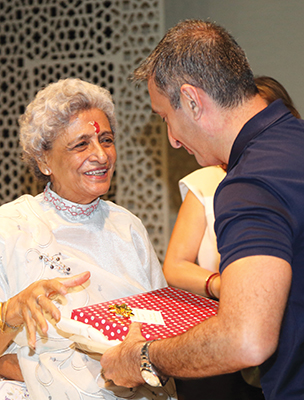
Dhun Bagli felicitating Adil Nargolwala
Dhun presented Adil with a momento. Thanking the DPA for honoring him, Adil whose late father Shiavax was a former president of the DPA, revealed how running has brought him lots of happiness. Running 4.30 hours in a marathon "gives me a lot of time to think, analyze different issues and find solutions. It is a form of meditation,” he said.
The evening concluded with Parsi bhonu served by Rustom’s restaurant.