The renovated Wadia Dar-e-Meher in Karachi opened its doors on Navroz
Parinaz Gandhi
A new look, stone facade with a colorful asho farohar greeted nearly 50 devotees who had come to herald Jamshedi Navroz with a jashan at the Seth Dossabhoy Merwanji Wadia Dar-e-Meher (Gari Khata Agiary) in Karachi on March 20, 2021. It was not only the four priests who had their faces covered with a padaan; the laity too had their masks on during the jashan performed by Ervads Burjise Bhada, Rustom Dastur, Mehernosh Bhadha and Ardavan Solan. Other community members were requested to pray from home at the same time as the jashan although they could not partake of the malido and ravo that was served to the gathering.
Due to Covid precautions, the infirm were dissuaded from attending the jashan but a thoughtfully provided ramp ensures that even those confined to a wheelchair may easily enter the sacred precincts in future.
The renovations and cleaning had been completed just a day earlier. The major structural walls had been reinforced with fresh plaster and imported porcelain tiles covered the floor and walls. One section with the original tiles was cleaned to retain the original ambience of the nearly 152-year-old Agiary. New electrical fittings and fixtures with wiring, cabling, light switches were installed. Most repair time though was spent on installing a new roof reinforced with steel. "Owing to heavy rains in August 2020, the old roof of the agiary had collapsed at most of the places and the atash dadgah was shifted to an adjacent building,” wrote Byram Avari, chairman of the Karachi Parsi Anjuman Trust Fund (KPATF), in response to queries from Parsiana.
"In order to reconstruct/renovate the agiary, leading Muslim structural engineers and architects were requested to design it. These consultants refused to take any remuneration as they felt that they would like to show their contribution to the Parsi community and that an agiary is like a mosque for which they would not have charged any consultancy fees,” stated Avari. The trustees of the Anjuman delegated the responsibility of coordinating and supervising the renovation work to Byram’s son Xerxes who is a director of Avari Hotels Limited. The time schedule estimated for the renovations got extended because of the intermittent lockdowns and Covid infecting some workers, requiring them to be quarantined.
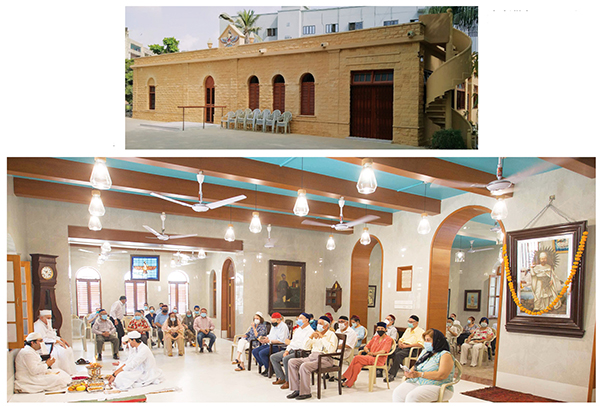
Top: Seth Dossabhoy Merwanji Wadia Dar-e-Meher in Karachi; above: jashan
Photo: Minocher Vakharia
Top: Renovated interiors of Wadia Dar-e-Meher; above: at the jashan
(front row from l) Khursheed Kotwal, Goshpi and Byram Avari, Soli Parakh and Homi Khambatta
The total cost of renovation was approximately Pak Rs 15 million (USD 96,117). While a large portion was borne by the Anjuman, the trustees appreciate that donations also came from the community and other Parsi trust funds in Pakistan, as also Parsis in the diaspora with a substantial contribution of USD 30,000 (Pak Rs 4,681,773) coming from the Zoroastrian Charity Funds of Hongkong, Canton and Macao.
Taking turns to tend the sacred dadgah fire at the Agiary are three mobeds. One of them from India was granted a 10-year visa to stay in Pakistan. His wedding to a girl from Karachi was arranged by one of the leading community members, reported Byram. There is another mobed from Quetta who, like the priest from Bombay, lives with his family in the community flats built around the agiary. Another young mobed who is yet a college student comes to assist the duo when required. A housing complex was developed in the Agiary compound in the 1950s with the construction of the Khajurina Building and the Kothari Building, both of which were handed over to the KPATF. The Anjuman Building came up later.
The Dar-e-Meher that comes under the management of the KPATF was consecrated on roj Adar, mah Adar, May 28, 1869. On the golden jubilee of the Wadia Dar-e-Meher in 1919, Jahangir Framroze Punthakey had compiled a history of this fire temple according to which Rs 15,720 were raised from Parsis in Karachi and Bombay when the shrine was built. The utensils and implements for the Dar-e-Meher were imported from China by Bejonji Khurshedji Golwala. Originally a dadgah was consecrated for the Dar-e-Meher which after 35 years was upgraded to an adarian with costs borne by Khan Bahadur Cowasjee Katrak. Three priests from Udvada were specially brought in to serve the sacred fire — Ervads Muncherji Gorana, Navroji Gorana and Bhicaji Sidhwa. Ervad Shapurji Katila assisted them while managing the kitchen. The longest serving priests at this Agiary were the Katila family who have been with the Karachi community for over 50 years.
Besides Avari the other Anjuman trustees are honorary secretary Homi Khambatta, honorary treasurer Pouruchisty Sidhwa, Soli Parakh, Khursheed Kotwal, Ardeshir Marker and Furengeez Tampal. Navjoted children, as long as any one parent is a Zoroastrian, have been permitted into this Agiary for nearly a decade (see "Equal rights for men and women,” Zoroastrians Abroad, Parsiana, July 7, 2011).