It was a cloudy morning on June 19, 2019 when the 30 newly installed solar panels atop the Ruttonbai R. D. Panday Girls’ High School were inaugurated. While Adwait Hebbar, head of Corporate Services and Corporate Social Responsibility (CSR) of IndusInd Bank which funded the project unveiled the plaque commemorating the event, the School’s teachers, trustees and house captains stood by in the compound between the old building that dates from 1898, and the new one built in 1966. The house flags the students carried added some color to an otherwise overcast day.
Under a project titled "Schools on Solar,” conceived and implemented by Dr Rashneh Pardiwala-founded Centre for Environmental Research and Education (CERE), the panels atop the 1966 building will generate approximately 13,000 kWh of solar electricity for the School, with a saving of Rs 89,000 per annum, the environmentalist noted. "This represents a reduction in carbon emission by 10.6 mt per annum,” she communicated later to Parsiana. Spreading awareness among students on the benefits of solar energy is part of the project. As CERE co-founder Kitayun Rustom exhorted the assembled students, "you are now ambassadors of solar energy.”
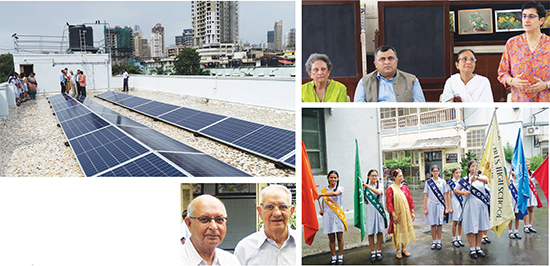
Clockwise from above: Solar panels atop Ruttonbai R. D. Panday Girls’ High School; Dr Nawaz Mody,
Adwait Hebbar, Kitayun Rustom, Dr Rashneh Pardiwala; School students with principal Hutoxi Mistry,
trustees Rohinton Padder, Kersi Treasurywala
Dr Nawaz Mody, chief executive officer of Garib Zarthoshtiona Rehthan Fund that runs and manages the School appreciated the potential savings, and the training to be imparted to the students on energy conservation, carbon emissions and reduction in pollution. "We will greatly benefit from the learning that the project will provide to the students, staff and teachers…We hope that the message of energy conservation will permeate the lives of all involved,” Mody communicated to Parsiana.
Besides Panday School, four other institutions, Sophia Polytechnic College, Sophia Bhabha Hall, Marwari Vidyalaya High School and Cathedral and John Connon School have benefitted from "Schools on Solar.” The estimated annual generation for the five institutions is 1,19,000 units of solar electricity with a combined annual saving of Rs 8,76,850, according to a write-up received from Pardiwala. "On average each school saves Rs 15,000 to 32,000 per month based on the size of the solar installation…. This also represents a combined carbon emission reduction of 97.58 mt annually,” she noted.
In addition to the IndusInd Bank, the project has also received support from private donors. "The schools were selected by CERE on basis of need, technical feasibility and cooperation from the managing body,” Pardiwala explained. For the current year, a "minimum of 10 low-income schools will be taken up for implementation of the project.” CSR funds have already been received for this, she noted.
The environmentalist explained that while the project is designed by CERE, it is managed jointly with the participating institutions. The Center "installs the best European solar panels with a 25-year warranty and minimal maintenance cost where panels have to be cleaned once a week,” noted Pardiwala. Installation services are provided by Burgis Bulsara’s company Avesta Solar. Schools that are short on financial resources are being supported by CSR funds of large companies while schools that can afford to invest in solar panels themselves can join the initiative for the educational component and larger learning experience. As per law, firms with a net worth of Rs 500 crore or more, or a turnover of Rs 1,000 or more, or a net profit of five crore rupees or more, have to spend two percent of their average three-year annual net profit on CSR activities in a financial year.
"India has a potential of generating 6,000 million giga watt hours (GWh) of energy per year,” given the 250-300 days of solar radiation annually, noted Pardiwala. "The payback period on real-time solar energy projects is usually 3.5 to four years,” she stated. Future plans of CERE include the development of a web-based portal which will steer the environmental campaigns of the schools. "It will be a platform for participating schools to share and exchange ideas,” stated Pardiwala. Educational material for schools to decide how to prepare for an energy audit, for example, will be made available on the portal, she added.
"CERE is keen to help more schools adopt solar energy and help India become energy sufficient,” noted Pardiwala.