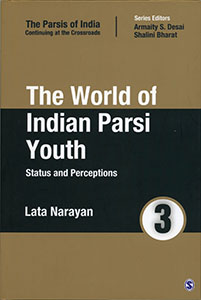
The World of Indian Parsi Youth: Status and Perceptions by Lata Narayan. Volume 3 of the series The Parsis of India: Continuing at the Crossroads by Armaity Desai and Shalini Bharat. Published in 2017 by SAGE Publications India Private Limited, B1/I-1 Mohan Cooperative Industrial Area, Mathura Road, New Delhi 110044; website: www.sagepub.in. Pp: xlvi + 263. Price: Rs 9,900 (for the four-volume set).
"Are you aware of the history of your community and its inception in India?” I recall asking a young participant while collecting data for this study on Indian Parsi youth in 2009. "Of course!” he replied. "Our ancestors were on their way to Singapore. They lost their way and landed in India! Here I am, answering this questionnaire, which will solve none of our problems,” he responded, tongue in cheek. I assured him that research has potential and holds promise of evidence-based change. He disagreed but answered the questions. There is always banter, a good laugh, hospitality, thoughtful questions and remarks when in conversation with Parsis. The book captures it all.
 The declining population of Parsis underlies the larger objective of this series which is expected to foster debates and community decisions and inform each Parsi to take responsibility for the survival of their religion and culture. The goal of this book is to understand youth perspectives and attitudes as presumably youth will play a key role in reversing the decline in the population.
Youth are central in chapters focused on identity, education, occupation, family, culture and lifestyle. There are 10 chapters, though the chapter "The Parsis: From Persia to India,” seems redundant as Volume I has provided a well-researched history of the Parsis.
The book is a mine of information. It chronicles information garnered from 761 Parsi youth in four locations in India. There is, however, a time lag between the collection of the data and its publication. The Indian subcontinent is changing rapidly. For example, the outreach of internet relevant to culture, lifestyle and entrepreneurial opportunity for youth has changed staggeringly since 2007. The children of that time are now youth and some have progressed to a different age group. Forty percent of the respondents of the study would not qualify as youth today.
The casual assumption of a "unique genetic pool” has missed the attention of reviewers. One writer has implied that the Parsis must form a unique gene pool because many Parsis have been socially and professionally successful. This has loaded implications: that Parsis are disproportionately successful and that social and professional success has a genetic link. Research does not allow for this and is primarily undertaken to verify such assumptions. A gene pool is a complicated topic and has not been dealt with in this research.
The definition of youth in a community with a high life expectancy is well debated. Adults over 30 years are included, while those over 18 but less than 20 years are not. In current times, those over 18 would argue that if they have the right to vote, they should be included in research which will affect their and their community’s future.
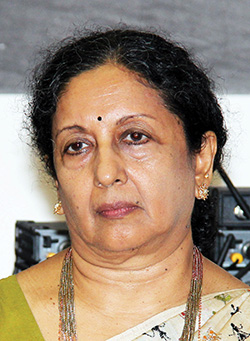
The book is written from the point of view of expectations from the youth. The author Lata Narayan (pictured) holds five ideas all along. A glorious past and accomplishments of Parsis during the pre- and post-independence era, the expectations from and the onus on youth, a dwindling population, gender equity and the ethno religious identity of Parsi Zoroastrians.
Narayan elaborates on a known comparison of current youth to the pioneers of the past. As opportunities available in the past were different from those of today, the comparison may be unfair. This debate, which should be based on data, is only fleetingly referred to. If the youth are expected to follow in the steps of the pioneers, at least a fair comparison should be made.
 The data on identity is almost labyrinthine and has been presented carefully in categories of nationality, geography, religion and ethnicity. That Parsis are a minority in numbers, though official minority status for the community has been challenged, is discussed in the book. The fact that they have been compared to Hindus, minority communities in India as well as endogamous dwindling populations in the world is proof of the complexity of their identity. The data provides a new perspective on minority communities and is thus informative.
The author concludes that Parsi women are better empowered, and this is supported by data especially in the context of education and occupation. A gender bias is seen in leisure activities, choice of profession, ownership of large businesses and in the exclusion of "homemaking” as a full-time occupation. Contemporary gender debates across the globe seek equal opportunity in every sphere and Parsi women should be no exception.
The numbers and concerns of the dwindling population are extensively presented, though discussions on the concerns remain on the fringes. The research should clearly reference the reasons for decline in population and the potential role of the youth should be derived and unambiguously stated. This clarity is lacking in the book. As stated in the final conclusion, the youth seek consensus on religious notions as these would affect their decisions and life. Family, marriage and religion are central to discussions, but data relating to beliefs of purity are noticeably missing. There is a reference to two DNA studies and many legal as well as social writings but scientific data on Parsi lineage and genetics is absent. These would be relevant for both the youth and leaders of the community to make the "informed” decisions the author refers to in the concluding paragraph of the book. Genetics and epigenetics, the two disciplines of heredity and inheritance, have much evidence to offer but this has not been tapped in this research.
The discussion of data turning into a narrative in certain parts of the book makes it difficult to follow and decipher. Long sentences and misplaced fleeting thoughts are also distracting.
A vital factor for youth is their health. In India the youth face multiple health challenges including substance abuse, road traffic injuries, diabetes, heart disease, high blood pressure, obesity and mental health issues. This research makes a fleeting reference to addictive substances and their implications to health.
The final two chapters present essential gleanings from the previous chapters and raise some important questions that the community must address. The book is for the leaders of the community, researchers as well as all lay Parsis. Religion plays a pivotal role and has potential in society beyond the current political environment. Zoroastrianism is one of the earliest, if not the first monotheistic religion. The Parsis have preserved the religion which has evolved in a unique manner since it was first practiced. To remain oblivious to a future where there will be fewer descendants, and therefore fewer followers, is unfair for those Zoroastrians who will be alive in the decades to come. It will also be a loss to the religious and cultural diversity of India. Research, including this book, is empowering and provides evidence for decision-making.
HITAKSHI SEHGAL
Sehgal has a PhD in environmental health and is a practising homeopath at Masina Hospital.