Soli Sorabjee’s legal prowess and
photographic memory were incomparable
Zia Mody
Edited extract from Down Memory Lane: A festschrift in honour of Soli J. Sorabjee published by All India Reporter Pvt Ltd, 2020. Reprinted with permission from the publishers.
As a child, I used to watch my father in wonderment at the dinner table talking about the preparation of his matters for the next day, busy conversations, law coming out of his mouth so easily, citations of judgments he wanted ready the following day. I simply marveled and wanted to be right there. Forty years later, I have ruefully but happily realized I could never be right there. I can never surpass my father. After Daddy went to Delhi and we didn’t see much of him, I went off to study and he would stay in touch often through my mother. I will never forget when he wrote a birthday letter to me in his very scrawly handwriting which said "Happy Birthday Dearest Ziyu. You are __ years old today” and I saw my mother’s handwriting dutifully fill in my age. I guess age was trivia and what was more important is that I was, and remain, what my father continues to pull my hair and call me, his "Monkey Bilari (cat).”
My father and Justice Tulzapurkar shared the same birthday, March 9. And I believe it was always a race as to who would call and wish the other one first. My father thought that Justice Tulzapurkar would love to hear him speak in Marathi, not realizing that the poor man must have been cracking up at the other end of the line at Daddy’s version of Parsi Marathi.
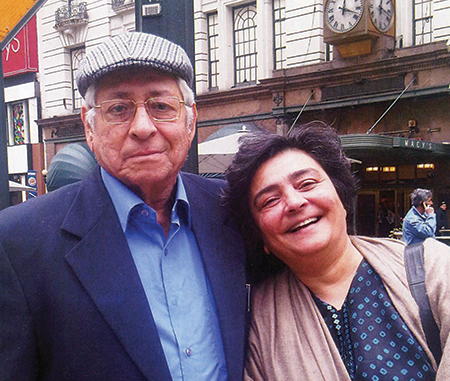
Soli Sorabjee with daughter Zia Mody
Soli and wife Zena holding baby Zia
My father has many quirks, some of them in fact quite hilarious. I remember an incident where a client was desperate for him to come to the Central Excise Tribunal to argue a matter. He asked me to tell my father that they would pay double his fees. I dutifully relayed this to Daddy who promptly replied: "Tell him I will not come only because he thought that I could be bought for money.” When I informed the client that his sin was wanting to pay more, he, a good Gujarati businessman, hung up very confused.
I still remember an incident when I was rushing to the Bombay High Court to argue a matter before the division bench and knew there was the judgment that would clinch my case. I knew the name, but I couldn’t, for the life of me, recall the citation. This was in the mid ’80s. I phoned my father and I said, "I really need this citation, please help!” He first laughed and said, "What has it come to that I am now my daughter’s legal assistant?” He then went on to give me the citation. He told me to take out the relevant Supreme Court judgment from the library in his High Court chamber, where I sat. He mentioned the relevant paragraph number and said that there would be a small dot made by him in pencil which was the fourth line from the top. I giggled and walked into the chamber and turned to the page, and guess what, it was the paragraph I was looking for and the pencil dot was right there! Then and there I lost my competitive illusions and recognized that I should only be proud and bask in the glory and the grandeur of a man with such prowess and a memory that defied imagination.
We were often told that as a child, and being an only child, my father tried to memorize everything that came his way. He was his grandmother’s delight since he knew all the Zoroastrian prayers backwards. His father was a steward at the Race Course and my father knew the handicaps of all the horses for the daily run. This also he memorized. So memorizing judgments, citations, paragraphs came easily to him whilst we sat enviously, struggling to get our memory cells to catch up.
We often went for holidays to Mahabaleshwar where my father recouped his energy. He used to go for long walks, spend hours in the forest taking along with him books of poems and, of course, Shakespeare. He made us memorize parts of Hamlet and delighted in making us recite couplets that would please him immensely. As we grew older, we didn’t want to go to Mahabaleshwar as we wanted to party in Bombay, and after he moved to Delhi he didn’t really come back there too often. Those memories remain where we met his friends, especially (lawyers) Nani Palkhivala who came along sometimes and Jangoo Gagrat.
I remember my father was very proud when I got a job with Baker & McKenzie in New York and came to see me there. He saw that I had a cabin and a secretary and told me: "If you ever think of coming back, you must know this will not be available to you and you will be starting from the very bottom.” I didn’t really believe him. I came back to marry my husband Jaydev (Mody) and started off as a raw junior counsel. I sat in Daddy’s chambers. His junior, Obed Chinoy, then became my senior. I actually shared a four-foot desk with poor, generous Obed for years and years with his briefs piled on one side, one after the other. My father’s worry about the shock of this new environment came true. But given that I had no choice, I plodded on.
My father gave me some nuggets of advice which stood me in good stead as a junior counsel. He told me that what you need to do is to be heard. There is nothing more important than to argue in person. And so his advice was: undercharge drastically compared to your peers, so that you get the briefs and you get the opportunity. And if you have a daily prayer, it should be that your senior should fall sick. He also told me how important it was that one’s reputation as a counsel should never be tarnished and one could lose it only once. Forever. He said that every judge forms an impression of a junior lawyer which then stays with him. He also told me that if you have upset one judge, don’t forget he will tell all the other judges at the lunch table.
When I didn’t have much work in the beginning and used to complain and wonder if I would ever be successful, he would tell me, "When you have time, the most important thing is to get to know your judge. Go to the courts, sit and listen, understand his preferences, see what he likes, what he doesn’t like and learn to make sure that your arguments keep that in mind. Judges are human and they will listen and have a predisposition to what they are predisposed about.”
I have hardly argued or worked on any notable cases with my father. There were a few for which I would travel to Delhi but those were finished very quickly. My one regret is that we never really got into many long meaty final hearings together. But as my father travelled through his journey and became attorney general, his prominence, his gravamen and his unquestioned integrity were soon even more amply displayed.
Today, at 90, my father may not be dashing around the Supreme Court, but he has a permanent place in the hearts of most of his judges, his juniors and the bar at large. In our long journey, what is important is how we are treasured by those whose lives we have touched.
As for me, my dearest Daddy, I will always be,
Your Monkey Bilari!
Sorabjee passed away on April 30, 2021, a year after the festschrift was published on the occasion of his 90th birthday.