Six weeks after its release in India Homi Adajania’s maiden film Being Cyrus continues to excite audiences
Parinaz M. Gandhi
Cyrus beckoned. And the English speaking adult audiences obliged. Some went eagerly, and some reluctantly to the screenings of Being Cyrus. The compulsion to see this movie was overwhelming though the reasons were varied: Saif Ali Khan’s fans were keen to see how he came across in his first English film; critics wanted to assess debutant director Homi Adajania’s potentials; the general public was intrigued by this black comedy; Parsis of course were interested in determining how the community has been portrayed…
Released with an unprecedented 88 prints nationally, in the first three days itself the collection was two crore rupees with over two lakh people having seen the film, reportedly the highest ever opening for an English language multiplex movie from India, as noted the Sunday Times of India of April 2, 2006. For the producers Miracle Cinefilms and Serendipity Films and the presenters Times Infotainment Media Limited their investment was justified for the film was shot with a modest budget of Rs 3.5 crores in just 32 days.
"I definitely attribute the opening weekend collections to the curiosity with the cast. But curiosity can only last the weekend after which the film has to walk on its own two feet,” Adajania responded to our Parsiana questionnaire by e-mail. The story is narrated by the protagonist Cyrus Mistry played by Saif as he observes the Panchgani based retired sculptor Dinshaw Sethna (Naseeruddin Shah), his frustrated wife Katy (Dimple Kapadia) who is seeking an escape through a dalliance with Dinshaw’s estranged brother Farokh (Boman Irani). His scheming wife Tina (Simone Singh) plays the master stroke and exposes the skeletons while father Fardoonjee’s (Honey Chhaya) life borders on despair. "It’s good to see Being Cyrus striding through its five weeks (after its launch in India on March 24, 2006)! Today our audiences are very discerning and will not accept just about anything that comes their way,” observes the 34-year-old director.
Before it was released in India, the 87-minute film had been screened at international film festivals where it won rave reviews, as reported in the Afternoon Despatch and Courier of March 2: The Asian Film Festival at Lyon felt it was "a film so quirky and intriguing, worthy of the great Hitchcock.” The South Asian Film Festival at New York acclaimed it as "incredible and refreshing to see such unique cinema coming out of India.” At the Indian Film Festival in Israel Being Cyrus "captivated the audience…with such impressive simplicity presenting such a complex theme…”
The camera rolls
"The film was a labor of love. And not just for me, but the cast and crew were really backing each other up on this project. Everything was so meticulously preplanned that when we got on the floor to shoot it all slotted into place more or less easily…The most rewarding experience for any filmmaker is when the camera rolls and an actor brings that extra magic to the performance,” acknowledged Adajania.
Planned according to the American format of scheduling, "it followed a systematic story-board, inputs were woven into the script by actors when they attended pre-filming workshops and each one of the crew and cast knew what had been scheduled when, resulting in a meticulously followed plan,” reported The Week, March 19, 2006, quoting the director as saying, "We used sync-sound to create a feel of the moment and have not dubbed a single shot.” All the actors were fluent in English and essaying the characters was a challenge as they told The Week: Saif mentioned, "Actually I think the first reason why I was involved was because I always wanted to do something in English. Something slightly alternate to the kind of commercial cinema I used to do.” For Dimple, "This role marks a complete departure from anything I have done before. There was very little that we as actors had to do. Homi had done the study, he had etched out our characters well.” Conveyed Boman, the only Parsi in the lead star cast, "I knew that Farokh Sethna was not me but it was a challenge to get into the role of this seemingly crude, mean and obnoxious character who is also vulnerable at a certain level.”
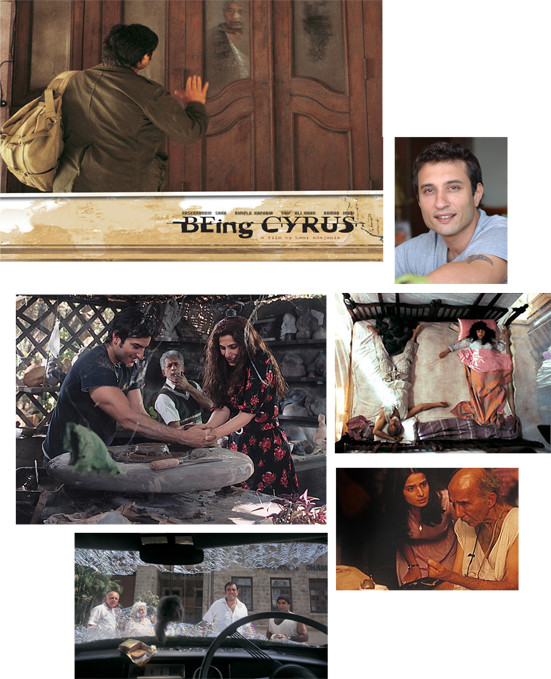
First row: Saif Ali Khan (left) and Homi Adajania Second row: Saif, Naseeruddin Shah and Dimple Kapadia at their Panchgani home; Crestfallen Boman Irani sees his car windscreen shattered (Far right): Simone Singh and Honey Chhaya
The scene where Farokh gets into a slanging match with his neighbor after her dog bites him is one of Adajania’s favorite. As he recalled in the Mid Day of April 2, "I had briefed Bom on how I wanted the scene played out. I told him to run with it till I called ‘cut’. The madness and energy he brought was unbelievable.” Around the same time when he was supposed to shoo away the dog that tries to bite him, Boman’s kick in the air made him lose his balance and land on his backside, injuring his tailbone. Despite the agony he smiled through to release the tension on the sets.
Yet another harrowing moment for Adajania was on the first day of the shoot when during the interrogation sequence the bulb blew up in Dimple’s face. Considering that Dimple was the only one from the star cast who had to be persuaded to accept the role in the first place, Adajania was dumbfounded but luckily for him she "smiled, retained her composure and politely asked for the shot to be taken again.”
The director’s favorite character in the film though is "the old man. He’s vulnerable, he’s flawed but you still love him.” Mistaken by a real-life Parsi by many, Honey as Fardoonjee found an admirer in Parsiana too. He was the only one from the star cast who returned our call when we tried to reach them for their personal inputs (never mind that he gave us a buzz at 0.30 hours in the morning!) With his years of experience in Gujarati films and theater, Honey thought the film was "perfectly planned. Homi is too good – very clear in his concept and mind. The workshops that he conducted for script reading helped us to get into the character.” Of course, having worked with Adi Marzban for some years and known a lot of Parsi friends, "it was possible for me to improvise a lot,” added Honey.
From short story to script
The film is based on a short story written by Kersi Khambatta. "It is a completely fictional piece woven out of the madness of his imagination,” Adajania told us, adding, "When I read the story I immediately decided to make it into a film. We wrote the screenplay together and added more scenes and characters to the original story.” Although he knew in his mind what each scene was going to look like the title for the film kept eluding him. The first title was Maasko (keep it under wraps), then Akoori (scrambled eggs), later A Stranger Within, then My Side of Their Story (a line from Saif’s voiceover) until the producers finally settled on Being Cyrus (considering Cyrus is originally Xerxes).
"It was Homi’s conviction in the story that got us going. We are extremely happy and proud to have presented Being Cyrus as our first film,” acknowledged Munish Purii, chief operating officer of Times Infotainment Media Limited. "We wanted to test waters in this business before taking big steps.” Around the same time, Miracle Cinefilms and Serendipity Films were looking for a presenter. "We found the script very interesting…Before we knew, we were making Akoori, the Times Infotainment platform adding a few flavors including introduction of a world renowned editor Jon Harris who flew down to Bombay and re-cut the film from scratch…We also developed a very focused marketing plan and went after the right audiences…Apart from the marketing wherewithal we had the ability to hold on to the film and wait for the right time to release it,” Purii reveals how they contributed to the success of Being Cyrus, the "largest Indian English film in less than four weeks in terms of domestic box office collections.”
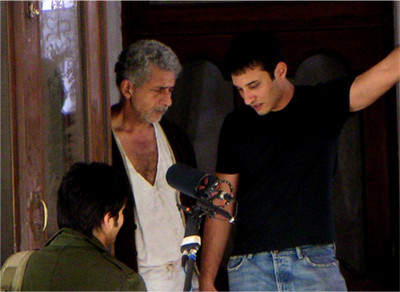
Adajania (right) directing Saif and Naseeruddin
Parsis peeved
Many Parsis left the cinema halls feeling betrayed by the director. They were hoping to see captured on celluloid all the pluspoints of the community and were quite disillusioned with the turn of events. As expressed Aban Bana in her open letter to Adajania circulated on the internet: "The film only succeeds in giving a very one-sided and, in my opinion, an entirely wrong impression of the Parsi community which is extremely civilized, highly educated, cultured and sophisticated…Artistically the film was very good, even the acting of the stars was commendable…But the subject was most inappropriate and handled badly. Of course, people will like it. Non-Parsis will most certainly have something to laugh about. It will reconfirm their view of the Oddball Parsi which has been cultivated by earlier Bollywood films… The only thing that’s left to redeem the situation is to make another film about Parsis in which they are shown as they really are: decent and honest and very, very clean…”
"It’s quite sad but certain Parsis seem to have missed the point completely. I guess there are some people in the world who suffer from some irrational persecution complex and sometimes one really feels like shaking them and saying, ‘I hate to burst your bubble buddy, but it’s really not about you!’” Adajania responded to our query adding with exasperation, "From day one I have been screaming myself hoarse that Being Cyrus is not about the Parsi community. It is a fictional tale about a specific dysfunctional family that could be any family in the world…It only needs a little intelligence to realize that the Parsi backdrop in Being Cyrus has been used to communicate a palette for production design, costume design and character nuances while telling a universal and fictional story. If I wanted to make a film on the community, I would have made a documentary. Why on earth would I intentionally make a film to upset my own community? Somehow I felt we would have a more evolved outlook. I think maybe it springs from the fact that there are such few films with Parsi backdrops that these people think it’s about them!”
Adajania’s wife Anaita (she was the stylist for the Bollywood blockbuster Dhoom) conceptualized the look of the Parsi characters. Adajania’s own home in Panchgani with its huge rooms and antique furniture was chosen as the residence for Dinshaw and Katy Sethna to give it a Parsi ambience. "The nuances and production design may be realistic to an extent. But even the way my characters dress and behave are keeping in context to these extreme human beings whom we created and I think that’s pretty obvious,” maintains Adajania.
Expanding canvas
"It’s with pride that I say I am a Parsi. And I am happy to support any movement that aims to allow the community to progress and flourish the way it once did…As for the religion, I think it’s a fantastic philosophy. What more does one need in life other than good thoughts, good words and good deeds?” His philosophy in life surfaces most unexpectedly at different times in the course of the film. In the words of his Cyrus who ultimately realizes the futility of worldly pursuits: "the more we grabbed the more we’d lose a few parts of ourselves” and then again "once the game is over, the king and pawn go back in the same box” or the dope smoking Dinshaw mouthing profundities like "God is in the small details.”
"The best part about Homi is that he was always very clear in his head about what he wanted and would not settle for anything else. He also had the advantage of being exposed to various other avenues in life and had never really ‘struggled’ to make it big in films. There was therefore that much less pressure on him…” remarked Purii.
Having studied at Bombay’s Cathedral and John Connon School and graduated from St Xavier’s College, filmmaker Adajania’s versatility is evident in his career graph: a freelance writer, a scuba diving instructor in Lakshadweep, an adventure travel director, ran a gas station, worked on some bizarre jobs like taking a fakir to Venice for one of the world’s largest international art festivals and scouting cripples and mutants for a controversial Italian project.
Adajania’s canvas of life keeps expanding: "I have received quite a few interesting scripts lately and am working on another one myself. At some point I will make some hard-hitting documentaries. There’s a truth one can express through the art of documentary filmmaking that cannot be censored. I want to find that…Life is too short to be stuck behind some desk dreaming…”