A Parsi was one of the champions of Thailand’s film industry
Farrokh Jijina
While people in India talk reverentially about the Parsi contribution to the early years of the country’s cinema [thespian and director Sohrab Modi, maker of the country’s first talkie film Ardeshir Irani, music composer Khorshed Minocher-Homji (Saraswati Devi) et al], not many may know that a Parsi name pops up as a forerunner in the nascent Thai film industry. Film buff D. J. Murthy drew Parsiana’s attention to the Bangkok-born director, producer, cinematographer and screenwriter Rattana Pestonji (1908-1970), who is generally known as the father of contemporary films in Thailand. The Bangkok Asean Film Festival held in July this year to mark the 51st anniversary of the founding of the Association of Southeast Asian Nations screened Pestonji’s 1958 movie Sawan Mued (Dark Heaven) while showcasing "classic” cinema of the region, Thai news portal The Nation noted on July 3, 2018.
Born to parents who migrated to Thailand from Lahore, the pioneer is said to have shown an avid interest in photography from an early age. Pestonji’s daughter, Phannee Trangkhasombat, recalled in an interview published on the website thaicinema.org that "I was told he used to dismantle and reassemble his camera so often that grandfather decided to send him to London University to do engineering.”
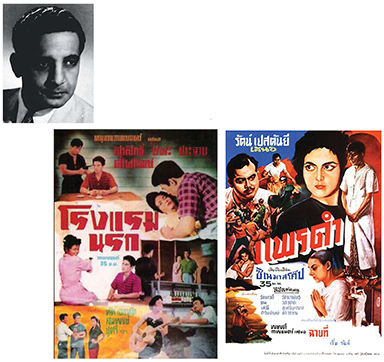
Rattana Pestonji (above, Photo: Wikipedia); maker of pioneering
Thai movies, Rongraem Narok (l) and Prae Dum (Photos: IMDb)
A wax figure of Pestonji at the National Film Archive of ThailandPhoto: commons.wikimedia.org
Pestonji came into the limelight with an award for his short film Tang at an amateur cine competition in Glasgow, and a screening of another short film White Boat in New York, both in the late 1930s. "In 1949 he was asked by Maj Gen Prince Bhanu Yugala (a grandson of the country’s King Chulalongkorn) to act as a cameraman on the film Phanthaay Norasingh (Oarsman Norasingh),” noted a 1995 article titled "The prince of celluloid” in The Nation. Around this time, Pestonji formed his own studio, Hanuman Films Company and directed his first feature film, Tukkata Jaa (Dear Dolly) in 1951.
The prints of the 1954-made Santi-Vina, cinematographed by Pestonji were considered lost until discovered in 2015. The movie was screened in the classic section of the 69th Cannes Film Festival (May 2016), the first time ever for a Thai film, noted the Bangkok Post of April 21. An innovator, Pestonji used only one camera while shooting Rongraem Narok (Country Hotel), similar to the technique used by Hollywood director Alfred Hitchcock in his 1948 movie Rope, according to Wikipedia. His first color film in 1958, Sawan Mued featured songs and dramatic battlefield scenes, while 1961’s Prae Dum (Black Silk) is believed to be the country’s first film noir, a genre marked by a mood of pessimism and fatalism.
The Internet Movie Database (IMDb), the global repository of cinematic information, notes Prae Dum was co-directed with his daughter Ratanavadi Ratanabhand (screen name of Trangkhasombat) who also starred in it. Nahmtaan Mai Waan (Sugar Is Not Sweet) released in 1965 was his final film, notes Wikipedia. A romantic farce, it was made in the pop-art style of Western films of the time.
thaicinema.org summed up Pestonji’s movies: "His films often went against the public grain by daring to have unhappy endings — which usually spell death at the box-office. This is probably why his movies were respected more than they were actually watched.”
The website also records the events of the last day of the filmmaker’s life: "Pestonji was feeling very optimistic as he walked into the Montien Hotel that humid evening in August, 1970. After years of frustration, he was finally nearing his goal (of getting support for the domestic film industry, although he had retired from directing movies six years earlier)... Economics Minister Bunchana Atthakorn had agreed to meet Thai filmmakers… all those who had crowded into the Hotel’s Methee Room that evening were eagerly waiting to hear what Pestonji had to say.
"‘I’ve spent every baht I ever earned on my productions and now I have to make advertisements (movies) just to survive…The foreign film distributors have been preying on Thai cinema,’ he said.” With this, the filmmaker is said to have faltered and crumpled to the floor. Death came three hours later, of a massive coronary attack. "Stress and anger were the main causes of my father’s death,” insisted Trangkhasombat, according to the website. "If Dad didn’t give that speech, firing his passion, I don’t think he would have died so soon.”
A few days after that fateful meeting, the government decided to set up the Thai Film Promotion Board. The new organization would be responsible for promoting and encouraging investment in home-grown movies, noted the website.
Hanuman Films Company, now called Santa International Film Productions, is operated by Pestonji’s sons Edal and Santa and provides technical support and equipment to foreign film productions. In 1976, Santa directed a remake of Santi-Vina, Rattana’s first film as cinematographer. Parsiana’s email to the company to get more information about the life and times of Rattana from his descendents did not receive a response. Parsiana’s inquiries with longtime residents of Lahore about Rattana’s family drew a blank too.
Posthumously awarded the Lifetime Achievement Award at the 2004 Bangkok International Film Festival, Wikipedia notes that The R. D. Pestonji Award, the top prize of the Thai Short Film and Video Festival, is named in his honor.