The Bai Jerbai Wadia Hospital witnessed the birth of both pediatrics and pediatric surgery in India
Dr Hirji S. Adenwalla
I was both thrilled and intrigued to read "Child care center” (Events and Personalities, Parsiana, August 7, 2016), about the newly renovated Bai Jerbai Wadia Hospital, India’s first one meant entirely for children. It was planned on the lines of the Great Ormond Street Hospital in London by Sir Ness and Sir Cusrow Wadia in memory of their mother Bai Jerbai, whom they revered and idolized. The piece evoked nostalgic memories of the most important period of my formative years.
My association with the Hospital dates from childhood, since I was eight years old. My father Dr Sorab Adenwalla gave up a successful general practice in Ahmednagar to become assistant to the principal medical officer (dean) of the Bai Jerbai Wadia Hospital, the doyen among surgeons, Dr Rustomji Cooper. After I qualified in medicine, I worked at the Hospital as house surgeon for one year, resident anesthetist and radiologist for eight months and registrar in surgery for three years. The Hospital then had 150 beds equally divided between medicine and surgery. There were no pediatricians or pediatric surgeons in those days.
Wards I, II and III were allocated for medical cases. Ward IV was for dermatology. Ward V with 30 beds was devoted to congenital and acquired orthopedic deformities under Dr Rustom Katrak, one of the two pioneers in orthopedic surgery in this country. Ward VI was meant entirely for tuberculosis of the spine, again under Katrak who was one of the first to decompress these paraplegic patients’ spines to relieve their paralytic condition so that they could walk again. Ward VII was reserved for pediatric surgery under Drs Arthur de Sa, Rustom Irani and Charles Pinto. These three were the first pediatric surgeons in the city of Bombay. Pinto branched out into plastic surgery. The Jerbai Wadia Hospital then became the Mecca for cleft lip and palate reconstruction. The four years that I worked there were perhaps the happiest period of my professional life.
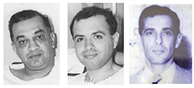
(L to R) Drs Charles Pinto, Hirji Adenwalla and Rustom Iran
(Top) busts of Bai Jerbai and Nowrosjee Wadia with Bai Jerbai Wadia Hospital
(Photos: Jasmine D. Driver)
Drs Rustom Katrak (left) and Rustomji Cooper: pioneer surgeons.
Ext (r) Dr Sorab Adenwalla
This Hospital saw the birth of both pediatrics and pediatric surgery in India, a development that went virtually hand-in-hand with the advent of orthopedic surgery. During World War II, an ammunition ship on its way to Burma blew up in the Bombay docks, damaging the area and injuring hundreds of people, many of whom required amputations. These amputations were reportedly badly performed so that false limbs could not be fitted on them later. The government of the day called for an inquiry and a team of orthopedic surgeons arrived from England to head the court of enquiry. Their findings were that the amputations had been performed by general surgeons because there were no trained orthopedic surgeons in the country.
Two men were selected for training in the discipline — Katrak from Bombay and Dr M. G. Kini from Madras — and sent to the Liverpool centre in England, resulting in their becoming the first two orthopedic surgeons in India. Katrak set up a unit at the King Edward Memorial (KEM) Hospital and another at the Bai Jerbai Wadia Hospital for children.
I recall the Bai Jerbai Wadia Hospital as an immaculately clean public hospital, professionally administered, where exemplary patient care was given to the poor, completely free of charge. It was one of the first to have a physiotherapy department devoted to rehabilitation of children with congenital orthopedic deformities. It was a pioneer in running a school in the wards for children who had congenital deformities and tuberculosis of the spine and had to remain in the Hospital for prolonged periods of time. It was also one of the first institutions with a social service department and an orthopedic appliance factory where calipers were made for children suffering from poliomyelitis (infantile paralysis) and other conditions. Of the many firsts, it was perhaps the first hospital in the pre-ventilator days to have an iron lung to keep bulbar (involving the medulla oblongata) polio patients alive.
There was an unbelievable spirit of cooperation and camaraderie in the Hospital at that time. There was never any nepotism when I was registrar in surgery. I vividly remember an incident when a child was admitted with an intussusception (the slipping of a length of intestine into an adajacent portion causing obstruction) of the gut, a condition that requires immediate abdominal surgery. It was customary to inform the honorary surgeon on duty. Dr Irani asked me to carry on with the operation. As I was scrubbing up the theater, a sister informed me that Dina Neville Wadia (née Jinnah) was sitting on the stairs outside. I went out at once and spoke to her about the child’s condition. I asked her whether she would like Dr Irani to operate as the patient was her driver’s child. "Dr Adenwalla,” she said, "under normal circumstances who would operate?” "The registrar, madam,” I replied. Without the slightest hesitation she said, "Then please go ahead, doctor.”
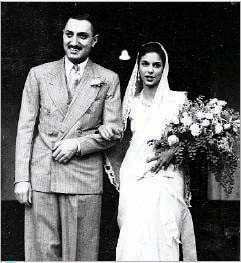
Dina and Neville Wadia on their wedding
After the operation was over, I came out to find her still seated on the stairs. I explained that all was well with the child. She thanked me profusely. She came every day to visit the child until the patient was discharged. The last time I saw her she again expressed her gratitude. She left behind memories of a charming and gracious lady who never threw her weight around, who was polite and courteous, who obviously thought that her driver’s child was as important as her own. She always came during visiting hours, though she could have walked in at any time and demanded special attention, as she was the wife of the owner of the Hospital and Muhammad Ali Jinnah’s daughter.
Dr Hirji Adenwalla is head of the department of Plastic Surgery, Burns and the Charles Pinto Centre for Cleft Lip, Palate and Cranio Facial Anomalies at the Jubilee Mission Medical College in Trichur, Kerala.